

Most plumbing businesses leave thousands on the table every month because they treat maintenance plans like an afterthought. A tech mentions it if they remember. The office sends a renewal notice when someone thinks about it. Meanwhile, your competition runs maintenance plans that generate $35k-75k in monthly recurring revenue with minimal overhead.
The difference isn't luck or market conditions. It's having an actual system versus hoping your team remembers to mention the program.
Why Maintenance Plans Fail Before They Start
Every plumbing owner knows maintenance plans make sense on paper. Predictable revenue, higher customer lifetime value, easier scheduling during slow periods. Yet most shops either never launch them properly or watch them slowly die after the initial push.
The breakdown happens in three places. First, pricing gets set arbitrarily—usually whatever number sounds good in a meeting. Nobody calculates actual service costs, margin requirements, or competitive positioning. Second, the sales process relies entirely on individual tech initiative. Some techs push plans hard, others never mention them, and there's no consistency in how they're presented.
Third, the renewal process becomes a manual nightmare that gets ignored when things get busy.
What starts as "we should offer maintenance plans" becomes a half-implemented program that generates maybe $1,800 monthly instead of $40k+. The owner assumes maintenance plans don't work for their market. In reality, the system never had a chance.
The Three-Tier Pricing Structure That Actually Converts
Forget about copying competitor prices or picking round numbers that feel right. Maintenance plan pricing needs to account for actual service delivery costs, desired margins, and psychological purchasing patterns.
Stop missing service calls and double bookings.
Plummerly helps you schedule, assign, and manage every plumbing job efficiently.
- Centralized job scheduling
- Technician dispatch & tracking
- Customer notifications
No credit card required
Start with your base service costs. A typical maintenance visit runs $80-115 in fully-loaded tech cost including drive time, vehicle expense, and basic materials. That's your floor. Now add desired margin—usually 45-55% for maintenance work since it's scheduled, predictable labor.
-
Basic Tier ($19-29/month) - Annual inspection - Priority scheduling - 10% service discount - No overtime charges
-
Standard Tier ($39-49/month) - Everything in Basic - Semi-annual inspections - 15% service discount - Water heater flush - Emergency priority
-
Premium Tier ($69-89/month) - Everything in Standard - Quarterly inspections - 20% service discount - All drain cleaning included - Parts warranty extension
Include drain cleaning in the premium tier since it often pays for itself by preventing repeat callouts.
The key isn't the exact numbers—adjust for your market. It's having clear value jumps between tiers. Basic customers want peace of mind. Standard customers want prevention. Premium customers want to never think about plumbing problems.
Notice how the premium tier includes drain cleaning. That single inclusion often pays for itself while giving customers a tangible benefit they use. One customer getting their kitchen drain cleared twice yearly at $189 per service already justifies the premium price point.
Tech Sales Scripts That Don't Sound Like Sales Pitches
Your techs hate selling because most sales training teaches them to act like someone they're not. The aggressive closer personality doesn't fit the trusted advisor role customers expect from their plumber.
Instead of teaching "sales," teach conversation patterns that naturally lead to maintenance plan discussions:
During Diagnosis "Mrs. Johnson, before we talk about fixing this water heater, I noticed it's about 8 years old. These typically last 10-12 years with regular maintenance, maybe 8-10 without it. Have you been having it flushed annually?" Customer says no. "That's pretty normal—most people don't until something breaks. We actually have a program where we handle all that maintenance automatically. Would it be helpful if I explained how that works while I'm writing up the repair quote?"
After Repair Completion "Alright Mr. Chen, your disposal is working perfectly now. Just so you know, this happened because of normal grease buildup—totally expected after a few years. We include drain cleaning in our premium maintenance program specifically to prevent this. The program actually costs less than calling us out twice a year for clogs."
For New Construction/Remodel "Since everything here is brand new, you've got manufacturer warranties covering defects. What they don't cover is maintenance-related failures—that's actually most of what goes wrong. Our maintenance program extends those warranties and keeps everything running like new. Most people in new homes sign up for at least the first few years."
The pattern stays consistent: identify a maintenance-related issue, explain why it matters, then position the program as the solution. No pressure, no false urgency, just logical problem-solving.
CSR Phone Scripts for Different Scenarios
Your CSRs handle maintenance plan conversations differently than techs. They're setting expectations and handling renewals, not discovering problems on-site.
New Customer Calling "I can definitely get a plumber out to fix that leak. Quick question—are you already part of our maintenance program? No? Okay, I'll make sure the technician explains how that works when they're out there. Members get priority scheduling and discounts, so if this becomes anything major, it could save you quite a bit."
Existing Customer Without Plan "I see you've used us a few times this year. Did anyone explain our maintenance program? It would have saved you about $400 on those services, plus you would have gotten same-day scheduling. Want me to email you the details so you can look it over?"
Renewal Call "Hi Mrs. Patterson, this is Sarah from ABC Plumbing. Your maintenance plan renews next month. I wanted to confirm your payment information is still current and see if you had any questions about your upcoming inspection. Also, since you've been a member for over a year, you qualify for our loyalty pricing—would you like me to apply that discount?"
The renewal call structure matters. Lead with service, mention renewal as housekeeping, then add value with the loyalty discount. This approach maintains around 80% renewal rate versus 55-60% for letters or emails alone.
Building the Annual Service Calendar
Random maintenance visits waste windshield time and disrupt emergency scheduling. A proper maintenance calendar clusters visits geographically and seasonally while balancing workload.
Start with seasonal patterns. Spring visits focus on sump pumps, outdoor faucets, and irrigation systems. Fall visits emphasize water heater prep, heating system drainage, and winterization. Summer handles AC condensate lines and heavy-use fixture inspection. Winter becomes your catch-up and emergency buffer.
Now overlay geography. If a third of your maintenance customers live in the Riverside neighborhood, dedicate every second Tuesday to Riverside maintenance runs. A tech completing 8-10 maintenance visits in one neighborhood versus scattered across town changes the entire economic model.
-
Week 1-2 Dense neighborhood routes
-
Week 3 New member onboarding inspections
-
Week 4 Make-up visits and premium tier quarterlies
This structure maintains flexibility while ensuring consistent service delivery. Members know roughly when to expect service, and dispatch can plan around predictable maintenance blocks.
Here's a quick visual of how seasonal planning, geographic clustering, and weekly routing come together.
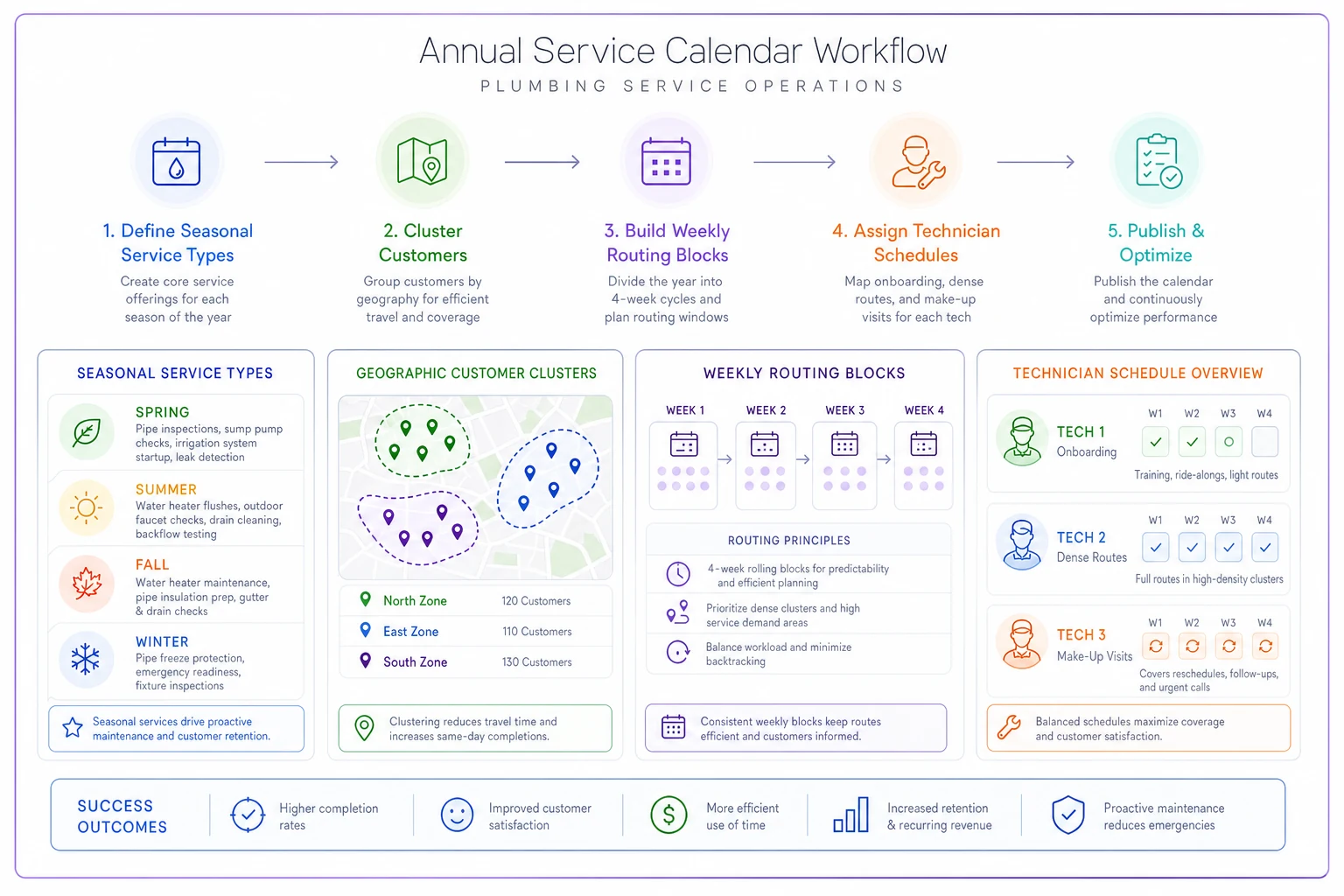
Members know roughly when to expect service, and dispatch can plan around predictable maintenance blocks.
Automated Touchpoints That Maintain High Renewal Rates
Manual renewal tracking guarantees dropped members. By the time someone remembers to check expiring plans, the customer already called another plumber for their last two issues.
| Timeline | Touchpoint |
|---|---|
| Day -90 | Email highlighting service history and savings achieved |
| Day -60 | Mailed renewal notice with loyalty discount offer |
| Day -45 | CSR call for payment update and scheduling |
| Day -30 | Text reminder with one-click renewal option |
| Day -15 | Final notice with "we'd hate to lose you" messaging |
| Day 0 | Pause service email with win-back offer |
| Day +15 | Re-engagement campaign begins |
Each touchpoint serves a purpose. The 90-day email reminds them of value received. The 60-day mailer provides physical documentation. The 45-day call adds human touch. The 30-day text makes renewal effortless. The final notice creates urgency without being pushy.
This sequence maintains higher renewal rates than any single method. Email-only yields around 55% renewal. Call-only hits maybe 65-70%. The full sequence consistently achieves 80-85% retention.
Tracking the KPIs That Actually Matter
Most shops track the wrong maintenance plan metrics. Total member count tells you nothing about program health. Revenue per member ignores acquisition costs.
Monthly Recurring Revenue (MRR) Growth Rate Not just total MRR, but month-over-month growth percentage. Healthy programs grow 2-4% monthly through a combination of new sales and tier upgrades. Below 1% means your acquisition engine stalled. Above 6% suggests unsustainable discounting or overselling.
Service Delivery Rate What percentage of scheduled maintenance visits actually get completed on time? Below 88% means you're creating service debt that kills renewals. Above 95% indicates good operational rhythm.
Cost Per Acquisition Include tech time spent selling, CSR processing time, marketing materials, and any signup incentives. Most shops discover their $39/month plans cost $75-95 to acquire, meaning roughly 3-month breakeven. That math drives different sales strategies than assuming zero acquisition cost.
Lifetime Value by Tier Basic tier members average 16-20 months retention. Standard tier hits 24-28 months. Premium tier reaches 35-42 months. Multiply by monthly fee plus average additional service revenue to get true lifetime values. This data justifies spending more to acquire premium members.
These metrics reveal whether you're building an asset or running a treadmill. Growing MRR with declining delivery rates means future mass cancellations. High acquisition costs with low lifetime values means each sale loses money.
The Integration Points Where Systems Break
Maintenance plan operations touch every part of your business. When one connection fails, the entire program suffers.
Dispatch needs visibility into member status during call booking. Without it, members don't receive priority scheduling, killing a core value proposition. Billing must automatically process renewals and tier changes. Manual billing creates gaps where members receive service without payment or lose access despite paying.
Inventory tracking gets complex with included parts and materials. Premium members get free angle stops, supply lines, and wax rings. Without proper tracking, techs either give away too much or tell members their covered parts aren't included, creating trust issues.
The compensation structure needs special attention. If techs earn commission on maintenance plan sales but nothing on service delivery, they'll oversell plans they never intend to fulfill. If they earn the same on maintenance visits as emergency calls, they'll prioritize higher-margin work.
Most failures trace back to treating maintenance plans as a bolt-on program instead of core operations. When plans integrate deeply into dispatch, billing, inventory, and compensation systems, they become self-sustaining revenue engines.
Turning Good Execution Into Predictable Revenue
A plumbing shop with 300 maintenance members averaging $45 monthly generates $162,000 in annual recurring revenue. That's before any additional service work from those members. With proper execution, those same 300 members generate another $350-450k in priority service calls.
The real value isn't just the revenue—it's the predictability. Knowing you'll start each month with $13,500 in guaranteed income changes how you manage cash flow, hire staff, and invest in growth.
The challenge comes in reaching critical mass. Below 100 members, the program costs more to administer than it generates. Between 100-250 members, you break even on administration but lack scheduling density. Above 250 members, economics improve dramatically. Routes become efficient, renewal processes justify automation investment, and the program becomes profitable.
This creates a catch-22 situation. You need scale for profitability, but can't sustain investment without profitability. The solution involves treating the first 250 members as customer acquisition cost for a long-term asset, not a short-term revenue program.
Why Traditional Approaches Stop Scaling at 500 Members
Around 500 maintenance plan members, manual systems collapse entirely. CSRs can't track renewals, dispatch struggles with scheduling, and service delivery becomes inconsistent. The owner faces a choice: hire dedicated maintenance plan staff or let service quality decline.
Neither option works long-term. Dedicated staff adds $55-75k in overhead, killing margins. Declining service drives cancellations, shrinking the program back below profitable levels.
The breakdown happens because humans can't track hundreds of renewal dates, service schedules, and payment methods simultaneously. Even with spreadsheets and calendars, something gets missed. A member doesn't get scheduled for six months. Another gets billed twice. Premium members receive basic service. Each mistake costs trust and renewals.
This is where operational software becomes essential, not optional. AI-powered platforms now handle the entire maintenance plan lifecycle—from initial sales tracking through automated renewals. They identify members due for upgrades, flag at-risk accounts before they cancel, and ensure service delivery matches plan promises.
The same AI automation that routes your trucks efficiently can predict which members will likely cancel based on service patterns. It notices when a premium member hasn't used their drain cleaning benefit and triggers an outreach campaign. It identifies neighborhoods with high member density and suggests targeted marketing.
Modern platforms don't just track maintenance plans—they actively grow them. They prompt techs with conversation starters based on customer history. They customize renewal messages based on actual service usage. They adjust scheduling to maintain service intervals while maximizing route density.
Making It Real: A 6-Month Implementation Timeline
Month 1: Design your three-tier structure and pricing. Create sales scripts and train techs on conversational selling. Set up basic tracking in your existing systems.
Month 2: Launch with existing customers first. Have CSRs call your top 100 customers about the new program. Expect 15-25 signups from people who already trust you.
Month 3: Add new customer acquisition. Every service call includes maintenance plan discussion. Track conversion rates by tech and service type. Adjust scripts based on what's working.
Month 4: Implement automated renewal sequences. Set up email, text, and mail touchpoints. Design the service delivery calendar based on member geography.
Month 5: Optimize operations based on early data. Identify bottlenecks in scheduling, billing, or service delivery. Add technology solutions where manual processes break down.
Month 6: Scale aggressive acquisition. With proven operations, invest in marketing. Target neighborhoods with existing member clusters. Run seasonal promotions around AC season or winter prep.
By month six, expect 120-180 members generating $6-9k monthly recurring revenue. More importantly, you'll have proven systems ready to scale toward 500+ members.
The Compound Effect of Systematic Execution
Plumbing maintenance plans aren't about the plans themselves. They're about building predictable, scalable revenue streams that transform business economics.
With proper structure—clear pricing tiers, trained team members, automated touchpoints, and integrated operations—maintenance plans become self-sustaining growth engines. Each happy member refers neighbors. Each successful renewal strengthens the program's reputation. Each efficient maintenance route improves margins.
The shops struggling with maintenance plans treat them as side programs. The shops generating $35k+ monthly in recurring revenue treat them as core operations worthy of systematic design and continuous improvement.
The difference between failure and success isn't market conditions or customer willingness. It's having comprehensive systems that sell, deliver, and renew maintenance plans automatically, letting you focus on growing the program instead of constantly fixing it.
Start with the framework outlined here. Price based on actual costs and value delivery. Train conversations, not scripts. Automate what humans consistently forget. Track metrics that predict future success. Then scale systematically instead of hopefully.
Your maintenance plan program should run as smoothly as your emergency dispatch. When it does, you've built an asset that generates revenue whether you're there or not—the definition of scalable business operations.
Ready to optimize your plumbing operations?
Join 500+ plumbing businesses using Plummerly to save time, reduce scheduling errors, and improve customer satisfaction.