



Most plumbers switching to flat rate pricing plumbing mess up the fundamentals right from the start. They grab a competitor's price book, maybe adjust it 10% up or down, and wonder why their margins disappear three months later.
The problem runs deeper than bad pricing. I've watched dozens of plumbing companies build their pricing systems, and the pattern is always the same: shops that fail at flat-rate pricing never actually calculate their true operational costs per service. They guess at labor times, ignore overhead allocation, and end up with a price menu that bleeds money on every third call.
Understanding your costs isn't rocket science, but most shops treat it like optional homework.
Why Traditional Flat-Rate Conversions Fail
The typical conversion looks something like this: Owner decides hourly billing confuses customers. Downloads a generic price book template. Multiplies their hourly rate by estimated job times. Adds some percentage for profit. Launches it Monday morning.
Six weeks later, techs complain about losing money on water heater installs. The office manager notices callbacks eating into margins. Customer complaints about "surprise" pricing start rolling in because nobody explained the new system properly.
What went wrong? Everything started backwards.
Profitable flat-rate pricing requires understanding your actual cost structure first. Not your competitor's costs. Not some national average. Your specific operational reality — including that extra 12 minutes your techs spend finding parking in downtown areas, or the 8% material markup your supplier actually charges versus the 5% you thought you were paying.
Building Your Cost Foundation
Start with real time studies, not estimates. Track your five most common services for two weeks. Have techs log actual start-to-finish times including drive time from previous call, setup and customer interaction, actual repair work, cleanup and payment processing, and documentation and parts restocking.
Stop missing service calls and double bookings.
Plummerly helps you schedule, assign, and manage every plumbing job efficiently.
- Centralized job scheduling
- Technician dispatch & tracking
- Customer notifications
No credit card required
A toilet repair you think takes 45 minutes probably takes 67 minutes door-to-door. That water heater install budgeted for 2 hours? Try closer to 3 hours when you include the second trip for the expansion tank the customer decided they wanted.
Your techs won't love logging times initially. Do it anyway. The data reveals everything.
| Service Type | Book Time | Actual Average | Hidden Time |
|---|---|---|---|
| Toilet Repair | 45 min | 67 min | Parking, explaining options |
| Faucet Replace | 60 min | 84 min | Removing old caulk, cleanup |
| Water Heater Install | 120 min | 168 min | Permit, disposal, callbacks |
| Drain Clearing | 30 min | 52 min | Equipment setup, testing |
| Garbage Disposal | 45 min | 71 min | Electrical check, alignment |
The data reveals everything.
Labor Band Calculations That Actually Work
Stop thinking in single hourly rates. Your tech making $28/hour actually costs you around $41/hour once you factor in payroll taxes, workers comp, benefits, uniforms, and training time.
Create three labor bands based on tech experience:
Band A - Apprentice Level ($35-42/hour loaded cost) Basic repairs, assisting on installs, simple diagnostics
Band B - Journeyman Level ($48-58/hour loaded cost) Standard installs, most repairs, customer-facing work
Band C - Master Level ($65-75/hour loaded cost) Complex diagnostics, code corrections, high-value installs
Now assign each menu item to the appropriate band. Toilet repairs might be Band A work. Tankless water heater installs definitely need Band C expertise.
The bands prevent you from sending expensive expertise to cheap jobs, and cheap labor to complex problems.
Material Markup Reality Check
The industry standard 50% material markup sounds great until you realize your actual costs include supplier delivery fees, inventory carrying cost, damaged parts write-offs, time spent ordering and receiving, and vehicle stock that expires or gets lost.
Track your real material costs for 30 days. Include everything — the brass fittings that disappear from trucks, the PVC glue that dries out, the callbacks when the "lifetime warranty" part fails after 6 months.
Most shops discover their true material overhead runs somewhere between 18-24% before any profit markup. That means your 50% markup is really generating closer to 26-32% gross margin.
Painful realization, but necessary math.
Converting to Menu Pricing
Service: Kitchen Faucet Replacement
-
Determine actual time investment
Average actual time is 84 minutes with Band B tech level needed at $52/hour loaded cost.
-
Calculate base labor cost
84 minutes equals 1.4 hours times $52 equals $72.80.
-
Add overhead allocation
Vehicle cost per call $18, insurance allocation $12, office support $15 for total overhead of $45.
-
Include material costs
Average faucet cost $95 marked up 65% equals $156.75, plus supplies like putty and tape add $8.
-
Set target margin
Total costs of $72.80 plus $45 plus $156.75 plus $8 equals $282.55, with target gross margin of 38% for final menu price of $456.
Below is a simple workflow of the build process.
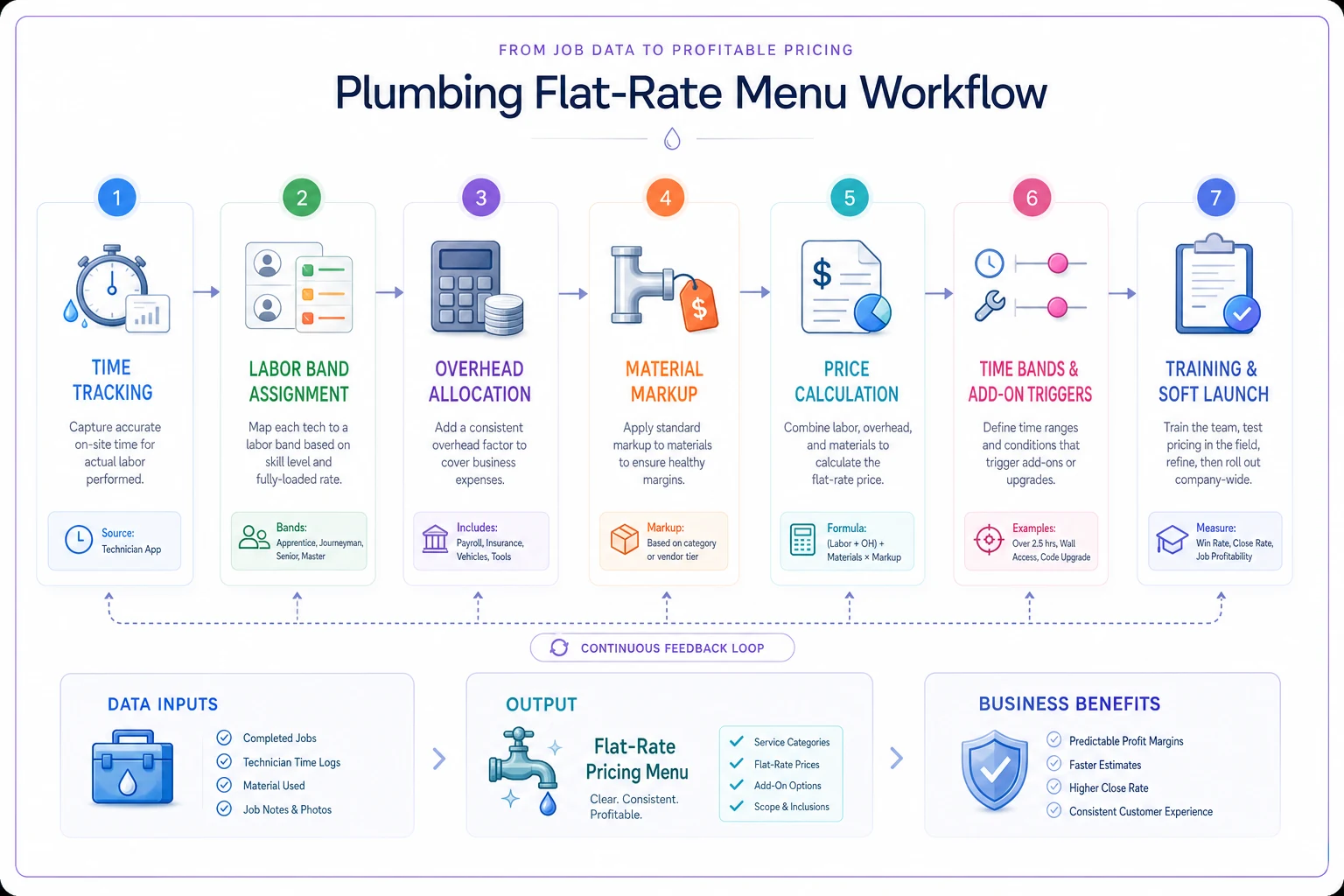
But most shops stop there. They create the price and launch it. Smart operators add structure around it.
Time Bands Prevent Margin Erosion
Every menu item needs time boundaries. That faucet replacement priced at $456? It assumes standard shutoff valves present and functional, no corrosion requiring line replacement, countertop in good condition, and standard mounting configuration.
Build triggers for additional charges. Corroded shutoff valve replacement adds $127 each. Supply line replacement adds $47 per line. Non-standard mounting adds $95. Disposal of old fixture adds $25.
Train techs to identify these during initial inspection, not halfway through the job.
Without clear boundaries, your $456 faucet job becomes a $250 loss when the shutoffs crumble and the customer expects everything included.
Customer Communication Scripts That Prevent Pricing Shock
The biggest flat-rate pricing failure happens at the kitchen table, not in the price book. Techs stumble through explanations, customers feel ambushed, and jobs get declined that should close.
Wrong approach: "It's $456 to replace your faucet."
Right approach: "I've inspected your faucet situation completely. To replace it with a quality fixture that matches your kitchen, handle the mounting properly, and ensure everything's up to current code, the investment is $456. This covers everything — the faucet, installation, testing, and our warranty. No surprises or add-ons unless we discover something unexpected, which I'd discuss with you first."
For multi-option situations:
"I can offer you three ways to solve this leak. We can do a repair today for $187 that should hold for 6-12 months. We can replace just the valve cartridge for $298, which typically lasts 3-5 years. Or we can replace the entire faucet for $456, which comes with our 5-year warranty and solves the problem permanently."
The difference in close rates between these approaches is dramatic.
The Margin Protection System
Track actual margins weekly, not monthly. Create a simple spreadsheet with job type, menu price charged, actual time spent, actual materials used, and calculated margin.
When margins on specific services drop below target for two weeks straight, investigate immediately. Usually you'll find scope creep where techs do extra work without charging, time creep where jobs take longer than tracked, material waste where premium parts get used on standard jobs, or callback drag where free return visits eat profits.
One shop discovered their garbage disposal replacements were losing money because techs were automatically replacing the power cord and air switch without charging — adding $47 in materials and 20 minutes of labor to each job.
Quick fix, massive impact on profitability.
Implementation Timeline That Minimizes Disruption
Don't flip the switch overnight. Week 1-2 focuses on data collection where you track real times and costs on your top 20 services. These probably represent around 70% of your revenue.
Week 3 involves building your initial menu by creating pricing for those 20 services using the cost-build method above. Include time bands and addon triggers.
Week 4 covers tech training where you role-play pricing presentations, practice handling objections, and review when to offer options versus single solutions.
Week 5 starts your soft launch where you test with roughly 20% of jobs while tracking everything and gathering feedback from techs and customers.
Week 6-7 is refinement time where you fix the obvious problems. Usually prices are too low on complex work, communication scripts need tweaking, and forgotten addon scenarios surface.
Week 8 brings full launch where you roll out to all services while keeping the feedback loop open.
Mistakes to Avoid in Month One
Underpricing complex work is the biggest killer. That main line replacement you priced using perfect-world timing? Add around 40% for reality — concrete cutting, unexpected turns, permit delays.
Don't overcomplicate the menu either. Starting with 200 items confuses everyone. Better to have 40 well-defined services than 200 nobody understands.
Seasonal adjustments get forgotten too. Winter prices need to account for frozen ground, shorter days, and equipment warmup time.
Travel zones matter more than most realize. Charging the same price for downtown service with 5 miles between calls and rural routes with 15 miles between calls kills rural margins.
Each mistake costs money immediately. Better to start conservative and adjust up than bleed cash for months.
When Your Market Resists Flat-Rate Pricing
Some markets genuinely struggle with flat-rate adoption. Usually older demographics or rural areas where hourly billing has deep roots. The solution isn't abandoning flat-rate but offering hybrid options.
"We can work on time and materials if you prefer, with a two-hour minimum at $145/hour plus parts. Most customers choose our flat-rate option at $456 because it eliminates uncertainty, but I'm happy to work either way."
Around 80% pick flat-rate when presented this way. The remainder who insist on hourly often end up paying more, which reinforces the value of your menu pricing to other customers.
Measuring Success Beyond Revenue
Revenue might jump with flat-rate pricing, but watch these metrics for real health. Callback rate should drop with better first-visit fixes. Average ticket should increase somewhere between 20-30%. Close rate might dip initially, then improve. Tech satisfaction goes up with less arguing about bills. Customer complaints should decrease after month two. Margin consistency shows less variation between jobs.
Revenue without margins just keeps you busier, not richer.
Advanced Pricing Strategies
Once your basic flat-rate system runs smoothly, layer in sophistication.
Dynamic surge pricing works well. After-hours calls get 1.5x multiplier. Weekend rates run 1.3x. Same-day service adds $75. The menu prices stay consistent, modifiers handle urgency.
Bundle discounting increases tickets. "Fix multiple issues today, save 15% on the second repair." This increases average tickets while providing real value.
Membership integration helps too. Members get 15% off menu prices plus priority scheduling. The predictable revenue stream more than offsets the discount.
Performance pricing builds trust. Guarantee completion times for standard services. Running late? Discount kicks in automatically.
Operational Automation Makes Flat-Rate Sustainable
The manual maintenance of flat-rate pricing systems causes most failures. Updating prices, training new techs, tracking margins — it overwhelms small shops. Modern operational platforms change this completely.
These systems automatically adjust pricing based on your actual costs, track tech performance against estimates, and flag jobs consistently missing margin targets. Instead of spending weekends updating spreadsheets, the system handles it continuously.
The real advantage shows in consistency. Every tech quotes the same price. Every customer gets the same options. Every invoice follows the same format. The reduction in operational confusion alone justifies the investment.
AI-enhanced systems take this further by analyzing patterns across thousands of jobs, suggesting price optimizations based on actual close rates, and even predicting which customers prefer premium options versus budget solutions. Not magic, just pattern recognition applied to your operational data.
Without automation, flat-rate pricing becomes another administrative burden instead of an operational advantage.
Building for Long-Term Success
Flat-rate pricing isn't about charging more — it's about charging accurately. The shops that succeed understand this distinction. They build their menus from real operational data, train their teams properly, and adjust continuously based on actual results.
The math might take effort upfront, but the operational simplicity pays for itself within months. No more arguing about hours. No more customers shocked by final bills. No more techs undercharging because they feel bad about the time a job took.
Start with your top 20 services. Track real costs for two weeks. Build your menu from actual data, not assumptions. Train your team on presentation, not just pricing. Then measure, adjust, and improve continuously.
The shops running profitable flat-rate systems all learned the same lesson: pricing is just math, but presentation is everything. Get both right, and flat-rate pricing becomes your competitive advantage instead of your operational headache.
Start with your top 20 services. Track real costs for two weeks. Build your menu from actual data, not assumptions. Train your team on presentation, not just pricing. Then measure, adjust, and improve continuously.
The shops running profitable flat-rate systems all learned the same lesson: pricing is just math, but presentation is everything. Get both right, and flat-rate pricing becomes your competitive advantage instead of your operational headache.
Ready to optimize your plumbing operations?
Join 500+ plumbing businesses using Plummerly to save time, reduce scheduling errors, and improve customer satisfaction.