


Your dispatcher picks up at 9:47 PM. Water is gushing somewhere, the caller's frantic, and three other lines are ringing. Without a clear triage system, this becomes a guessing game—send your only available tech to what might be a shut-off valve situation while missing a genuine slab leak emergency two blocks away.
Most plumbing shops handle emergency calls with whatever feels right in the moment. The owner takes some calls, dispatchers make judgment calls based on experience, and somehow it usually works out. Until it doesn't. Until you send a senior tech at overtime rates to turn off a toilet supply line. Or worse, treat a sewage backup as tomorrow's problem and face a contamination claim.
Shops without structured emergency triage either overtreat everything (killing margins) or undertreat real emergencies (killing reputation). The sweet spot requires turning panic into process—specifically, a 60-second intake flow that captures severity, assigns response tiers, and matches tech skills to actual needs.
The Real Cost of Bad Triage Decisions
Every plumbing business owner knows the Sunday night dilemma. Call comes in about water "everywhere." Do you wake up your senior tech on call? Send whoever's closest? Wait until morning and risk damage claims?
Without clear triage criteria, these decisions eat profit from both ends. Overtreating means paying overtime for basic shut-offs, burning out your best techs on routine calls, and training customers that panic equals priority. Undertreating means missed opportunities for high-margin emergency work, reputation damage from slow response, and potential liability for preventable water damage.
The financial impact compounds quickly. A shop running 15-20 emergency calls weekly without proper triage typically overspends around $2,800 monthly on unnecessary overtime dispatch. That same shop leaves another $3,500 on the table by missing legitimate emergency work that competitors grab. Add reputation damage and tech burnout, and poor triage becomes a $75,000+ annual problem.
Most emergency calls fall into predictable patterns though. The same six or seven scenarios represent about 80% of after-hours calls. A burst washing machine hose presents differently than a slab leak. A backed-up toilet needs different resources than a failed water heater on a second floor. Once you map these patterns, triage becomes systematic rather than situational.
Building Your 60-Second Intake Script
The intake script serves one purpose: extract maximum diagnostic information in minimum time while keeping panicked callers focused. This isn't about customer service excellence—that comes later. This is operational triage.
Stop missing service calls and double bookings.
Plummerly helps you schedule, assign, and manage every plumbing job efficiently.
- Centralized job scheduling
- Technician dispatch & tracking
- Customer notifications
No credit card required
Start with the critical path question: "Is water currently flowing that you cannot stop?" This immediately separates active emergencies from contained situations. Follow with location: "Where exactly is the water?" Kitchen, bathroom, basement, yard—each answer triggers different response protocols.
Start with the critical path question to separate active from contained situations immediately.
Here's a working intake script that consistently captures what you need in under a minute:
-
Opening "Plumbing emergency line. Is water currently flowing that you cannot stop?"
-
If YES "Where is the water coming from—can you see the source?"
-
- Under sink/toilet → "Can you see shut-off valves underneath?"
-
- Wall/ceiling → "Which floor? Any fixtures above that spot?"
-
- Floor/foundation → "Constant flow or intermittent? Any recent plumbing work?"
-
- Outside/yard → "Near the meter? Foundation? Sprinkler system?"
-
If NO "What's the current situation?"
-
- No water → "Partial or complete? All fixtures? When did it start?"
-
- Backup → "Which fixtures? Lowest level backing up? Sewage smell?"
-
- Leak stopped → "How did it stop? Where was it? Any visible damage?"
-
Severity markers "Quick questions to assess urgency:"
-
- "Is the water reaching electrical outlets or panels?"
-
- "Is sewage involved?"
-
- "Are multiple floors affected?"
-
- "Is this a commercial property or multi-family building?"
-
Close "We're categorizing this as [Priority 1/2/3]. Expected response time is [timeframe]. Text photos to [number] if possible."
Notice what this script doesn't do—it doesn't try to diagnose, doesn't promise immediate response, and doesn't collect life stories. Every question drives toward one decision: which response tier does this require?
Response Tier Mapping That Actually Works
Most shops try to run with two tiers: emergency and not emergency. This binary thinking creates the overtime problem. Real operations need at least four tiers that match resources to actual urgency.
Tier 1: Immediate Dispatch (0-60 minutes)
-
Active slab leak or main line break
-
Sewage backup in living space
-
Water reaching electrical systems
-
Commercial property with business interruption
-
Multi-family building with multiple units affected
Required tech level: Senior tech with full diagnostic kit and repair capability. These calls justify overtime, emergency rates, and pulling techs from other calls.
Tier 2: Priority Response (1-4 hours)
-
Contained burst pipe (water shut off)
-
Single fixture backup not spreading
-
Water heater failure (no active leak)
-
Partial pressure loss affecting habitability
Required tech level: Experienced tech with standard repair parts. Schedule within current shift if possible, early next shift if not.
Tier 3: Same Day Service (4-12 hours)
-
Slow drain not backing up
-
Minor leak customer contained
-
Running toilet
-
Single fixture not working
Required tech level: Any qualified tech, schedulable within normal routes. No overtime, standard rates.
Tier 4: Next Business Day
-
Preventive concerns
-
Second bathroom/non-critical fixtures
-
Outdoor/irrigation issues
-
Water quality questions
Required tech level: Appropriate specialist during regular hours.
This tier system transforms dispatch from emotional decisions to operational ones. Dispatcher doesn't need to judge panic levels or negotiate urgency—they follow the criteria.
Matching Tech Skills to Call Requirements
The expensive mistake happens when you send your $45/hour senior tech to tasks your $22/hour apprentice could handle. Or worse, send an apprentice to a situation requiring immediate diagnostic expertise.
Build your skill matching matrix around actual capabilities, not just experience levels:
-
Senior Tech Deployment Triggers
-
Requires immediate diagnosis without supervision
-
Involves cutting into walls/slabs
-
Needs permit or code expertise
-
Commercial/liability-sensitive situation
-
Multi-system troubleshooting
-
Journeyman Deployment Triggers
-
Standard fixture replacement
-
Supply line repairs
-
Basic drain clearing
-
Water heater replacement (standard)
-
Shut-off and assessment calls
-
Apprentice Deployment Triggers (with clear instructions)
-
Water extraction and containment
-
Toilet resets
-
Faucet cartridge replacement
-
Simple supply line replacement
-
Information gathering for senior tech
Many emergency calls need immediate response but not immediate repair. Send an apprentice to shut off water and assess, then schedule appropriate repairs for normal hours. This satisfies customer urgency without burning overtime on non-critical repairs.
Decision Trees That Eliminate Second-Guessing
Decision paralysis kills response time. Your dispatcher shouldn't debate whether a water heater leak qualifies as Tier 1 or Tier 2. They should follow a clear decision path.
For the most common scenario—water leak calls:
Active water flow? → YES: Can customer stop it? → NO: Tier 1 (immediate dispatch) → YES: Has it stopped? → YES: Assess damage, likely Tier 3 → NO: Walk through shut-off, then Tier 2 → NO: Evidence of recent flow? → YES: Determine source → Slab/wall: Tier 2 (priority response) → Fixture: Tier 3 (same day) → NO: Schedule evaluation, Tier 4
For backup calls: Sewage backing up? → YES: Multiple fixtures? → YES: Tier 1 (immediate) → NO: Contained to one fixture? → YES: Tier 2 if bathroom, Tier 3 if kitchen → NO: Spreading? Upgrade to Tier 1 → NO: Slow drain only? → Tier 3 or 4 depending on fixture criticality
These trees remove interpretation. The dispatcher asks questions, follows branches, arrives at tier designation. No judgment calls, no debates, no inconsistency between dispatchers.
SLA Commitments That Protect Both Margins and Reputation
Service Level Agreements for emergency response create customer expectations and operational boundaries. Most shops either overpromise (creating impossible operational pressure) or stay vague (creating customer frustration).
Effective SLAs tie to your tier system:
Tier 1 SLA: "Technician on-site within 60 minutes"
-
Clock starts when call categorized as Tier 1
-
Customer receives text with tech name and ETA
-
If delayed, automatic update every 20 minutes
-
Failure triggers automatic service discount
Tier 2 SLA: "Response within 4 hours"
-
Quoted as actual time window, not "within 4 hours"
-
Example
"Tech will arrive between 2-4 PM today"
-
One confirmation call/text when tech dispatched
-
Failure triggers priority scheduling next day
Tier 3 SLA: "Same day service"
-
Scheduled for specific time block
-
Grouped with regular route when possible
-
Standard scheduling communications apply
Tier 4 SLA: "Next business day"
-
Scheduled as normal appointment
-
No emergency rates or expectations
These SLAs accomplish something critical: they train customers on what constitutes a real emergency. When Tier 1 means 60-minute response at emergency rates, but Tier 3 means same-day at standard rates, customers self-select more accurately.
Sample Dispatch Rules for Common Emergencies
Specific symptoms mapped to dispatch decisions. These become your dispatcher's quick reference guide.
Burst Pipe Scenarios:
-
Under sink/visible location
-
Customer can shut off
Tier 3, any available tech
-
Customer cannot find shut-off
Tier 2, apprentice for shut-off, then schedule repair
-
Water reaching other areas
Tier 1, senior tech with repair capability
-
In wall/ceiling
-
Active flow
Tier 1, senior tech immediately
-
Stopped but wet
Tier 2, journeyman for assessment
-
Staining only
Tier 4, schedule leak detection
-
Outdoor/irrigation
-
Geyser/flooding
Tier 1 if near foundation, Tier 2 otherwise
-
Pooling water
Tier 3 during business hours
-
Damp spots
Tier 4, evaluation appointment
No Water Situations:
-
Complete loss
-
Single family home
Tier 2, check meter/main/PRV
-
Multi-family
Tier 1, potential for multiple unit impact
-
Partial loss
Tier 3, likely single fixture issue
-
Low pressure
-
Whole house
Tier 2, PRV or service line issue
-
Single fixture
Tier 3 or 4, aerator/cartridge service
Backup Emergencies:
-
Sewage in living space
-
Multiple fixtures
Tier 1, main line emergency
-
Single toilet
Tier 2, contained but urgent
-
Floor drain only
Tier 3, schedule jetting service
-
Kitchen backup
-
Both sides backing
Tier 2, needs clearing
-
Single side slow
Tier 3 or 4, standard service
These rules eliminate the guesswork. Dispatcher hears symptoms, checks the rule sheet, assigns tier. The consistency alone improves customer satisfaction.
Building Tech Skill Matrices
Not every tech can handle every emergency. Your dispatch rules need to account for actual capabilities, not just availability.
For each tech, rate capabilities:
-
Slab leak detection and repair
-
Main line diagnostics
-
Backflow/commercial systems
-
Multi-story troubleshooting
-
Permit work/code compliance
-
Customer de-escalation skills
Then match to call requirements:
| Call Complexity | Tech Level Required | Example Scenarios |
|---|---|---|
| High (senior tech only) | Master/Senior | Slab leaks, main sewer backups, commercial emergencies |
| Medium (journeyman+) | Journeyman or above | Water heater replacements, fixture replacements under pressure |
| Low (any qualified tech) | Apprentice+ | Shut-offs, toilet resets, supply line replacement |
This prevents the 11 PM mistake of sending your apprentice to a slab leak or your master plumber to reset a toilet. Match complexity to capability, regardless of who's on call.
When Automated Triage Becomes Essential
Once you pass about 50 emergency calls monthly, manual triage starts breaking down. Dispatchers forget protocols under pressure. Different shifts interpret rules differently. Customer service degrades while trying to manage multiple emergency lines.
AI-powered operational software transforms emergency response from chaotic guesswork into structured process. Instead of dispatchers juggling scripts and decision trees, the system handles intake through structured prompts. As callers describe issues, the platform automatically categorizes severity, assigns tiers, and identifies qualified available techs.
Here's a visual workflow of the automated triage process.
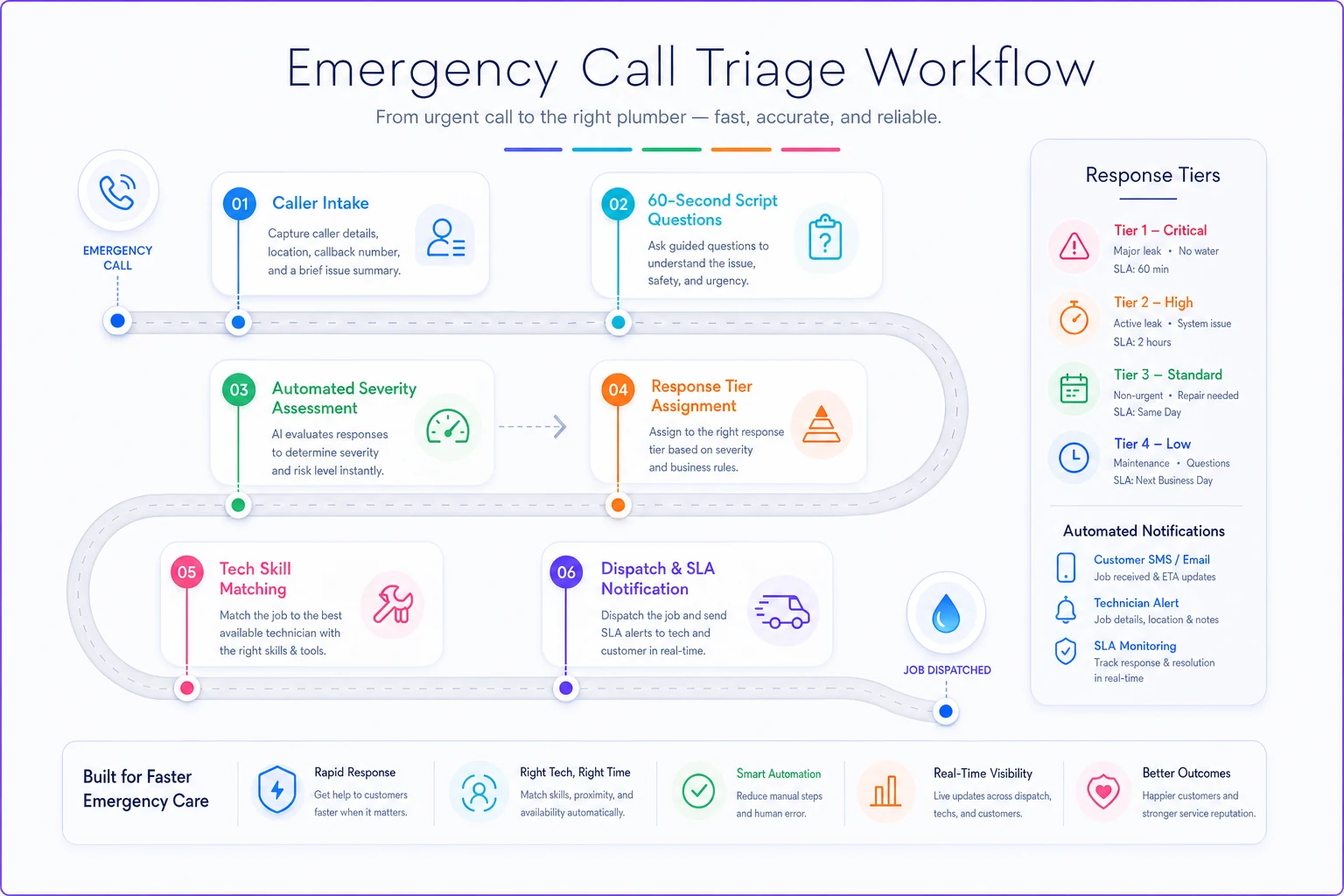
The consistency advantage becomes massive. Every call follows the same triage path. Every similar situation receives the same response tier. The system doesn't panic, doesn't play favorites, and doesn't forget protocols at 2 AM. It processes symptoms, applies your rules, and routes calls appropriately.
Modern platforms can even handle initial customer intake through chat or voice, gathering preliminary information before human dispatch gets involved. This pre-triage means your dispatcher receives calls already categorized with recommended response tiers. They can focus on coordination rather than diagnosis.
The data accumulation becomes equally valuable. After a few months, you see patterns—which call types actually require emergency response, which techs handle which situations most effectively, which customers consistently overcall urgency. These insights let you refine protocols based on actual outcomes rather than assumptions.
Measuring and Refining Your Triage System
A triage system without measurement gradually degrades back to chaos. Track these specific metrics to maintain effectiveness:
-
Response accuracy What percentage of Tier 1 calls actually required immediate response? If more than 20% could have waited, your criteria need tightening.
-
Tech utilization How often do senior techs handle low-complexity calls? Track skill mismatches to identify dispatch training needs.
-
SLA performance Meet your promised response times? Missing Tier 1 SLAs damages trust. Missing Tier 3 SLAs suggests poor capacity planning.
-
Customer callbacks How many emergency calls require return visits? High callback rates indicate incorrect initial tier assignment or tech skill mismatches.
-
Revenue per tier Calculate average revenue by response tier. Tier 1 should generate premium revenues. If not, examine whether you're undercharging for emergency response or overcategorizing urgency.
Review these metrics monthly. Adjust rules that consistently miscategorize calls. Retrain dispatchers on problem areas. Share metrics with techs—when they understand how triage affects operations, they provide better field feedback.
The goal isn't perfection, it's consistency and improvement. A system that correctly categorizes 85% of calls is infinitely better than random judgment calls.
The Psychology of Emergency Dispatch
Behind every emergency call sits a stressed human. They're watching water destroy their property or dealing with sewage in their home. Your triage system must balance operational efficiency with human psychology.
Callers need to feel heard, even while you're rapidly categorizing their situation. The intake script provides structure, but delivery matters. A dispatcher rushing through questions creates more panic. One taking too long frustrates urgent situations.
Train dispatchers to use what psychologists call "acknowledged urgency"—verbally recognize the situation's importance while maintaining operational calm. "I understand water is flowing. Let me quickly determine how to get you the fastest help." This validates concerns while maintaining process control.
Similarly, tier assignment needs framing. Never tell a customer their emergency "isn't really an emergency." Instead: "Based on what you've described, we can have someone there within [timeframe] to resolve this." Focus on solution timing, not problem minimization.
Customers calling after hours already expect premium pricing, but surprises still create conflicts. Build rate transparency into your triage communication. "This qualifies for Tier 1 emergency response at our after-hours rate of $XX. Should I dispatch immediately?" Clear expectations prevent billing disputes later.
Common Triage Mistakes That Kill Profitability
Even with solid protocols, certain mistakes repeatedly emerge in plumbing emergency triage:
-
Overreacting to customer panic levels. The volume of customer distress rarely correlates with actual urgency. A calm customer might have serious slab leak, while a screaming one might have a dripping faucet. Train dispatchers to focus on facts, not emotion.
-
Letting techs override dispatch decisions. When your on-call tech starts negotiating which calls to take, triage breaks down. Techs should provide field feedback for system improvement, not make real-time dispatch decisions based on convenience.
-
Creating too many tiers. Some shops try running six or seven response tiers. This creates confusion and inconsistency. Four tiers provide sufficient granularity while remaining manageable.
-
Failing to update after seasons change. Winter pipe bursts require different responses than summer irrigation leaks. Review and adjust protocols seasonally rather than running the same rules year-round.
-
Promising impossible response times. If you can't consistently meet 60-minute Tier 1
These recurring mistakes erode margins and customer trust. Correcting them through process, measurement, and training is essential to maintain profitable emergency response.
The goal isn't perfection, it's consistency and improvement. A system that correctly categorizes 85% of calls is infinitely better than random judgment calls.
Ready to optimize your plumbing operations?
Join 500+ plumbing businesses using Plummerly to save time, reduce scheduling errors, and improve customer satisfaction.