

Your lead tech just quit.
The guy who knew exactly which valve supplier to call for that weird European fixture. Who memorized which customers get annoyed when you call before arriving. Who could quote a water heater replacement in his sleep.
Now you're scrambling to train someone new while fielding angry calls about a botched dispatch this morning. The new dispatcher sent your commercial guy to a residential toilet repair forty minutes away, while your residential tech sat in a parking lot waiting for a commercial job that never materialized.
This chaos happens because most plumbing businesses run on tribal knowledge instead of documented systems.
Why plumbing operations break without proper documentation
After working with service businesses for three years, plumbing companies consistently struggle with the same pattern. The owner builds the business around their personal expertise. They train people by having them shadow for a few weeks. Important details live in people's heads—which parts vendor gives the best prices, which neighborhoods tip well, how to handle that one property management company that always disputes invoices.
Someone leaves, gets sick, or you try to scale beyond one crew, and everything breaks.
The average plumbing business loses around $2,800 per month just from operational friction. Techs driving to wrong addresses. Parts ordered from expensive suppliers because the new guy doesn't know about your wholesale account. Quotes that miss critical line items. Jobs scheduled without confirming parts availability first.
Most owners think they'll document their processes "when things slow down." Things never slow down. You're always putting out fires, and the fires keep happening because you never documented how to prevent them.
What actually belongs in a plumbing operations playbook
A functional operations playbook isn't some 200-page manual nobody reads. It's the specific workflows your team follows every single day, documented so someone off the street could execute them.
Stop missing service calls and double bookings.
Plummerly helps you schedule, assign, and manage every plumbing job efficiently.
- Centralized job scheduling
- Technician dispatch & tracking
- Customer notifications
No credit card required
Start with your core operational flow: how a job moves from initial call to final payment. Most plumbing businesses handle this in five stages, and each stage needs its own documented process.
A simple visual of the core job flow helps make the process clear.
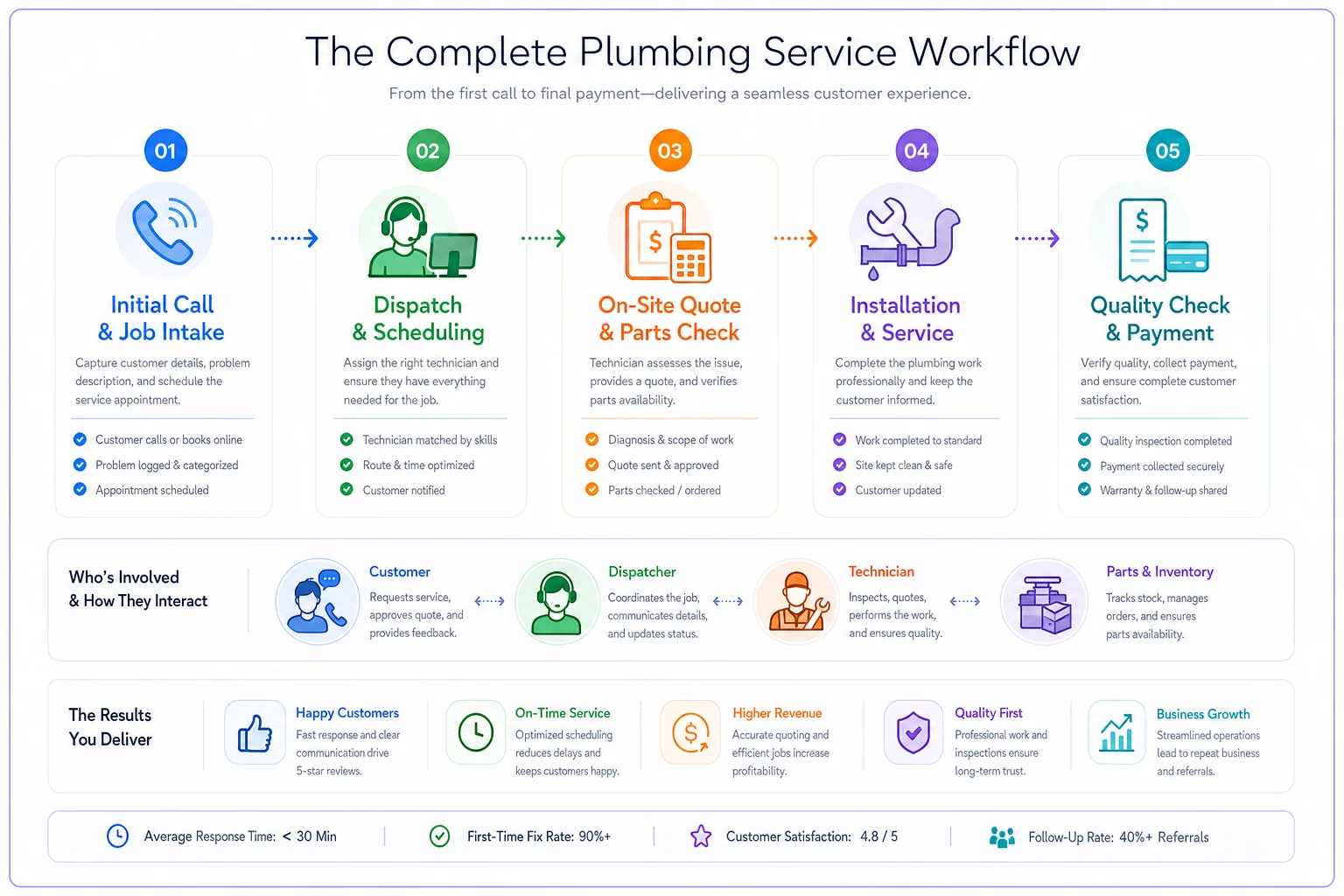
Dispatch operations cover everything from call intake to tech assignment. This includes your criteria for emergency versus scheduled calls, how you determine which tech gets which job, what information dispatch must collect before creating a work order, and how you handle schedule changes. One company reduced their dispatch errors by 70% just by creating a simple checklist for call intake—things like confirming the service address matches the billing address, asking if there's gate access, checking if the customer has a home warranty.
Quoting procedures need more structure than most shops realize. Your playbook should specify exactly which repairs require photos before quoting, your markup structure for different job types, how to handle quotes that exceed certain thresholds, and what language to use when presenting options. Include templates for common scenarios—a standard water heater replacement should have predetermined options for tank versus tankless, different gallon capacities, warranty tiers.
Parts management kills profitability when it's not documented. Your playbook needs to specify which parts each truck should stock, reorder points for common items, preferred vendors for different part categories, and the process for emergency parts runs. Document your relationships too—if you have a wholesale account that gives 15% off copper fittings, write down the account number, the rep's name, and the direct phone line.
Billing workflows seem simple until someone forgets to add the service call fee or doesn't know your policy on warranty work. Document exactly when to collect payment, what payment methods you accept, how to handle financing applications, your collections process for past-due accounts. Include the specific language for common billing disputes.
Quality assurance usually gets ignored until you get a bad review. Your playbook should outline customer follow-up procedures, how to handle complaints, what triggers a callback, and your warranty terms for different services. One shop started requiring photo documentation of completed work—just before-and-after shots of drain cleanings—and their callback rate dropped significantly.
Building SOPs that techs will actually follow
Most people get this wrong: they write SOPs like legal documents instead of practical guides.
Your procedures need to work for the guy who shows up hungover on Monday morning, not the detail-oriented person who wrote them. That means simple language, clear steps, and visual aids where possible.
-
Call customer 30 minutes before arrival
-
Put on boot covers before entering home
-
Diagnose issue and take photos of problem area
-
Present three repair options (when applicable)
-
Get written approval before starting work
-
Complete repair and test thoroughly
-
Clean work area and remove all debris
-
Walk customer through what was done
-
Process payment and email receipt
-
Ask for review (if customer seems satisfied)
Keep each SOP step to a single specific action so techs don't skip parts.
Notice how each step is one specific action? That's intentional. When you combine multiple actions into one step, people skip parts.
Your SOPs should also include the "why" behind critical steps. Techs follow procedures better when they understand the reasoning. "Call 30 minutes before arrival (reduces no-shows by 40% and lets customer prepare)."
Creating checklists that prevent expensive mistakes
Checklists work because they acknowledge human fallibility. Even experienced plumbers forget things when they're rushing between jobs.
Your truck stock checklist prevents that embarrassing moment when your tech drives 45 minutes just to realize they don't have the right size coupling. List every single item that should be on that truck, organized by category. Include quantities. Update it quarterly based on what's actually getting used.
Your new construction rough-in checklist ensures nothing gets missed before the walls close up. Every vent, every slope, every connection point. One missed detail here costs thousands to fix later.
Your water heater installation checklist covers permits, code requirements, safety procedures, and customer education points. Did you check the T&P valve? Set the temperature to 120 degrees? Explain the anode rod to the customer? These details matter.
The key is making checklists easy to use. Physical laminated cards work better than digital documents for field use. Group related items together. Use simple yes/no format rather than requiring written responses.
Example workflows for common plumbing services
A complete workflow for a standard water heater replacement covers a huge chunk of residential plumbing revenue.
Initial contact: Customer calls about no hot water. Dispatcher asks age of current heater, any visible leaks, gas or electric, and preferred scheduling window. Creates work order with "diagnostic/possible replacement" and assigns to tech with water heater inventory on truck.
Arrival and diagnosis: Tech confirms water heater failure, inspects installation area for code compliance, checks venting (for gas), measures space, photographs manufacturer label and current setup. Takes measurements for expansion tank requirement, checks water pressure.
Quoting: Tech presents three options using predetermined pricing:
-
Basic
40-gallon standard efficiency tank, 6-year warranty
-
Better
50-gallon high-efficiency tank, 10-year warranty
-
Best
Tankless conversion with 15-year warranty
Each option includes all materials, permits, haul-away, and labor. No surprises.
Installation: Once approved, tech shuts off water and gas/power, drains old unit, removes and loads for disposal. Installs new heater following manufacturer specs and local code. Adds expansion tank if required. Tests all connections, sets temperature, checks draft (gas units), ensures proper drainage.
Completion: Tech walks customer through new unit operation, explains warranty, provides maintenance recommendations. Processes payment, emails receipt with warranty information. Schedules haul-away if needed. Requests review.
This same detailed workflow structure applies to drain cleaning, toilet replacements, faucet repairs—every service you offer. The specificity prevents shortcuts and ensures consistency across different techs.
Adapting your playbook as your business grows
A single-truck operation needs different processes than a five-truck company.
When you're solo or have one helper, your playbook might be fifteen pages covering the basics. Dispatch is probably you answering your cell phone. Parts management means stopping at Ferguson on the way to jobs. Quality control happens through direct customer relationships.
Add a second truck, and suddenly you need real dispatch procedures. Who gets which calls? How do you track where everyone is? What happens when both trucks are booked and an emergency comes in?
By three trucks, you need someone dedicated to answering phones. Your playbook now includes office procedures, customer service scripts, scheduling protocols. Parts management becomes critical—you can't have three trucks making separate supply runs.
At five trucks or more, you're managing inventory across multiple vehicles, coordinating complex schedules, handling multiple jobs simultaneously. Your playbook needs sections on fleet management, inventory transfers between trucks, and multi-tech job coordination.
The playbook should evolve quarterly. After each growth stage, certain processes break and need updating. What worked for tracking parts with two trucks fails at five trucks. The quoting process that was fine for residential work needs adjustment when you add commercial accounts.
Digital tools and software integration
Paper playbooks gathering dust on a shelf don't improve operations. Your procedures need to be accessible and actively used.
Modern plumbing operations benefit from AI-powered operational software that embeds these procedures into daily workflows. Instead of hoping techs remember the water heater installation checklist, the software prompts them through each step. Dispatchers can't skip critical information gathering because the system requires those fields before creating a work order.
This kind of platform centralizes your tribal knowledge while making it actionable. Your parts pricing lives in the quoting system. Your preferred suppliers are built into purchasing workflows. Customer preferences get attached to their profiles. The new dispatcher sees that Mrs. Johnson needs 24-hour notice for appointments, right there in the system.
The AI automation aspects handle the repetitive stuff that burns out good employees. Automatic dispatch based on tech location and skillset. Quote follow-ups that go out without anyone remembering. Parts reorder notifications when truck inventory runs low. This frees your team to focus on actual plumbing work instead of administrative tasks.
When you integrate your playbook into operational software, it becomes a living system that improves through use. The software tracks which processes get followed, which get skipped, and where mistakes cluster. You can update procedures based on real data instead of guessing what's broken.
Measuring success with your operations playbook
A playbook without metrics is just wishful thinking. You need to track whether these procedures actually improve operations.
Start with callback rates. If your quality assurance procedures work, callbacks should drop below 3%. Track this monthly by tech and job type. Drain cleaning callbacks might indicate technique issues. Water heater callbacks suggest installation problems.
| Metric | Target / Notes |
|---|---|
| Callback rates | If your quality assurance procedures work, callbacks should drop below 3%. Track this monthly by tech and job type. Drain cleaning callbacks might indicate technique issues. Water heater callbacks suggest installation problems. |
| Quote-to-close ratios | Good quoting procedures should close at least 35% of residential quotes. If certain techs consistently underperform, they might be skipping steps in the quoting process—not presenting options, rushing through explanations, or failing to build value. |
| First-time fix rates | When techs follow parts management procedures and stock trucks properly, they should complete 85% of service calls without return trips for parts. Every parts run costs you roughly $75 in lost productivity. |
| Dispatch accuracy | With proper procedures, less than 5% of dispatches should have errors—wrong address, wrong tech for the job type, missing customer information. Each dispatch error typically costs $150 between wasted drive time and customer frustration. |
| Average ticket sizes | Proper quoting procedures and option presentation should increase average tickets by 20-30%. If techs consistently sell only basic options, they're probably not following the three-option presentation process. |
| Employee turnover | Good documentation reduces training time and frustration. New hires should be productive within two weeks instead of two months. |
Monitor quote-to-close ratios. Good quoting procedures should close at least 35% of residential quotes. If certain techs consistently underperform, they might be skipping steps in the quoting process—not presenting options, rushing through explanations, or failing to build value.
Track first-time fix rates. When techs follow parts management procedures and stock trucks properly, they should complete 85% of service calls without return trips for parts. Every parts run costs you roughly $75 in lost productivity.
Measure dispatch accuracy. With proper procedures, less than 5% of dispatches should have errors—wrong address, wrong tech for the job type, missing customer information. Each dispatch error typically costs $150 between wasted drive time and customer frustration.
Look at average ticket sizes. Proper quoting procedures and option presentation should increase average tickets by 20-30%. If techs consistently sell only basic options, they're probably not following the three-option presentation process.
Employee turnover tells you if your playbook actually helps or just adds bureaucracy. Good documentation reduces training time and frustration. New hires should be productive within two weeks instead of two months.
The real cost of not having documented operations
Your experienced dispatcher quits suddenly—family emergency, better offer, doesn't matter. The replacement starts Monday. You spend three hours explaining the basics, then throw them into the deep end.
By Wednesday, they've double-booked your best tech, sent a drain specialist to a water heater job, and forgotten to mention that the Thompson property has an aggressive dog. Your techs are frustrated, customers are calling to complain about late arrivals, and you're refunding service fees left and right.
Meanwhile, your newest tech keeps calling senior guys for advice. "What's our markup on copper fittings? Which supplier do we use for Kohler parts? Do we warranty sewer line repairs?" Each call disrupts two technicians' productivity. The senior tech loses 20 minutes between stopping work, answering questions, and getting back into flow. The junior tech waits around, burning billable hours.
Parts costs creep up because nobody remembers you have a wholesale account with that specialty valve supplier. Techs buy from whoever's convenient, paying retail. An extra $30 here, $50 there—it adds up to thousands monthly.
Quality suffers because everyone does things slightly differently. One tech always replaces supply lines during faucet swaps, another only when they look worn. One quotes tankless conversions with venting included, another adds it as a separate line item. Customers compare notes and feel like they're getting inconsistent service.
This operational chaos typically costs $3,000-4,000 monthly for a three-truck operation. Lost productivity, higher parts costs, customer refunds, and the time you spend putting out fires instead of growing the business.
Getting your team to actually use the playbook
Documentation means nothing if it sits unused. Getting buy-in requires making the playbook beneficial for the people using it.
Involve your team in creating procedures. Your lead tech knows the realistic time for a water heater swap. Your dispatcher knows which questions prevent wasted trips. When people help create processes, they're more likely to follow them.
Make the playbook solve their actual problems. Techs hate callbacks—so position quality checklists as callback prevention. Dispatchers hate angry customers—so frame intake procedures as conflict avoidance.
Keep it accessible. Physical copies in trucks, digital versions on phones, quick reference cards for common tasks. Don't make people dig through folders to find basic information.
Update based on feedback. When a tech finds a better way to handle something, incorporate it. This shows you value their expertise and keeps procedures current.
Tie usage to outcomes they care about. Show how following parts management procedures means fewer supply runs. Demonstrate how proper quoting increases commission. Connect dispatch accuracy to easier days for everyone.
Most importantly, lead by example. If you skip procedures when you're in a hurry, everyone else will too.
Building your playbook starts today
You don't need six months to create a perfect operations manual. Start with your biggest pain point.
If dispatch chaos causes daily problems, document that first. If inconsistent quoting hurts revenue, tackle that process. Pick one workflow, spend two hours documenting it properly, and implement it Monday.
Each documented process reduces friction somewhere in your operation. The dispatch SOP prevents double-bookings. The quoting template ensures consistent pricing. The truck stock checklist eliminates parts runs. Small improvements compound into major operational gains.
The plumbing business that runs smoothly without you—where new hires become productive quickly, where quality stays consistent across all techs, where customers get the same excellent experience regardless of who shows up—that business has documented operations.
Your playbook becomes the difference between a job that owns you and a business that runs without you. Between constantly training new people and having systems that train them. Between hoping things go right and knowing they will.
The choice is straightforward: keep running on tribal knowledge and personal expertise, or build documented systems that scale beyond you. One path leads to burnout and a business nobody wants to buy. The other creates an actual asset that generates profit whether you're there or not.
Start documenting today. Your future self will thank you when you're sitting on a beach while your business runs perfectly without you.
Ready to optimize your plumbing operations?
Join 500+ plumbing businesses using Plummerly to save time, reduce scheduling errors, and improve customer satisfaction.