



You know what kills a plumbing business faster than bad reviews? Sending techs back to the shop three times during a water heater install because they're missing a 3/4" dielectric union. That's not just lost time—it's a customer watching their tech drive away wondering if they picked the wrong company.
Most plumbing businesses treat truck inventory like a guessing game. Techs grab whatever looks low, dispatchers hope the right parts are on board, and owners discover missing inventory only when customers complain about multiple trips. The difference between companies hitting 92% first-time fix rates versus those stuck at 70% comes down to one thing: systematic par-level management by service type.
The real problem isn't that techs don't care about inventory. Nobody's given them a clear system that works in five minutes at 6:47 AM when they're loading up for the day.
Why Generic Stocking Lists Destroy Fix Rates
Generic plumbing truck lists assume every tech runs the same calls. That's like assuming every restaurant needs the same ingredients. A drain cleaning specialist needs completely different inventory than someone running water heater installs all day.
When you send a water heater tech out with drain cleaning inventory, you're basically guaranteeing a return trip. Sure, they've got plenty of 2" couplings and wax rings. But where's the thermal expansion tank? The vacuum breaker? The sediment trap assembly?
This mismatch creates a cascade of problems. The tech realizes mid-job they're missing parts. They either jury-rig something (creating callbacks), run to the supply house (killing productivity), or worse—tell the customer they'll need to come back tomorrow. Meanwhile, another tech two neighborhoods over has three expansion tanks gathering dust because they only run drain calls.
The operational damage goes beyond the obvious time waste. Techs start hoarding parts they think they might need, creating phantom shortages. Your newest tech can't find basic fittings because the senior guys have secret stashes. Inventory costs balloon while service quality drops.
Building Your Service-Specific Par Level Matrix
Instead of one master list, create targeted matrices based on your actual service mix. Start by analyzing your last 90 days of invoices—not what you think techs need, but what they actually use.
Stop missing service calls and double bookings.
Plummerly helps you schedule, assign, and manage every plumbing job efficiently.
- Centralized job scheduling
- Technician dispatch & tracking
- Customer notifications
No credit card required
Drain Cleaning Truck Matrix:
| Part Category | Min Stock | Max Stock | Reorder Point | Common Sizes |
|---|---|---|---|---|
| Cable attachments | 3 each | 5 each | 2 each | 3/8", 5/8", 3/4" |
| Wax rings | 8 | 12 | 6 | Standard, extra thick |
| P-trap assemblies | 4 | 6 | 3 | 1.5", 2" |
| Cleanout caps | 6 | 10 | 4 | 3", 4" |
| Toilet supplies | 5 sets | 8 sets | 3 sets | Bolts, caps, supply lines |
Water Heater Specialist Matrix:
| Part Category | Min Stock | Max Stock | Reorder Point | Common Sizes |
|---|---|---|---|---|
| Expansion tanks | 2 | 3 | 1 | 2-gal, 4.5-gal |
| T&P valves | 3 | 4 | 2 | 3/4" standard |
| Flex connectors | 6 sets | 8 sets | 4 sets | 18", 24" |
| Gas fittings | 4 each | 6 each | 3 each | 1/2", 3/4" |
| Vacuum breakers | 2 | 3 | 1 | 3/4" |
The drain tech needs multiple wax rings because toilet resets often happen in clusters at commercial sites. The water heater tech only needs two expansion tanks because they're expensive and tank jobs are typically scheduled, not emergency calls.
The Math Behind Reorder Triggers
Setting reorder points wrong costs more than people realize. Too high, and you're carrying $3,000 in dead inventory per truck. Too low, and you're making supply runs twice a week.
The formula: Reorder Point = (Average Daily Usage × Lead Time) + Safety Stock
In practice: If your drain tech uses roughly three wax rings per day, and it takes you a day to restock trucks, you need at least four on hand—three for tomorrow plus one safety buffer. That's why the reorder point sits at six in the matrix above. It gives breathing room without excess.
For expensive parts like expansion tanks, the calculation shifts. You're not using two per day. More like two per week. So your reorder trigger can be much tighter—when you hit one remaining, you restock. No need to carry five tanks at $85 each when historical data shows you never use more than three per week.
Track your actual usage for two weeks. Not what gets pulled from the warehouse—what actually gets installed. The difference between those numbers is your shrinkage rate, and it's probably higher than you think.
Mobile Count Workflow That Actually Takes 5 Minutes
Every inventory system fails at the same point: the morning count. Techs are trying to load up, handle calls from dispatch, and somehow do a full inventory check.
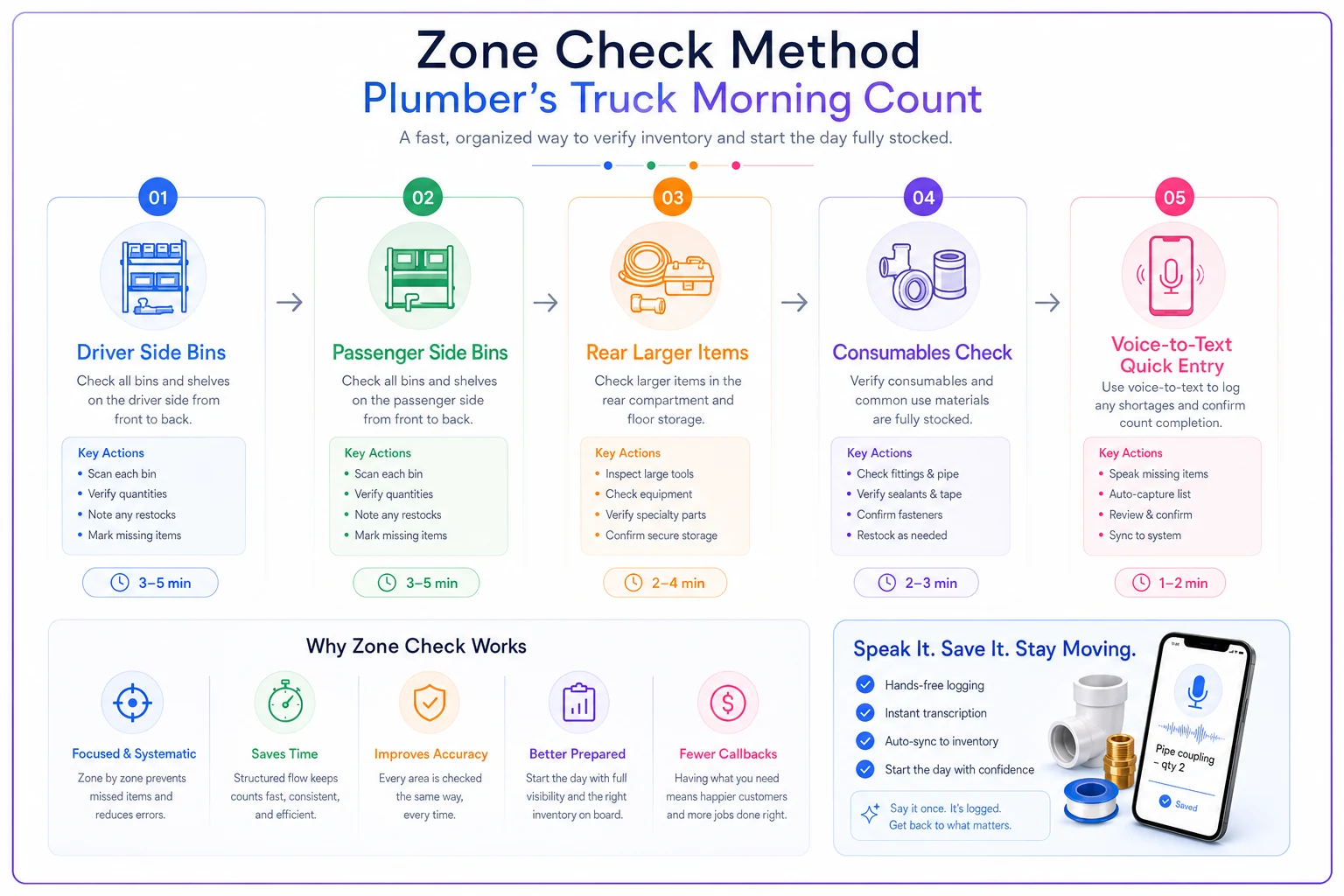
The Zone Check Method:
-
Zone 1 - Driver Side Bins (90 seconds) Open each bin, scan for obvious gaps. Don't count individual fittings. Check: Are my primary categories stocked to the fill line? Flag any bin below 50%.
-
Zone 2 - Passenger Side Bins (90 seconds) Same process. Quick visual on specialty parts. You're looking for empty sections, not counting washers.
-
Zone 3 - Rear Larger Items (60 seconds) Water heaters, expansion tanks, major equipment. Binary check: Do I have what I need for today's scheduled calls?
-
Zone 4 - Consumables Check (60 seconds) Solder, flux, sandpaper, primer, glue. Touch test—if the container feels light, it goes on the list.
-
Quick Entry (30 seconds) Voice-to-text the shortage list into your phone. "Low on half-inch couplings, out of expansion tanks, need Teflon tape."
This isn't a full count. It's a functional check that catches 80% of problems before they become field issues. Same order, same zones, every morning. Your brain starts recognizing patterns. After two weeks, techs can spot shortages without conscious thought.
Quick visual of the zone check workflow.
This isn't a full count. It's a functional check that catches 80% of problems before they become field issues. Same order, same zones, every morning. Your brain starts recognizing patterns. After two weeks, techs can spot shortages without conscious thought.
When Par Levels Need Seasonal Adjustments
Static par levels assume your business never changes. Your water heater installs spike 40% every October when people realize winter's coming. Drain calls drop in January when commercial clients slash maintenance budgets.
Build seasonal variations into your matrix upfront. Track your service mix by month for one full year. You'll see patterns like:
-
Water heater parts need 30% higher pars October through December
-
Sump pump supplies triple in March and April
-
Outdoor hose bibb repairs spike before first freeze warnings
-
Toilet repairs jump in November (holiday guest prep)
When you spot these patterns, pre-adjust inventory levels two weeks before the spike. Your techs stay stocked through the rush without emergency supply runs.
The adjustment process is simple: multiply your standard par by your seasonal factor. If historical data shows 40% more water heater calls in November, multiply those specific part pars by 1.4 for that month. Round up for critical items, round down for expensive ones.
Converting Paper Systems to Digital Reality
Par level matrices on paper work until they don't. The sheets get coffee-stained, lost in trucks, ignored after two weeks. But jumping straight to complex inventory software usually fails too.
Start with a basic spreadsheet that lives on tablets. Not fancy—just your matrices in Google Sheets with conditional formatting. Red cells when inventory drops below reorder points. Green when fully stocked. Yellow in the caution zone.
Techs update counts using dropdown menus or simple number entry. No typing part numbers, no complex forms. The sheet automatically calculates what needs restocking and can generate a pick list for your warehouse team.
Use dropdowns and conditional formatting to minimize typing and speed updates.
Once this simple digital system runs smoothly for 60 days, then consider specialized software. Most shops under 15 trucks don't need anything fancier. The spreadsheet version gives you 80% of the benefit with 10% of the complexity.
The transition trick: run both systems parallel for two weeks. Paper counts in the morning, digital entry at lunch. This catches discrepancies and builds the habit without risking service disruption.
Real Scenario: How Dynamic Par Levels Saved a 7-Truck Operation
A Houston plumbing company was bleeding money on truck rolls. Seven trucks, mostly residential service, averaging 1.4 trips per call. That's essentially failing 40% of the time.
Their problem wasn't lazy techs or bad dispatching. They were using a 10-year-old "master stocking list" that tried to prepare every truck for every situation. Drain specialists carried water heater parts they never used. New construction plumbers had bins full of repair fittings for fixtures they'd never see.
-
3 trucks optimized for drain cleaning and toilet repairs
-
2 trucks configured for water heater and gas work
-
2 trucks set up for general service and repairs
Each configuration had its own par levels, reorder points, and even bin layouts. Drain trucks had more small parts bins. Water heater trucks had larger storage for expansion tanks and venting materials.
The morning count process went from a 20-minute full inventory to a 5-minute zone check. Techs actually started doing it because it was fast and prevented their personal nightmare—explaining to customers why they needed to leave mid-job.
After 90 days, their first-time completion rate hit 89%. Not perfect, but that improvement meant roughly 300 fewer truck rolls per month. At $120 per wasted trip (fuel, time, opportunity cost), that's $36,000 monthly recovered. Inventory carrying costs actually dropped by $8,000 because they stopped overbuying "just in case" parts.
Common Mistakes That Break the System
The first mistake everyone makes: setting pars based on truck capacity instead of usage patterns. Just because you can fit 20 angle stops doesn't mean you should carry 20 angle stops. If you use three per week, carrying 20 is just expensive storage.
Another killer: not accounting for tech hoarding. When techs don't trust the resupply system, they start hiding parts. Check under seats, behind water heaters, in personal tool bags. One shop found $2,000 in brass fittings stashed in various hiding spots. The fix isn't punishment—it's proving the system works.
Ignoring theft and damage is surprisingly common. Parts walk off trucks, especially in certain neighborhoods. Fittings get damaged bouncing around. Build a 10-15% buffer into your pars for this reality.
The deadly mistake: letting dispatchers override the system during busy seasons. "Just throw extra parts on every truck" sounds reasonable when calls are backing up. But it destroys your data, enables hoarding, and creates chaos when things slow down.
Making Restock Runs Profitable, Not Painful
Supply house runs kill productivity, but they're sometimes unavoidable. Smart operations turn dead time into training time.
When a tech needs an emergency restock, they take the newest apprentice. That 20-minute drive becomes a parts education session. The apprentice learns what each fitting does, why certain brands matter, how to spot quality issues.
Some shops schedule "milk runs"—one person hits all trucks at lunch, collecting restock lists and doing one consolidated supply run. This cuts individual trips by 70% and lets techs stay in the field.
The best approach: designated restock windows. Every Wednesday, 3-5 PM, one tech per area handles all restocking for their zone. They're off emergency calls during this window. It's planned, efficient, and prevents the 4:30 PM scramble when everyone realizes they're out of something.
Technology That Enhances But Doesn't Overwhelm
You don't need complex systems to track inventory well. But the right simple tools make everything smoother. A basic barcode scanner app on phones lets techs quickly log what they use. Not for every fitting, but for key tracked items—expansion tanks, water heaters, disposals.
Photo documentation beats written lists for visual learners. Techs snap a photo of any bin that looks low. At day's end, they text the photos to whoever handles restocking. No counting, no typing, just visual proof of what needs attention.
Voice notes work great for consumables. "Truck 3, almost out of flux, low on sandcloth, need purple primer." Fifteen seconds to record, automatically transcribed if you use the right apps.
The goal isn't perfect tracking. It's reducing friction enough that techs actually participate. When the system takes more than five minutes or requires multiple steps, compliance drops to zero.
Building Accountability Without Micromanagement
Techs need ownership of their inventory, but constant checking destroys morale. The balance comes from clear expectations and natural consequences.
Make one tech per truck the "inventory captain." They own that truck's stock levels. Not responsible for counting every fitting, but accountable for maintaining pars and flagging issues. Rotate this role quarterly so everyone learns the system.
Weekly spot checks keep everyone honest without feeling punitive. Check three random parts per truck. Are they within par ranges? If yes, that tech gets a small bonus or preferred scheduling next week. If no, they help with the next restock run to see how the system works.
The real accountability comes from peer pressure. When Tech A has to bail out Tech B because of missing parts, the team self-corrects. Post first-time fix rates by tech weekly. Not to shame anyone, but to show how inventory impacts performance.
The Path From Chaos to Consistency
Getting from where you are to reliable par levels takes about 45 days if you follow this sequence:
-
Days 1-14
Data collection. Track every part used, every shortage, every emergency run. Don't change anything yet. Just document reality.
-
Days 15-21
Build your initial matrices. Use the 80/20 rule—focus on the 20% of parts causing 80% of shortages. Get these right first.
-
Days 22-35
Test with your best tech. Pick someone who'll give honest feedback. Run their truck on the new system while everyone else continues as normal.
-
Days 36-45
Roll out to all trucks, but keep the paper backup. Let techs see the system works before removing their safety net.
-
Day 46 onward
Full implementation with weekly refinements based on actual data.
This gradual approach prevents the chaos of overnight changes while building buy-in through proven results. The techs see their colleague having fewer problems, and they want the same advantage.
A good par-level system isn't about perfect inventory control. It's about giving techs what they need to solve problems on the first visit. When you match inventory to actual service patterns, track usage without creating burden, and build simple restock workflows, something interesting happens: your team stops thinking about parts and starts thinking about solutions.
The companies hitting 90%+ first-time fix rates aren't smarter or working harder. They've just built systems that eliminate predictable problems. Their techs trust the truck stock, so they focus on diagnosis instead of worrying about missing parts. Their dispatchers schedule confidently knowing trucks are properly equipped. Their customers experience professional service without frustrating delays.
Start with one truck, one service type. Build that matrix based on real usage. Test the five-minute count workflow until it's automatic. Then expand systematically.
The business impact compounds quickly. Fewer truck rolls means more capacity for profitable calls. Better first-time fix rates drive referrals. Lower inventory costs improve cash flow. But the biggest win might be operational calm—that feeling when your team trusts their tools and can focus on delivering great service instead of hunting for parts.
Ready to optimize your plumbing operations?
Join 500+ plumbing businesses using Plummerly to save time, reduce scheduling errors, and improve customer satisfaction.