


Your best technician just spent 47 minutes driving from North Phoenix to South Scottsdale, passed three other service calls along the way, and now dispatch is sending them back north for an emergency. Sound familiar?
Small plumbing operations get stuck between two bad options: dispatchers juggling appointments on paper maps (inefficient but flexible), or expensive routing software that costs thousands annually and needs constant tweaking. Most shops with 3-8 trucks need something in the middle—practical zone rules that actually work with how plumbing calls come in.
The shops running smooth operations aren't using fancy algorithms. They're using simple zone assignments paired with basic clustering rules that any dispatcher can follow. No PhD in logistics required.
The Hidden Math Behind Windshield Time
Let's break down what excessive drive time actually costs a typical 5-truck plumbing operation. Take an average Tuesday: each tech handles 6 calls, averaging 22 minutes drive time between stops. That's 2.2 hours per tech in the truck, not turning wrenches. Across your fleet, that's 11 hours of windshield time daily.
But plumbing is different from HVAC or electrical work—your mix of emergency calls, scheduled maintenance, and installations creates unpredictable patterns. A water heater failure in Zone A might pull your Zone B tech away for half a day. A simple faucet repair scheduled for 2pm might finish by 12:30pm, leaving a gap. Traditional route optimization assumes predictability that plumbing shops rarely have.
The real damage shows up in three places:
Lost revenue capacity: At $185 average ticket, each tech losing 2 hours daily to windshield time represents roughly $370 in unrealized revenue. Multiply that across your fleet for a month.
Tech burnout acceleration: Plumbers already work physically demanding jobs. Adding unnecessary driving stress—especially in traffic, looking for addresses, backtracking across town—pushes good techs toward other shops or industries.
Customer perception erosion: When Mrs. Johnson sees your truck pass her house at 10am but her appointment isn't until 3pm, she wonders about your operation's competence. These perception hits accumulate into online reviews.
Zone Assignment Rules That Actually Work
Forget perfect optimization. Small fleets need zone systems that balance efficiency with daily plumbing chaos.
Stop missing service calls and double bookings.
Plummerly helps you schedule, assign, and manage every plumbing job efficiently.
- Centralized job scheduling
- Technician dispatch & tracking
- Customer notifications
No credit card required
Start with natural boundaries your team already knows. Rivers, highways, major commercial districts—these create logical zone breaks. A shop in suburban Denver might use I-25 as the east-west divider and Highway 6 as the north-south split, creating four primary zones. Your dispatchers and techs probably already think in these terms.
The key is sizing zones for your call volume. A zone generating 12-15 calls daily can support one dedicated tech. Zones producing 6-8 calls might share a tech with an adjacent area. Here's a working example from a 4-truck shop in Tampa:
| Zone | Geographic Boundaries | Daily Call Average | Tech Assignment |
|---|---|---|---|
| North Tampa | North of Bearss Ave, West of I-275 | 11-14 calls | Tech 1 (primary), Tech 2 (overflow) |
| South Tampa | South of Kennedy, West of Downtown | 8-10 calls | Tech 2 (primary) |
| Westchase/Carrollwood | West of Veterans Expressway | 13-16 calls | Tech 3 (dedicated) |
| Brandon/Riverview | East of I-75 | 9-12 calls | Tech 4 (primary), Tech 1 (emergency backup) |
Start with major highways and rivers as zone dividers—your team already thinks in those terms.
Notice the overlap assignments. Pure zone dedication falls apart when emergency calls hit or techs call in sick. Build flexibility into the system from day one.
But zones alone don't solve the problem. You need clustering rules within zones.
Daily Clustering Tactics for Maximum Density
Dispatchers earn their keep here. Within each zone, group calls by proximity and time windows to create dense clusters.
The morning cluster typically includes:
-
Elderly customers who prefer early appointments
-
Commercial properties needing service before opening
-
Yesterday's incomplete jobs
-
Routine maintenance visits
Group these geographically tight—ideally within 2-3 miles. A tech starting at 7am should knock out 2-3 calls before 10am without excessive movement.
Midday gets trickier. Emergency calls start disrupting your clusters. Build buffer time between appointments, roughly 20-30 minutes per stop. This seems wasteful until you realize it prevents the cascade effect where one long job destroys the entire afternoon schedule.
Afternoon clustering focuses on residential repairs and installations. These typically run longer and have more flexible timing. Stack them geographically but leave bigger time cushions—45 minutes minimum between major jobs.
The clustering decision table:
Same-Day Assignment Logic:
-
Emergency within current cluster zone → Assign to zone tech immediately
-
Emergency outside zone but within 5 miles → Evaluate zone tech availability
-
Emergency requiring specific expertise → Override zone rules
-
Non-emergency same-day request → Add to tomorrow's cluster unless zone tech has opening
Next-Day Assignment Logic:
-
Check existing clusters for geographic fit
-
If no cluster match, start new cluster (minimum 2 calls to justify)
-
Time-sensitive appointments anchor new clusters
-
Flexible appointments fill gaps in existing clusters
A dispatcher following these rules can reduce average drive time by 30-40% without any software beyond basic scheduling tools.
Here's a simple workflow to visualize clustering.
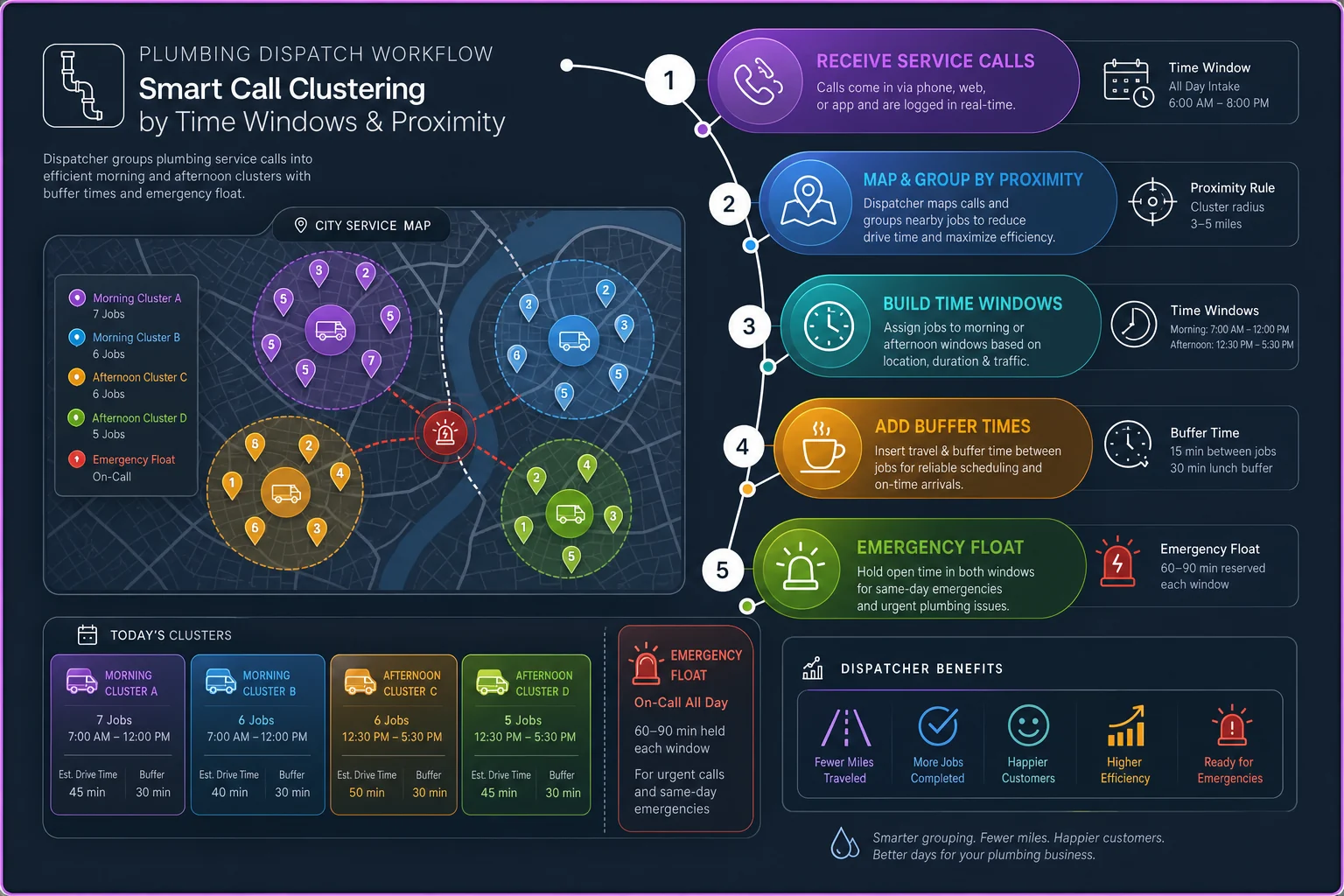
Keep it practical: morning density, midday buffers, and an afternoon sweep.
The Time Window vs. Utilization Tradeoff
Every plumbing shop faces this dilemma: tighter time windows make customers happy but destroy technician utilization. Promise Mrs. Chen a 10am-12pm window, and your tech might sit idle from 11am-11:45am if the job runs short.
The math gets uncomfortable quickly. Typical utilization rates by window strategy:
-
2-hour windows
65-70% tech utilization
-
4-hour windows
75-80% tech utilization
-
All-day windows
85-90% tech utilization
-
On-demand (no windows)
60-65% utilization but high overtime
Small shops often default to 4-hour windows as the compromise. But here's a better approach: vary windows by job type and customer segment.
Tight windows (2 hours) for:
-
Elderly customers
-
Commercial properties
-
High-value maintenance contracts
-
Second-attempt appointments
Flexible windows (4 hours) for:
-
Standard repairs
-
First-time customers
-
Non-urgent maintenance
Open windows (all-day) for:
-
Large installations
-
Diagnostic calls
-
Properties with gate codes or access issues
This variable approach maintains 75-78% utilization while keeping satisfaction high among your most valuable customer segments.
Building Your Zone Heuristics from Scratch
Stop trying to copy another shop's system. Your zone rules need to match your specific territory and customer base.
Map your last 60 days of service calls. Plot them on a physical map or use Google My Maps (free and simple). Look for natural clusters. Where do calls concentrate? Which areas generate emergency calls versus maintenance? Which neighborhoods have older homes needing more repairs?
Now overlay drive times. Not distance—actual drive time during your service hours. That suburban development 8 miles away might be 25 minutes during morning rush. The downtown cluster might be 10 minutes apart but parking adds 15 minutes per stop.
Create initial zones based on these patterns. Start conservative—better to have fewer, larger zones than too many small ones. You can always subdivide later.
Test the zones for a week without telling your techs. Track their natural movement patterns. Where do they deviate from zone boundaries? Those deviations usually highlight where your initial zones don't match operational reality.
Adjust boundaries based on actual data:
-
If techs consistently cross into adjacent zones, redraw the boundary
-
If one zone generates 40% more calls, split it
-
If two zones rarely fill a day's work, combine them
Within two weeks, you'll have working zones that match your operation's reality.
Sample Daily Schedules That Minimize Backtracking
A well-clustered day versus the chaos most shops accept as normal.
Typical Scattered Schedule (Tech 2, Tuesday):
-
8
00am - Water heater repair (North Austin)
-
9
30am - Toilet replacement (Central Austin)
-
11
00am - Drain cleaning (South Austin)
-
1
00pm - Faucet repair (North Austin)
-
2
30pm - Emergency leak (East Austin)
-
4
00pm - Garbage disposal (Central Austin)
Total windshield time: 2 hours 45 minutes
Total distance: 67 miles
Clustered Schedule (Tech 2, Tuesday):
-
8
00am - Water heater repair (North Austin)
-
9
45am - Faucet repair (North Austin, 1.2 miles away)
-
11
00am - Toilet replacement (North Austin, 0.8 miles away)
-
1
00pm - Lunch near next cluster
-
2
00pm - Drain cleaning (Central Austin)
-
3
30pm - Garbage disposal (Central Austin, 1.5 miles)
-
4
45pm - End day or handle emergency
Total windshield time: 55 minutes
Total distance: 31 miles
Same calls, different sequence. The clustered approach freed up nearly 2 hours of productive time.
The morning cluster keeps the tech in North Austin until lunch. The afternoon cluster handles Central Austin jobs in one sweep. The emergency call gets handled by the South Austin tech who's closer, or becomes tomorrow's first stop.
Common sense applied consistently.
When Your Current System Is Fighting Against You
Watch for these warning signs that your routing approach needs work:
Techs regularly ask to swap calls with each other. This means your initial assignments don't match geographic reality. When techs start horse-trading appointments in the morning huddle, your zones need adjustment.
The same addresses appear on different trucks throughout the week. If you're sending multiple techs to the same apartment complex or commercial plaza on different days, you're missing obvious clustering opportunities.
Afternoon schedules consistently run late while mornings have gaps. Your time estimates don't account for traffic patterns. That 15-minute drive at 7am becomes 35 minutes at 4pm.
Emergency calls create schedule dominoes. When one emergency tanks three other appointments, your buffer time is too tight or your zones are too rigid.
Dispatchers spend more than 30 minutes each morning plotting routes. If daily scheduling feels like solving a puzzle, your base rules are too complex. Good zone systems should make 80% of assignments obvious.
The Decision Framework for Route Changes
Not every efficiency gain is worth pursuing. Here's how to evaluate potential routing improvements:
Calculate the real impact first. If a change saves each tech 20 minutes daily, that's 1.67 hours per week, roughly 7 hours monthly. At $185 average ticket and 90-minute average job time, that's potentially 4-5 additional jobs monthly per tech. For a 5-truck fleet, we're talking 20-25 extra jobs monthly.
But consider implementation friction. Techs develop relationships with regular customers in their zones. Breaking those connections for marginal efficiency gains often backfires. Customers specifically request "the tall guy who fixed my shower last time."
Weigh training requirements. A complex new system might save 30 minutes daily but require two weeks of adoption time, during which efficiency actually drops. Simple zone rules that techs grasp immediately often outperform sophisticated systems that never get fully adopted.
Factor in flexibility needs. Plumbing work requires rapid response to emergencies. Rigid optimization that can't accommodate a burst pipe or sewage backup will frustrate everyone. Your system needs escape valves.
Making It Stick Without Management Software
Small shops often lack dedicated routing software, but you can implement zone-based clustering with basic tools.
Use a shared Google Sheet with tabs for each zone. Dispatchers drag appointments into time slots, keeping geographic proximity visible. Add a simple color code: green for confirmed, yellow for tentative, red for emergency additions.
Create a zone map and laminate it. Post copies in the dispatch office, break room, and trucks. When everyone visualizes the same zones, compliance improves naturally.
Build zone assignments into your phone system. "Press 1 for North County plumbing needs, Press 2 for Beach communities..." This pre-sorts incoming calls into the right clusters before dispatch even answers.
Print zone-specific price sheets and common parts lists. When Tech 3 knows they're covering Westside all week, they stock their truck accordingly. No more driving back to the shop for parts.
Share weekly metrics that matter. Post average drive times per zone, jobs completed per zone, and overtime hours by zone. Techs naturally compete to improve their zone's numbers.
These manual systems work surprisingly well for fleets under 10 trucks. Beyond that size, the complexity usually justifies proper routing software or an AI-powered operational platform that can handle dynamic clustering automatically.
Advanced Clustering Patterns for Mature Operations
Once basic zones are working, layer in sophisticated patterns that further reduce windshield time.
The "Maintenance Monday" pattern dedicates Mondays to preventive maintenance within tight geographic clusters. A tech might service 8-10 water heaters in a single condo complex or handle quarterly maintenance for an entire commercial strip. These predictable routes provide stability and efficiency.
The "Emergency Float" pattern keeps one tech deliberately unzoned, handling emergencies and overflow across all areas. This prevents emergency calls from destroying zone efficiency. The float tech expects drive time; other techs stay clustered.
The "Installation Team" pattern pairs techs for major jobs while maintaining zone integrity. Instead of pulling Tech 2 from South zone to help with a North zone water heater, the North zone tech partners with the float or a dedicated installation specialist.
The "End-of-Day Handoff" pattern transfers late-afternoon calls to techs who live near those zones. Tech 3 who lives in Westside handles the 5pm emergency there, while Tech 1 who lives downtown covers late calls in the central zone. Reduces overtime and improves response time.
Measuring What Actually Matters
Track these metrics weekly to gauge routing improvement:
-
Windshield time per job completed - Not total drive time, but average minutes driven per job. This accounts for varying daily job counts.
-
Jobs per tank of gas - Simple but effective. When techs complete more jobs per fuel tank, routing is improving.
-
Schedule adherence rate - Percentage of appointments kept within promised windows. Better clustering should push this above 85%.
-
Tech-initiated route changes - When techs stop requesting schedule swaps, your zones match reality.
-
Customer callbacks about timing - Reduced "where's my plumber?" calls indicate better clustering and realistic scheduling.
Skip complex metrics like "route optimization percentage" or "theoretical versus actual efficiency." These might impress investors but don't help daily operations.
The Realistic Path Forward
Perfect routing is a myth for small plumbing operations. But reducing windshield time by 25-35% is achievable with basic zone discipline and clustering rules.
Start tomorrow. Take your existing schedule and group jobs by proximity. Don't change anything else—just resequence based on geography. You'll immediately see 15-20% improvement.
Next week, establish rough zones based on your actual call patterns. Don't overthink boundaries. Pick obvious dividers your team already recognizes.
Within a month, implement clustering rules within zones. Morning density, afternoon flexibility, emergency protocols. Keep rules simple enough that any dispatcher can follow them.
After three months, evaluate and adjust. Which zones need splitting? Which clustering rules create problems? Where do techs naturally deviate?
The shops that struggle with routing are usually overthinking it. They want perfect optimization instead of consistent improvement. Meanwhile, their techs are driving in circles, burning fuel, and missing opportunities.
Zone-based clustering isn't fancy. It won't impress anyone at a trade show. But it works, scales with your business, and doesn't require a computer science degree to implement.
Your techs want to fix pipes, not fight traffic. Give them clustered routes that make sense, and watch both efficiency and morale improve. The sophisticated routing algorithms can wait until you're running 20+ trucks. For now, geography and common sense will take you surprisingly far.
Perfect routing is a myth for small plumbing operations. But reducing windshield time by 25-35% is achievable with basic zone discipline and clustering rules.
Start tomorrow. Take your existing schedule and group jobs by proximity. Don't change anything else—just resequence based on geography. You'll immediately see 15-20% improvement.
Next week, establish rough zones based on your actual call patterns. Don't overthink boundaries. Pick obvious dividers your team already recognizes.
Within a month, implement clustering rules within zones. Morning density, afternoon flexibility, emergency protocols. Keep rules simple enough that any dispatcher can follow them.
After three months, evaluate and adjust. Which zones need splitting? Which clustering rules create problems? Where do techs naturally deviate?
The shops that struggle with routing are usually overthinking it. They want perfect optimization instead of consistent improvement. Meanwhile, their techs are driving in circles, burning fuel, and missing opportunities.
Zone-based clustering isn't fancy. It won't impress anyone at a trade show. But it works, scales with your business, and doesn't require a computer science degree to implement.
Your techs want to fix pipes, not fight traffic. Give them clustered routes that make sense, and watch both efficiency and morale improve. The sophisticated routing algorithms can wait until you're running 20+ trucks. For now, geography and common sense will take you surprisingly far.
Ready to optimize your plumbing operations?
Join 500+ plumbing businesses using Plummerly to save time, reduce scheduling errors, and improve customer satisfaction.