

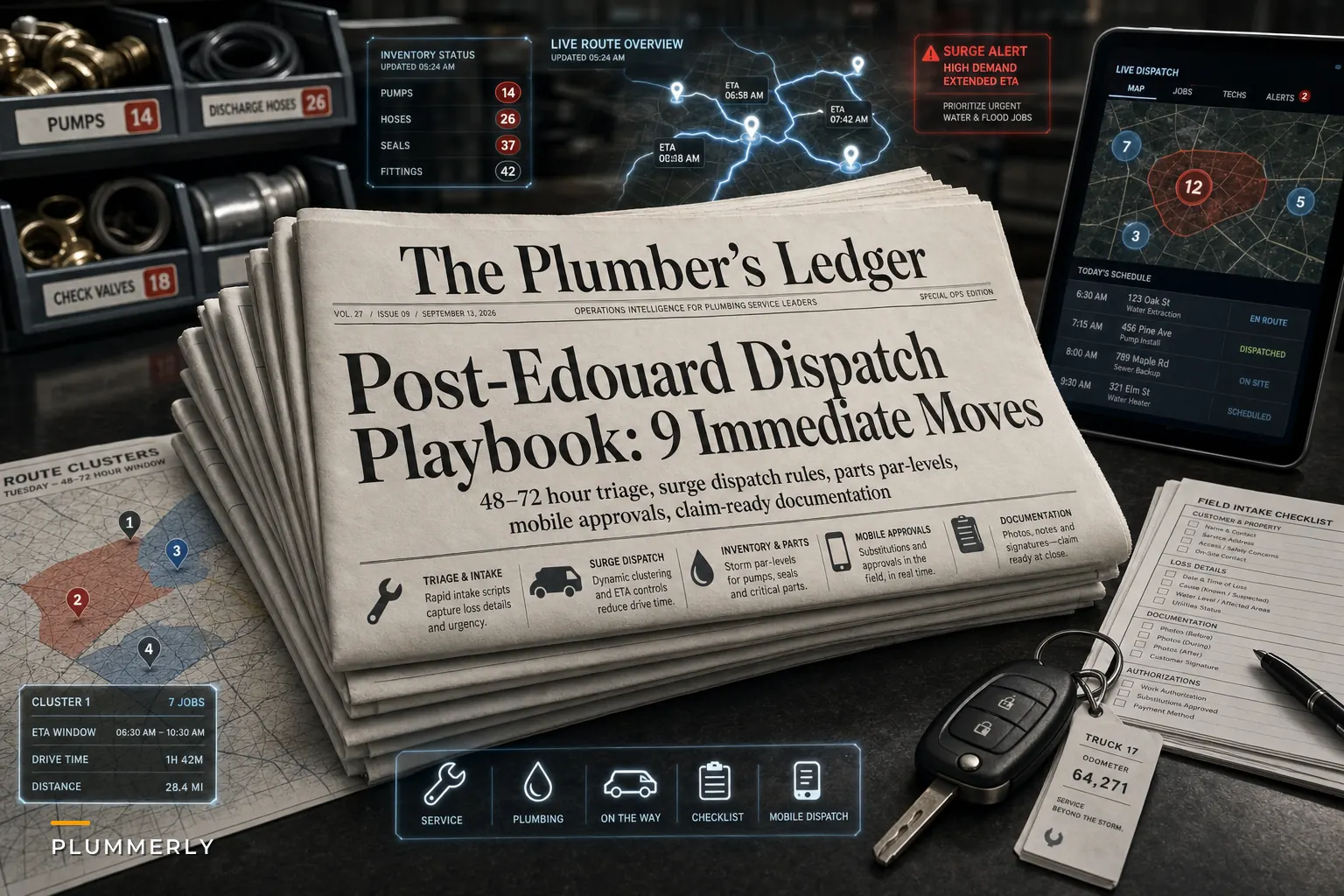

Edouard came ashore near the Texas–Louisiana border on September 1, dragging heavy rain, storm surge, and localized flooding across a stretch of Gulf Coast communities. NOAA's satellite team confirmed the landfall timing and track, and Reuters reported the immediate service disruptions in the affected corridor.
If you run plumbing trucks anywhere in that zone, you already know what's about to happen. The rain stopping isn't the event. The 72 hours after the water recedes is the event — that's when the phones blow up with backed-up mains, submerged water heaters, sump pumps that gave out at 2 a.m., check valves that failed, foundation drains overwhelmed. And that's also when most small shops quietly lose money they'll never track, because they run their storm week exactly like a normal week.
This isn't about storm prep. That window closed. This is about the operational moves that matter in the days right after, when demand outstrips your capacity and every decision about who to send where, what to stock, and how to charge either protects your margin or bleeds it. Post-storm operations reward the shops that change their playbook fast and punish the ones that don't.
The nine moves below are ordered roughly the way you should attack them: triage and dispatch first, because that's what's on fire right now, then inventory, then pricing and cash.
The real problem a storm exposes
A storm doesn't create new operational weaknesses. It amplifies the ones you already had.
If dispatch is loose on a normal Tuesday, it becomes chaos on a storm Wednesday. If your truck stock is "close enough" most weeks, it becomes a return-trip factory when every third call needs a check valve you don't carry. If your pricing is inconsistent between techs, that inconsistency turns into either angry customers or eroded margin the moment volume triples.
The shops that come out of storm weeks in decent shape aren't heroic. They just have tighter systems that hold up under load. Everyone else improvises, and improvising at 3x volume is where money disappears — in windshield time, in dead runs to the supply house, in emergency jobs quoted like routine service calls.
Move 1: Re-tier your calls before you touch the schedule
The single biggest mistake in the first 48 hours is treating every incoming call as a job to be scheduled in order. During a surge, arrival-order scheduling is a trap. You'll spend your best morning hours on a slow drip while three sewage backups sit in a queue getting angrier by the hour.
Stop missing service calls and double bookings.
Plummerly helps you schedule, assign, and manage every plumbing job efficiently.
- Centralized job scheduling
- Technician dispatch & tracking
- Customer notifications
No credit card required
You need a hard triage layer sitting in front of your schedule. Not a vague "we'll prioritize emergencies" — an actual tiering rule your intake person applies to every call in under a minute.
A workable storm-week tier structure:
| Tier | Trigger | Response target | Notes |
|---|---|---|---|
| 1 – Active hazard | Sewage backup, no water to occupied home, gas-adjacent water issue | Same day, first slots | Health/safety, bump everything |
| 2 – Property damage risk | Failed sump, active leak, submerged water heater | Same or next day | Damage clock is running |
| 3 – Loss of function | No hot water, single fixture down | 2–4 days | Real, but survivable |
| 4 – Non-urgent | Estimates, cosmetic, "when you get a chance" | Schedule after surge | Politely defer |
The key isn't the exact wording — it's that intake stops making judgment calls and starts applying rules. If you've never built a fast intake framework, the breakdown on emergency call triage with 60-second intake scripts and response tiers walks through the exact scripting logic. Storm week is when that discipline pays for itself.
One thing worth noting: shops that defer Tier 4 calls with a firm date ("I've got you on the list for the 8th, and I'll call if we free up sooner") lose almost none of them. Customers understand a storm. What they don't forgive is being promised "tomorrow" three days in a row.
Move 2: Re-cluster routes around access, not geography
Your normal zone map is essentially useless for a few days. Roads flood, some neighborhoods are completely inaccessible, and a route that's 20 minutes on a dry Tuesday might be an hour-long detour around a closed underpass.
Rebuild your clustering around what's actually drivable, not just proximity. Before you send a single truck, mark which zones are reachable and group jobs by accessible pockets rather than your usual grid.
In practice, this falls apart because dispatch assigns jobs in the morning and never revisits them as conditions shift through the day. A road that's passable at 8 a.m. floods again with the afternoon tide, and now your tech is stranded across town from his next three stops. Someone in the office needs to own a live picture of what's accessible and re-sequence in real time. On a storm day that's a full-time role, not a background task.
Move 3: Blow up your normal truck par-levels — temporarily
Storm week consumption patterns look nothing like a normal week. The parts that move are wildly different: sump pumps, check valves, backflow preventers, PVC fittings, flex connectors, water heater components. Running your standard par-level matrix during an abnormal week means you're perfectly stocked for jobs that aren't coming and empty on the ten parts every storm call needs.
Set a temporary storm par-level for 7–10 days. A rough starting point per truck for a Gulf Coast storm response:
-
Sump pumps (2 common sizes) — 2–3 units
-
Check valves — 6–8
-
Backflow and flood-related fittings — a stocked bin, not "grab a few"
-
Water heater elements, thermostats, T&P valves — doubled
-
Flex connectors and supply lines — doubled
-
PVC/ABS fittings in common storm sizes — bulk it up
The point isn't these exact numbers. It's the mindset shift. You're stocking for the storm's specific failure pattern, not your annual average. And when a substitution will save a second trip, take it — a return run during a surge costs you a whole other billable job you'll never get to.
Move 4: Assign one person to own the supply house relationship
Everyone in your market is hitting the same three suppliers for the same ten parts. Shelves empty fast. The shops that stay stocked are the ones where a single person owns supplier communication and gets ahead of shortages instead of discovering them at the counter.
That means calling your primary supplier before your first run to confirm what's actually in stock, placing a standing order on the fast-moving storm items, and lining up a secondary and tertiary source before you need them. When your main branch runs out of sump pumps on day two — and it will — the shop that already knows which other branch has fifteen in stock keeps working while everyone else waits around.
This makes sense for any shop running more than two trucks during a surge. For a solo operator, it's probably overkill — but even solo, keep a written fallback list of alternate suppliers somewhere accessible.
Move 5: Decide your surge staffing model on day one, not day three
You have three levers when demand outruns capacity: run overtime, subcontract, or defer. Most shops default to overtime by accident, burn their techs out by day four, and never consciously decided anything.
-
Estimate the surge — pull yesterday's call count and roughly double or triple it based on flooding severity in your zones.
-
Calculate your real capacity — honest jobs-per-truck-per-day at storm pace, which runs lower than normal because of drive time and job complexity.
-
Size the gap. If you can handle 24 jobs a day and you're fielding 60 calls, overtime alone won't close it. You need subs or aggressive deferral.
-
Line up subcontractors before the gap opens. The good ones get booked in the first 24 hours.
-
Set a hard OT ceiling so you don't torch your crew before the week's over.
The shops that quietly win storm weeks made peace early with the fact that they cannot take every job, and chose which ones to let go on purpose rather than by exhaustion.
Move 6: Standardize storm pricing before the first quote goes out
This is where inconsistency does the most damage. When three techs quote the same flooded water heater swap three different ways during a chaotic week, you get some combination of underpriced jobs, customer complaints, and eroded margin — and you won't spot it until you're reconciling invoices two weeks later.
A few pricing realities for storm response:
-
After-hours and emergency work carries a rate that reflects actual cost — overtime labor, expedited parts, added complexity. If you don't have a defined emergency rate, you're effectively subsidizing the storm out of your own margin.
-
Storm-driven parts costs can spike mid-week. Build a small buffer into your parts pricing so a supplier price jump doesn't quietly turn a profitable job into a loss.
-
Do not gouge. Beyond the ethics, several states enforce price-gouging laws during declared emergencies, and the reputational damage in a tight-knit coastal community outlasts any short-term gain. There's a clean line between fair emergency pricing and exploitation. Stay well on the right side of it.
The move here is a single, written storm rate sheet every tech quotes from. Consistency protects both your margin and your reputation at exactly the moment both are most exposed.
Move 7: Tighten cash terms while the risk is high
Storm weeks generate a lot of larger, unplanned jobs from customers who are stressed and waiting on insurance. That's a real accounts receivable risk. The fix is small policy changes for the duration:
-
Deposits on larger emergency jobs — anything over a threshold you set. This isn't distrust; it covers your parts outlay when you're buying at surge prices.
-
Collect on completion for standard work, same as always, but be strict about it during the surge.
-
Clear terms for insurance-pending jobs. Decide up front whether you'll wait on a claim or require payment with the customer reimbursed later. Waiting on dozens of open claims simultaneously is how a busy storm week turns into a cash crunch six weeks later.
Say all of this at intake, not at the door. A customer who hears "there's a deposit for emergency work" on the phone is fine with it. A customer who hears it from a tech standing in their flooded kitchen is not.
Move 8: Document everything for the insurance wave that's coming
A significant share of storm work ends up in an insurance claim. If your documentation is thin, your customer's claim stalls — and a stalled claim means your invoice sits unpaid for weeks.
Build documentation into every storm job as a non-negotiable step: photos of the failure and the water line, the cause where visible, model and serial numbers, a written description of what failed and what you did. This protects the customer, speeds their reimbursement, and gets you paid faster. During a surge it's tempting to skip it to save five minutes. That's exactly the shortcut that comes back as a payment dispute in October.
Move 9: Communicate proactively so your phone stops eating your day
During a surge, a large portion of your inbound calls aren't new jobs — they're existing customers asking "are you still coming?" Every one of those calls pulls your intake person off actual triage.
Get ahead of it. When you book a storm job, set an honest expectation and update proactively:
-
Confirm the appointment window at booking, and be real about it — an honest "sometime Thursday" beats a fake "first thing tomorrow."
-
Send a heads-up when the tech is genuinely on the way.
-
If you're running behind — and you will be — reach out before the customer calls you.
Shops that communicate proactively during storms cut their inbound "where are you" volume significantly, which frees the office to actually run triage. Silence during a surge doesn't read as "they're busy." It reads as "they forgot about me," and that's the customer who leaves a one-star review while sitting in an inch of water.
Where the right systems quietly carry the load
Nothing above requires software to execute. Plenty of good shops run a storm week on a whiteboard and a hard-working office manager. But the friction points are always the same ones that get harder as volume climbs: keeping triage tiers consistent across every call, re-sequencing routes as roads flood and clear, tracking which parts each truck is burning through, firing off status updates without pulling someone off the phones.
This is where a workflow platform that centralizes dispatch, live routing, mobile parts tracking, and automated customer messaging stops being a nice-to-have. When your dispatcher can see every truck, every job's status, and every accessible zone in one place — and when appointment updates go out automatically instead of one call at a time — a storm week runs on system instead of adrenaline. The value isn't the technology itself. It's that consistency holds up under load, which is exactly when it usually breaks.
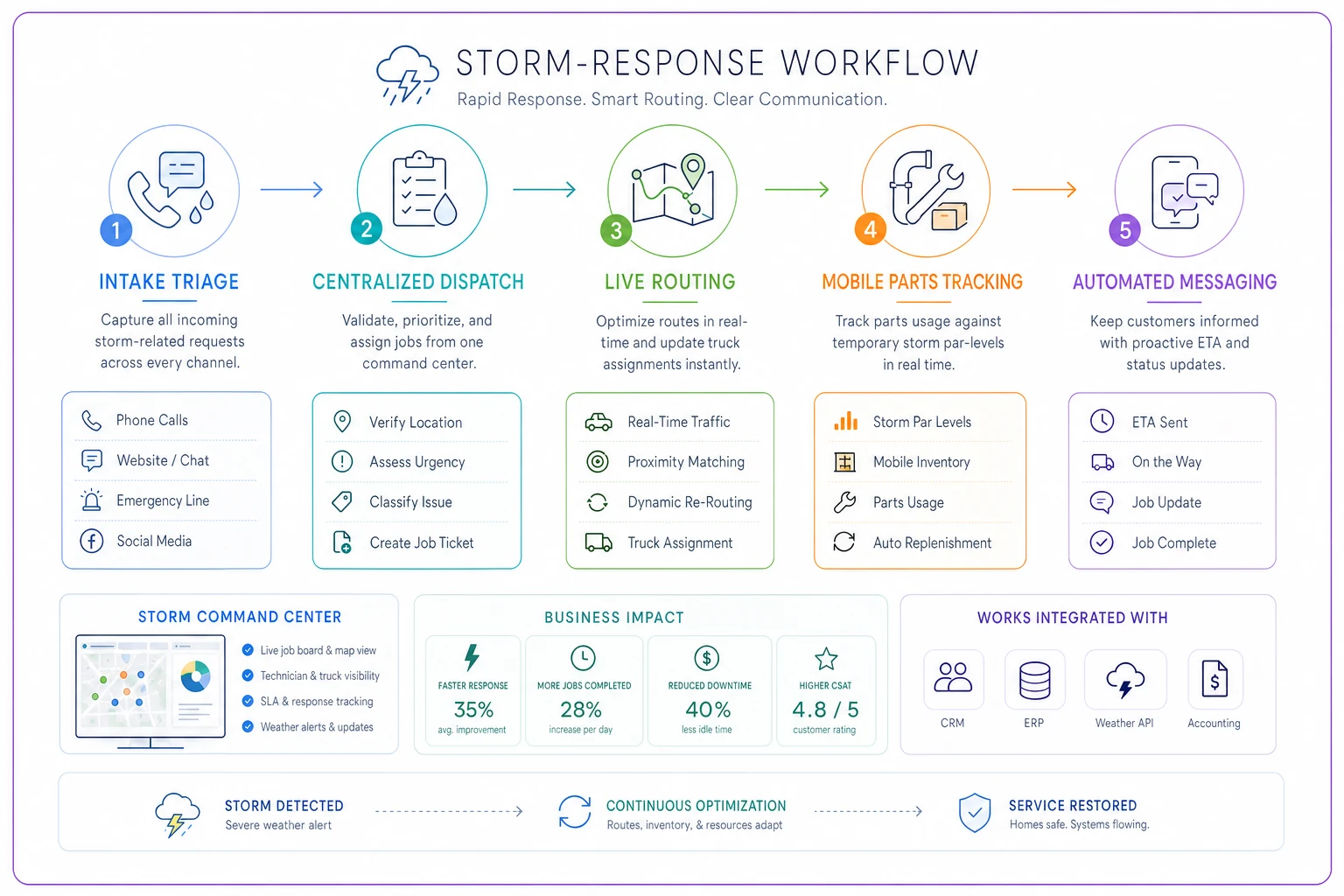
A simple diagram showing dispatch → live routing → parts tracking → automated messaging makes the flow clear for any manager.
A realistic storm-week snapshot
Consider a four-truck shop just inside the flooded corridor. Normal volume is around 20 calls a day. The two days after Edouard, they're fielding closer to 55–60.
Run it the normal way: first-come scheduling, standard truck stock, techs quoting off memory. Trucks make multiple supply-house runs a day for parts they didn't stock, the office spends half its time answering "are you still coming," and a handful of emergency jobs get quoted at routine rates. They clear maybe 22–24 jobs a day and finish the week exhausted, with a stack of underpriced invoices and a few unhappy customers.
Run it with the moves above: triage tiers protect the high-value, high-urgency jobs; storm par-levels cut the dead supply runs down sharply; one storm rate sheet keeps every quote consistent; proactive texts kill most of the inbound noise. Same trucks, same techs — but now closer to 32–36 jobs a day, at correct pricing, with cleaner documentation and a customer base that remembers the shop showed up and communicated when it mattered.
Same storm. Same crew. The gap is entirely operational.
Storms don't reward the biggest shop or the one with the most trucks. They reward the shop whose systems hold up when volume spikes and everything gets harder at once. Edouard is doing what every Gulf storm does — turning small, tolerable operational gaps into expensive ones, fast.
The nine moves here are all reversible. Re-tier your calls, re-cluster your routes around what's actually accessible, spike your par-levels temporarily, get deliberate about staffing and pricing and cash, document relentlessly, and over-communicate. Then, when the water's gone and the phones settle, roll most of it back to normal — and keep the two or three things that worked so well you wonder why you weren't running them all year.
Ready to optimize your plumbing operations?
Join 500+ plumbing businesses using Plummerly to save time, reduce scheduling errors, and improve customer satisfaction.