

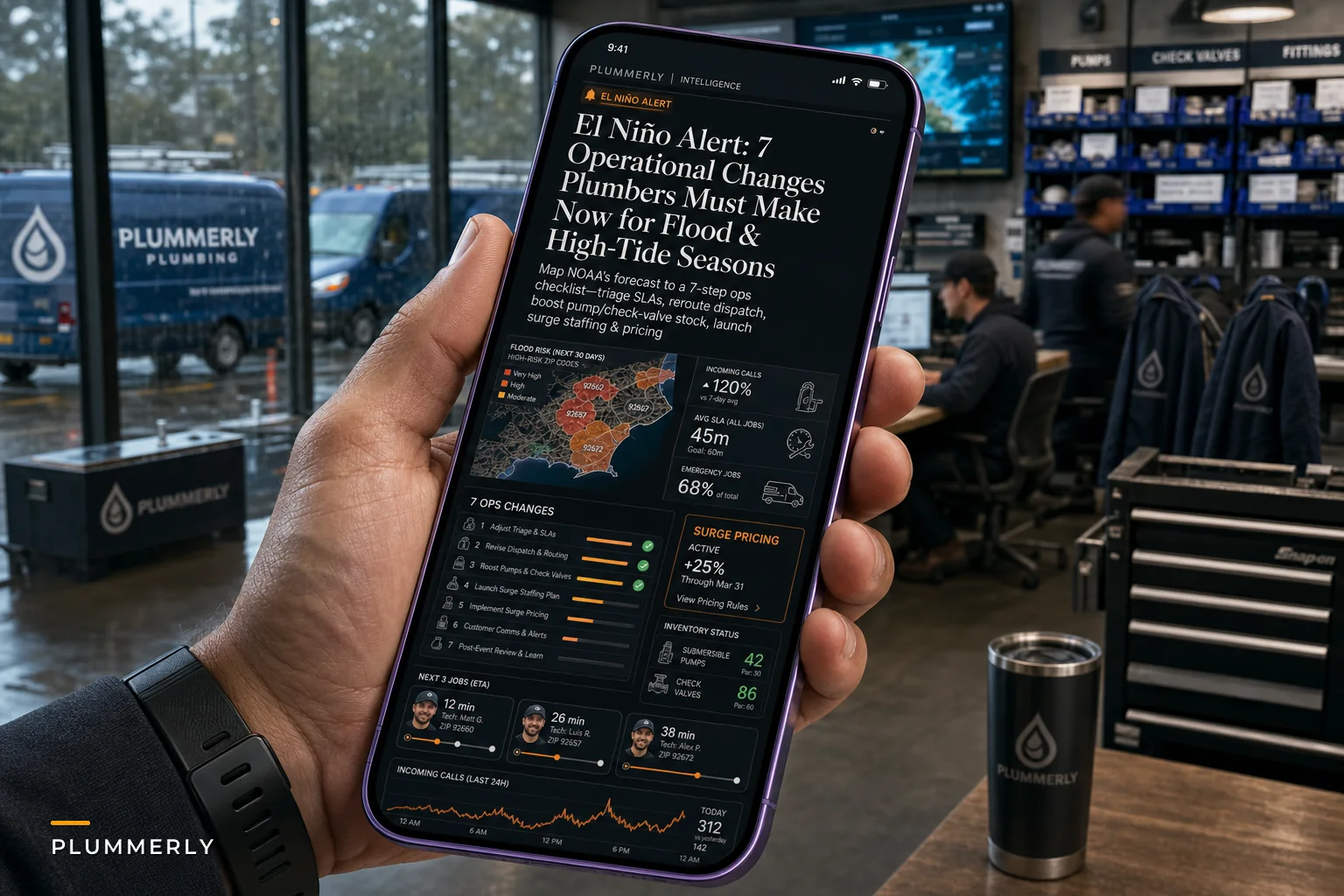

Last Tuesday, NOAA dropped their El Niño forecast right before hurricane season kicks off June 1st. While everyone's talking about fewer hurricanes this year, they're missing what actually matters for plumbing operations: El Niño means coastal flooding, overwhelmed storm drains, and sewer backups happening in places that rarely see them.
One contractor in Charleston went from handling maybe eight sump pump calls a week to getting forty-three in three days during the 2015-2016 El Niño. His trucks ran out of check valves by noon on day two. Two of his best techs quit the following week because they'd been working eighteen-hour days with no warning.
The operational chaos that's coming isn't from hurricanes - it's from high-tide flooding combining with unusual rainfall patterns that El Niño brings to coastal areas. Your regular commercial clients with basement mechanical rooms? They're about to panic-call you at 2 AM when saltwater starts seeping through foundation walls during king tides.
Why this El Niño hits different for plumbing operations
NOAA's analysis shows that El Niño amplifies high-tide flooding by 15-20% in many coastal communities. That doesn't sound like much until you realize it's the difference between water staying in the street versus pushing through every ground-level opening in buildings.
What really breaks operations is the timing overlap. You'll get morning high-tide flooding calls starting around 5 AM, afternoon thunderstorm drainage failures around 3 PM, evening backup emergencies when everyone gets home and runs dishwashers, plus overnight commercial sump pump failures when nobody's watching buildings. Your normal dispatch rhythm completely falls apart.
The standard morning meeting becomes useless when half your scheduled maintenance appointments are getting bumped for water emergencies. Everything you think you know about scheduling gets thrown out the window.
The seven changes that actually matter
1. Rebuild your parts matrix for water intrusion jobs
Stop missing service calls and double bookings.
Plummerly helps you schedule, assign, and manage every plumbing job efficiently.
- Centralized job scheduling
- Technician dispatch & tracking
- Customer notifications
No credit card required
Forget your normal truck stocking levels. During El Niño flood periods, you burn through specific parts at rates that make no sense based on historical data.
A single residential backup job might need multiple check valves in different sizes, several feet of PVC in various diameters, multiple rubber couplings, a backflow preventer, new cleanout cap, and possibly a sewage ejector pump.
Now multiply that by twenty calls per truck per week instead of your normal three. Your usual Tuesday parts run becomes a daily scramble, and wholesalers run out of the exact fittings everyone needs simultaneously.
Stock these specifically:
-
3" and 4" check valves (triple your normal inventory)
-
Rubber couplings in every half-inch size from 1.5" to 4"
-
Submersible pumps in 1/3 HP and 1/2 HP
-
Backwater valves
-
Test plugs for drain testing
Don't just increase quantities - pre-position backup stock at multiple locations. When three trucks need check valves at 8 PM and your shop is forty minutes away, that forward-positioned inventory saves entire jobs.
2. Create flood-specific dispatch tiers
Your normal emergency triage system breaks when every call sounds like priority one. The homeowner with two inches of water in their finished basement feels their situation is just as critical as the restaurant with sewage backing up into the kitchen.
Build new tiers specifically for flood scenarios:
| Tier | Response Time | Situations |
|---|---|---|
| Tier 1 | Under 30 minutes | Active sewage backup in occupied spaces, commercial food service with any backup, medical facilities with water intrusion, electrical panels or HVAC equipment actively submerged |
| Tier 2 | 2-4 hours | Clean water in basements over 1 inch deep, sump pump failures with rising water, multi-family buildings with drainage issues, storm drain backups affecting multiple properties |
| Tier 3 | Next day | Sump pump replacements (still working but old), preventive backflow valve installations, drain cleaning for slow-flowing systems, foundation leak repairs without active water |
During El Niño events, you explicitly tell Tier 3 callers they're looking at 24-48 hour wait times. Set expectations immediately or watch your online reviews tank when desperate customers think "emergency service" means two-hour response for every call.
3. Restructure crew scheduling for 18-hour coverage
Normal 7 AM to 5 PM coverage leaves money and reputation on the table during flood events. But running 24/7 burns out crews within a week.
The sustainable model runs three overlapping shifts. Early crew works 5 AM to 2 PM. Day crew covers 10 AM to 7 PM. Evening crew handles 3 PM to midnight.
That four-hour overlap between shifts handles the absolutely brutal 3-7 PM window when everything goes wrong simultaneously. Homeowners getting home, afternoon storms hitting, commercial buildings switching from cooling to idle mode revealing drainage issues - it all stacks up in those hours.
Pay structure matters here. Flat overtime rates make techs hunt for hours initially, then burn out and call in sick. Instead, offer surge bonuses for completed flood calls: extra $75 for Tier 1 completion, $50 for Tier 2. Techs stay motivated to close jobs rather than milk hours.
4. Pre-position equipment caches strategically
Your trucks become mobile warehouses during flood season, but they can't carry everything. Smart operators pre-position equipment at strategic points around their service area.
Rent small storage units or make deals with friendly customers for temporary storage areas. Each cache needs two submersible pumps, 200 feet of discharge hose, five check valves in various sizes, basic PVC fitting assortment, wet/dry vacuum, sandbags or water barriers, and at least one generator per cache location.
Map your cache locations against historical flood zones and typical traffic patterns. A crew stuck in flood traffic for ninety minutes loses three potential service calls. Having equipment ten minutes away changes everything.
5. Modify customer communication protocols
During normal operations, customers expect updates every few hours. During flood events, anxiety drives them to call every thirty minutes asking for ETAs. Your office staff drowns in repeat calls while techs can't work because phones won't stop ringing.
Implement automated status messaging. When customers book flood-related calls, automatically send initial confirmation with realistic time window, two-hour-out notification, thirty-minute arrival warning, and job completion summary with photos.
More importantly, create a flood status page on your website updated every two hours. Show current response times by area, number of crews working, approximate wait times by service tier, and parts availability status.
This transparency reduces panic calls by about 60%. Customers still anxious, but they stop treating your dispatcher like their personal anxiety counselor.
6. Build surge pricing into contracts now
Nobody wants to look like they're gouging during emergencies, but El Niño flood demand breaks your normal economics. Parts cost more due to scarcity. Labor costs spike with overtime. Insurance claims create longer payment cycles.
Implement transparent surge pricing before the crisis hits. Standard rates apply when normal weather conditions exist, standard parts are available, and regular scheduling is possible.
Surge rates apply when official flood warnings are active, response times exceed 4 hours for Tier 1 calls, or parts wholesalers report shortage conditions. Emergency rates apply for after-midnight calls, calls requiring immediate response jumping queue, or jobs requiring specialized flood equipment.
Publish this structure now. Email it to your customer list. Post it prominently. When floods hit and everyone needs service, customers already understand the pricing model rather than feeling ambushed.
7. Establish overflow partnerships before you need them
That competitor you sort of hate? You're about to need each other. During peak El Niño flooding, no single operation can handle their entire customer base plus emergency influx.
Create formal overflow agreements covering which types of calls you'll share, commission or referral fee structure, parts sharing protocols, quality standards both maintain, and how you'll handle warranty issues.
Three-company partnerships where each handles specific flood zones on rotating days work well. Monday, Company A takes everything north of downtown while B and C handle their regular zones plus A's overflow. Tuesday rotates. This prevents any single operation from completely collapsing.
The profit opportunity everyone misses
What separates operators who thrive during El Niño from those who merely survive: maintenance contract modifications sold right now, before panic hits.
Every customer with a basement, every commercial building at or below grade, every property in even marginal flood zones needs proactive service. But selling "flood insurance" feels scammy. Instead, expand existing maintenance agreements with "El Niño Preparedness Addendums."
These include quarterly sump pump testing and impeller cleaning, annual backflow preventer installation or inspection, priority response guarantees during flood events, pre-negotiated surge pricing caps where they pay 1.25x instead of 2x, and dedicated parts allocation from your forward-positioned stock.
Price these at roughly $35-45 monthly add-on for residential, $150-300 for commercial. A modest 200 customers signing up generates an extra $8,000 monthly baseline. More importantly, these prepaid agreements reduce emergency call volume by catching issues before flood conditions trigger failures.
The scheduling technology gap that kills flood response
Manual dispatch boards cannot handle El Niño flood patterns. You're juggling regular maintenance, emergency calls, parts availability, tech locations, and traffic conditions that change by the minute. Your dispatcher spending four minutes figuring out which tech should handle which call means twelve other calls backing up.
This is where AI-powered operational software becomes essential, not luxury. Modern platforms handle dynamic routing based on real-time conditions - automatically adjusting when a tech gets stuck in flood traffic or runs out of specific parts. They track which trucks have check valves left, who's certified for backflow preventer installation, and which crews are approaching overtime limits.
The automation also manages customer communication, sending those updates without anyone touching a keyboard. When integrated with parts inventory, the system alerts when specific trucks need restocking before they run out, not after.
During the 2015 El Niño, shops running manual dispatch averaged eleven-hour response times for Tier 2 calls by day three of flooding. Operations with automated routing and dispatch maintained sub-five-hour response times throughout.
The three-week implementation sprint
You have roughly three weeks before hurricane season officially starts and El Niño conditions potentially trigger the first flood events.
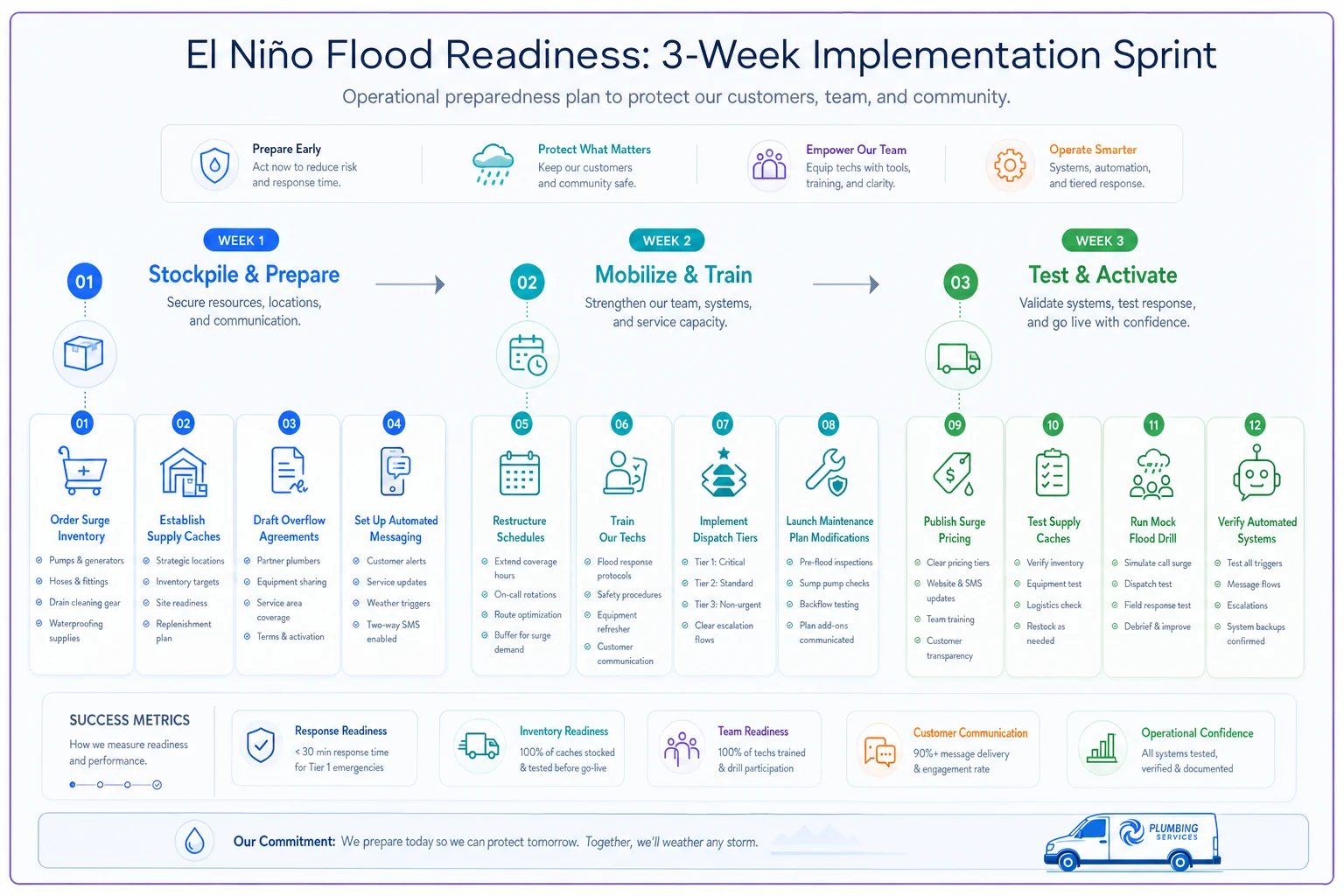
Week 1 requires ordering surge inventory focusing on check valves and pumps, establishing two forward-positioned equipment caches, drafting overflow partner agreements, and setting up basic automated customer messaging.
Week 2 means restructuring schedules for extended coverage, training all techs on flood-specific procedures, implementing new dispatch tiers, and launching maintenance plan modifications to existing customers.
Week 3 involves publishing surge pricing structure, testing equipment cache accessibility, running mock flood-response drill, and verifying automated systems functioning.
Here's a quick implementation workflow.
Don't try to perfect everything. Get basic systems operational then refine as you go. The shop that's 70% ready beats the shop still planning when the first flood hits.
This isn't a one-storm preparation - it's restructuring for an extended operational surge that could define your business trajectory.
Beyond this season
El Niño patterns typically last 9-12 months, sometimes extending to 18 months. The changes you make now for El Niño flood response become competitive advantages even during normal operations. That inventory forward-positioning helps with regular emergencies. The automated dispatch system improves everyday routing. The surge pricing structure sets precedent for future demand spikes.
Customers remember who showed up during the floods. The three AM sewage backup you handle professionally becomes a ten-year commercial maintenance contract. The panicked homeowner whose basement you pump out tells six neighbors about your response time.
Every El Niño creates market share shifts that last for years afterward. The prepared operators capture territory from overwhelmed competitors and never give it back. The question isn't whether flood calls are coming - NOAA's made that clear. The question is whether you'll be taking those calls or watching competitors handle your customers because you couldn't respond fast enough.
The clock's ticking. Hurricane season starts June 1st, and El Niño doesn't care if you're ready.
Ready to optimize your plumbing operations?
Join 500+ plumbing businesses using Plummerly to save time, reduce scheduling errors, and improve customer satisfaction.