

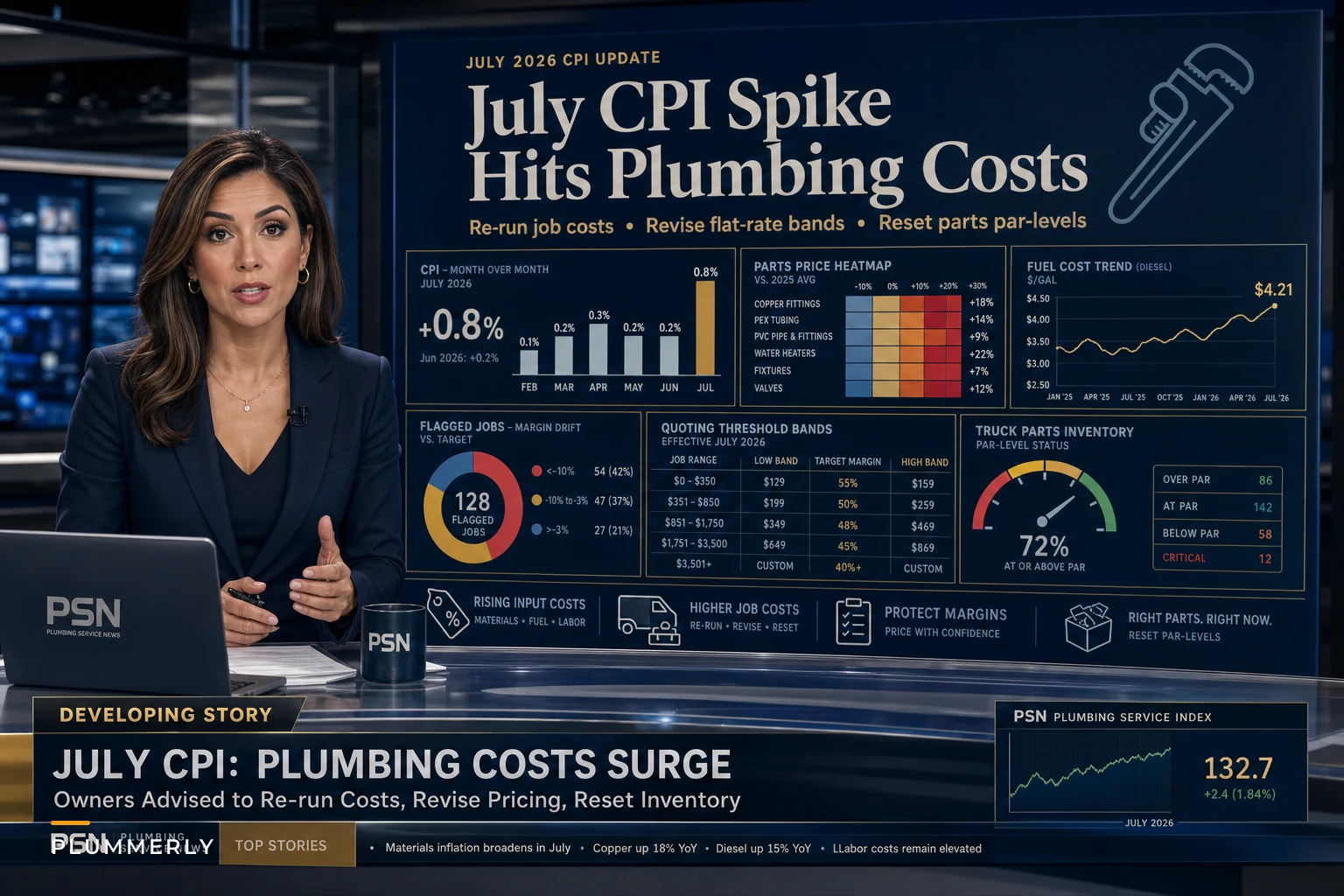

The July 2026 CPI came in soft — headline prices up just 0.1% month-over-month, running 3.4% year-over-year per the BLS release from August 12. A tenth of a percent sounds like nothing. Most owners glance at that number and move on.
That's the trap. The headline figure is an average across the whole economy — groceries, rent, airfare, used cars. It has almost nothing to do with what you're actually paying for a 3/4" ball valve, a wax ring, or a tank of diesel this month. The categories that feed a plumbing P&L move on their own schedule, and they rarely track the top-line print.
The real question isn't whether inflation is up or down. It's whether your flat-rate menu, your par-levels, and your payment terms are calibrated to prices you're paying right now — or to prices from whenever you last touched the spreadsheet, probably sometime last year.
The headline number lies to plumbers specifically
When CNBC broke down the July report, most of the coverage focused on consumer sentiment and interest rate implications. Useful if you're buying a house. Nearly useless if you're pricing a water heater swap.
The categories that actually hit a plumbing business — copper and steel, PVC and fittings tied to petrochemicals, fuel, wages — don't move in lockstep with a 3.4% average. Brass fittings can jump 8–12% over a stretch where headline inflation barely budges, simply because copper spot prices ran ahead of everything else. That happens more than people realize.
A "calm" CPI month can quietly hide a spike in exactly the line items that eat your margin. The plumbers who get burned are the ones who read "inflation is cooling" and assume their pricing is safe for another year.
The move isn't to react to the CPI print. It's to use it as a reminder to re-check your own inputs — because your costs and the national average are two genuinely different animals.
Where the pressure actually shows up on a plumbing job
Break a typical single-visit residential job into its cost components and you can see which pieces the current environment is squeezing:
Stop missing service calls and double bookings.
Plummerly helps you schedule, assign, and manage every plumbing job efficiently.
- Centralized job scheduling
- Technician dispatch & tracking
- Customer notifications
No credit card required
| Cost component | Sensitivity to current backdrop | Where it hides |
|---|---|---|
| Copper/brass fittings & valves | High — commodity-driven, moves fast | Small parts you don't re-price often |
| PVC/ABS pipe & fittings | Moderate — petrochemical-linked | Bulk stock, easy to ignore per-job |
| Fixtures (faucets, toilets, heaters) | Moderate — supplier list price creep | Manufacturer price letters |
| Fuel / vehicle operation | Volatile month to month | Drive time buried in overhead |
| Technician wages | Sticky upward — rarely comes back down | Loaded labor rate |
| Consumables (solder, tape, sealant) | Low individually, adds up | Rounding error you never audit |
The pattern worth noticing: the fast-moving, high-sensitivity items are usually the small parts — the fittings and valves nobody re-prices because they're "only a few bucks." A wax ring going from $3 to $4 feels trivial. Multiply that kind of creep across every small part on 300-plus jobs a year and it's real money leaking out quietly.
Wages are the other one people misread. Real earnings pressure doesn't reverse when inflation cools. Once you've bumped a tech's pay, it stays bumped. Your loaded labor rate ratchets up and holds — which means a menu built on last year's labor cost is already underwater.
Re-run your job costing before you touch the menu
The instinct when costs rise is to raise prices. That's actually the wrong order. You can't intelligently reprice anything until you know your current true cost per job. Otherwise you're guessing, and guessing usually means either leaving money on the table or putting out a number that confuses customers.
If it's been more than six months since you rebuilt your numbers from scratch, start there. Our job costing template for single-visit residential plumbing walks through the actual calculations — materials, loaded labor, overhead absorption, and margin targets. Run a handful of your most common jobs through it with today's invoice prices, not what you remember paying.
What usually turns up: owners find two or three jobs — often the water heater install and the main-line clear — have quietly dropped 4–7 margin points since they last checked. Not because anything dramatic happened. Just because inputs drifted and the menu didn't follow.
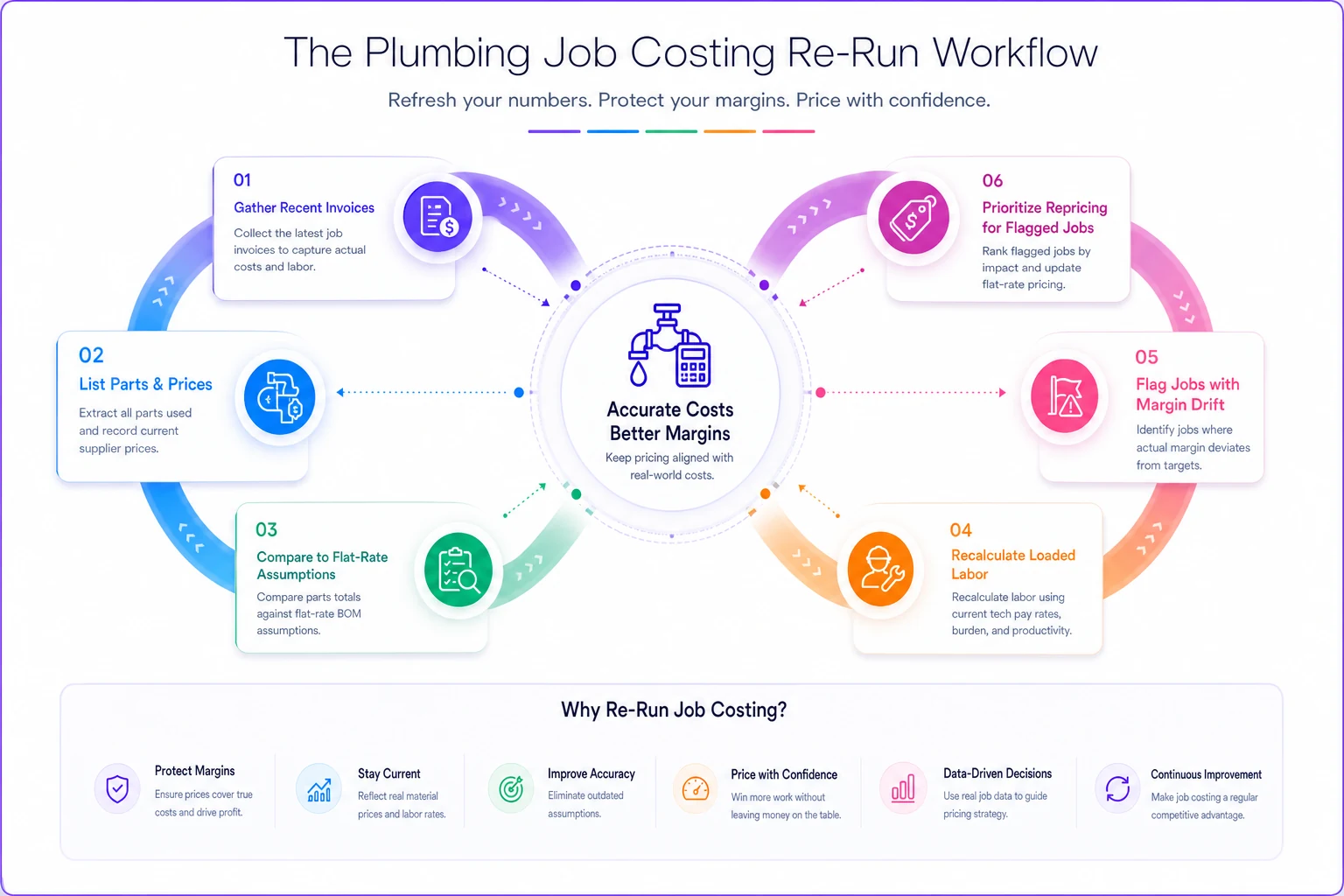
A quick way to sanity-check the drift:
-
Pull your last 10 invoices for your top 3 job types.
-
List every part on each, with the price you actually paid this quarter.
-
Compare that parts total to whatever's baked into your current flat-rate price.
-
Recalculate loaded labor using this year's tech pay, not last year's.
-
Flag any job where realized margin dropped more than 3 points.
-
Those flagged jobs are your repricing priority — not the whole menu.
Use this simple workflow to re-run job costing on a handful of jobs.
You don't need to touch everything. Find the two or three jobs where the drift is worst and fix those first. The rest can wait.
Surcharge or reprice? A quick decision guide
Once you know which jobs slipped, you've got a choice: bake the increase into the menu permanently, or add a temporary parts/fuel surcharge. They're not interchangeable.
When a permanent reprice makes sense:
-
The cost increase looks structural — wages, supplier list-price hikes that won't reverse.
-
The affected job is a core, high-volume offering.
-
You're overdue for a menu refresh anyway.
When a temporary surcharge makes more sense:
-
The driver is volatile and might reverse — fuel is the classic case.
-
You want to protect margin now without a full menu rebuild.
-
You're testing customer price tolerance before committing.
When you should do neither yet:
-
The drift is under a couple of margin points and volume is strong.
-
You haven't actually re-run the costing — don't reprice on vibes.
One caution on surcharges: a visible "fuel surcharge" line on the invoice tends to invite pushback and haggling on service calls. On smaller residential tickets it's often cleaner to fold the adjustment into the flat rate. Surcharges make more sense on larger jobs, or when material costs genuinely spike in a way customers are already hearing about in the news.
Par-levels are a pricing decision, not just an inventory one
This is the connection most owners miss. When commodity-driven parts get more expensive, your truck stock isn't just an inventory question — it's tied-up cash that's now worth more per unit sitting in the bin.
Two competing pressures pull in opposite directions:
-
Rising part costs push you to carry less, because every unit on the shelf ties up more cash.
-
Supply volatility pushes you to carry more, because a part you can't get means a second trip, a rescheduled customer, and a blown first-time-fix rate.
The resolution isn't a blanket "stock more" or "stock less." It's stocking tighter to actual demand. In a stable-cost environment you can afford sloppy par-levels. When the fast-moving parts are the ones getting more expensive, sloppy stocking directly inflates your carrying cost.
What tends to work: split your truck stock into "fast-mover, price-volatile" versus "slow-mover, price-stable" and manage them differently. The volatile fast-movers get tight par-levels reviewed monthly. The stable slow-movers you can mostly leave alone. Trying to micromanage everything equally just burns time on parts that don't really matter.
A short checklist for this month's par-level review:
-
- [ ] Identify your top 15–20 parts by usage frequency.
-
- [ ] Flag which of those are commodity/price-volatile (brass, copper, anything petrochemical).
-
- [ ] Pull current per-unit cost vs. what you assumed last time.
-
- [ ] Trim par-levels on high-cost, slow-moving overstock.
-
- [ ] Confirm minimum levels on volatile fast-movers so you never second-trip on them.
-
- [ ] Note any part where lead time is stretching — carry a small buffer on those.
Review fast-mover par-levels monthly and tie par decisions to usage frequency rather than gut.
Running through that list once a month takes maybe 20 minutes and saves a lot of quiet margin bleed over the course of a year.
The demand side nobody prices for
Cost is only half the story. The other half is what a nervous consumer does with a nonurgent repair.
When pocketbook anxiety rises — even if actual inflation is mild — homeowners start deferring the discretionary stuff. The dripping outdoor spigot, the slow-draining tub, the "we should probably replace that old water heater before it goes." Emergencies still convert. It's the elective work that softens first.
The pattern to watch: your emergency and repair calls hold steady, but your quote-to-close on planned replacements starts slipping. If you're not tracking those two funnels separately, you'll feel a revenue dip and blame the wrong thing.
Adjust your quoting thresholds and financing offers. On bigger-ticket elective jobs, having a payment option ready — even a simple split — keeps a hesitant homeowner from walking away. The job doesn't disappear; it converts on different terms.
Lean harder into maintenance-plan outreach. Deferred-repair season is exactly when membership plans earn their keep. A homeowner already on a plan is far more likely to say yes to the recommended fix because the relationship is already there. If demand for one-off work softens, your recurring base is what smooths the dip.
A real scenario
A two-truck residential shop — roughly 320–360 jobs a year — hadn't rebuilt their job costing in about 14 months. Nothing dramatic had happened; they just never got around to it.
When they finally ran their top five job types against current parts invoices, two things surfaced. Their standard 40-gallon water heater install had lost around 6 margin points, almost entirely from fitting and connector creep plus a fuel drift they'd never adjusted for. And their main-line snake was underpriced against the tech pay bump from six months earlier.
They didn't overhaul the menu. They repriced two jobs, added a modest material adjustment on the heater install, and tightened par-levels on about a dozen fast-moving brass fittings so they weren't carrying excess at the new higher unit cost. Nothing customer-facing changed except two numbers.
Over the following quarter, blended margin recovered by a few points. Not a dramatic swing, but on 80-something jobs a quarter it added up to money they'd simply been giving away. The fix wasn't clever pricing strategy. It was just catching drift they hadn't looked at in over a year.
The underlying problem the CPI print exposes
The real lesson from the July numbers has nothing to do with 3.4%. It's that most plumbing businesses reprice reactively — once a year, when a customer pushes back, or when a supplier letter finally forces the issue. Meanwhile costs drift continuously, unevenly, and in exactly the categories that don't show up in the headline.
The shops that protect margin treat costing as something they check on a regular cadence, not something they redo in a panic. They know their loaded labor rate to the current pay period. They know which parts are volatile and actually watch those. They track emergency demand and elective demand separately so they can read a slowdown correctly instead of guessing at the cause.
You don't need a fancy system to do this. A disciplined spreadsheet and a monthly habit beats an ignored software platform every time if nobody's actually using it. What matters is that the habit exists. A CPI release like this one is a decent forcing function — let it be the reminder to open your numbers, run your top jobs through current costs, and fix the two or three that have quietly slipped. Do that a few times a year and you stop bleeding margin you never knew you were losing, regardless of what the national average happens to say that month.
Ready to optimize your plumbing operations?
Join 500+ plumbing businesses using Plummerly to save time, reduce scheduling errors, and improve customer satisfaction.