

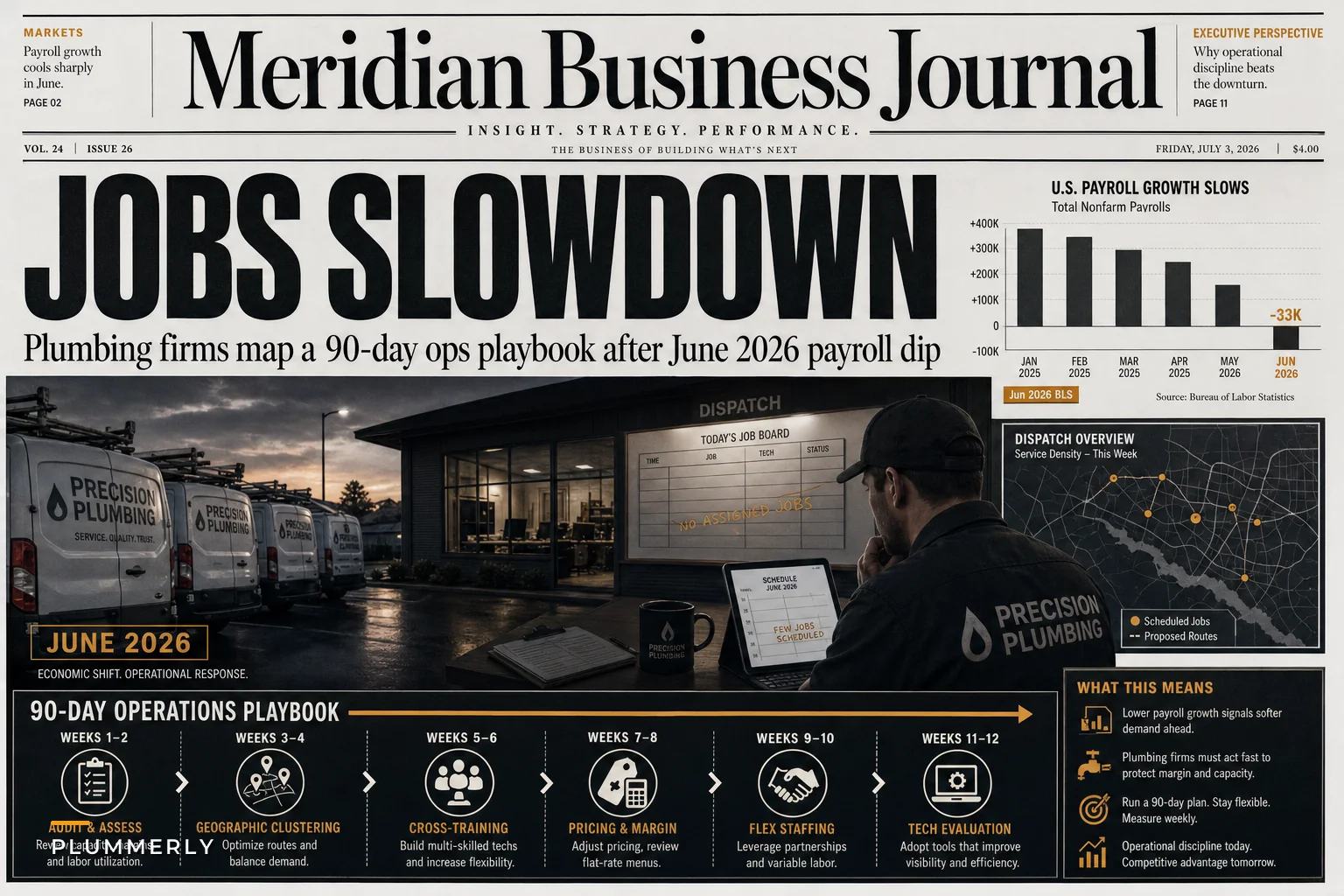

The June 2026 jobs report landed like a wrench in the gears—payroll growth crawled to just 57,000 jobs, well below expectations, while unemployment held at 4.2%. According to the BLS report, prior months were revised downward, signaling a meaningful cooling in the labor market that should influence operational planning now, not later.
For plumbing business owners this isn't just economic noise. A softer labor market reshapes who you can hire and at what cost, how you dispatch crews, and what you can reasonably charge. Ignore those shifts and you either overpay for unused labor or scramble for techs when demand unexpectedly surges.
The hiring leverage flip
Six months ago many shops were offering aggressive signing bonuses. With labor loosening, more experienced techs become available and previously lost apprentices may be open to returning. Availability alone, however, is not a signal to expand headcount.
The common mistake is operational bloat: hiring multiple techs because they're available, then watching per-tech revenue fall when call volume doesn't match. Without dispatch and utilization improvements, extra bodies become an overhead drain.
Swap weaker performers for stronger hires rather than increasing fleet size; trade up, don't scale up unless the numbers justify it.
Cross-training as a hidden profit center
When markets cool the instinct is to cut training. Instead, invest selectively in cross-training that stacks logical skills—drain specialists learn water heater basics, water heater techs pick up basic camera work, and new techs shadow dispatch occasionally.
Stop missing service calls and double bookings.
Plummerly helps you schedule, assign, and manage every plumbing job efficiently.
- Centralized job scheduling
- Technician dispatch & tracking
- Customer notifications
No credit card required
Flexible crews increase usable wrench time because dispatch can match available skills to demand in real time. That reduces single-tech bottlenecks and lowers the chance of whole-day service gaps when one tech is out.
Pricing adjustments that protect margin
A pricing paradox emerges in uncertainty: customers tighten spending while your wage costs remain positive. Reuters reports that wage growth is moderating but still present, so blanket price freezes or discounting will erode margin.
| Traditional Pricing | Restructured Approach | Customer Perception |
|---|---|---|
| $125 diagnostic + $340 repair | $465 flat rate (diagnostic included) | Simplified, one decision |
| Same-day: $50 surcharge | Priority tier: $30/month membership | Predictable, valuable access |
| Emergency: 1.5x rate | Emergency included in top tier | Protected from surprises |
| Separate trips for diagnosis/repair | Single visit resolution focus | Respects their time |
Restructure pricing around value perception: bundle diagnostics into repairs over a price threshold, sell priority response tiers for speed, and create maintenance packages to smooth revenue and reduce emergency dependency.
Dispatch rules that maximize tech utilization
Slowdowns expose dispatch inefficiencies. Instead of first-available assignments, optimize for route density so techs complete clustered jobs rather than wasting time driving across town between isolated calls.
-
Plan morning routes by 6 PM the previous day
-
Avoid single-job trips beyond 15 minutes unless emergency rate applies
-
Keep afternoon floats within 10-minute zones for quick-hit calls
-
Equip every tech with parts for the three most common add-ons
Route density increases margin and reduces burnout. Long drives add invisible stress and reduce quality on later calls; tighter zones yield more productive wrench time and better customer interactions.
Buffer staffing without the bloat
Instead of a skeleton crew or an overstaffed operation, build flex capacity: relationships with independent licensed plumbers, reciprocal agreements with nearby shops, and cross-training office staff for basic dispatch during surges.
A full-time tech costs roughly $65–75k per year whether busy or idle; flex arrangements cost per-job and only apply when needed, preserving margin while handling peaks.
-
1–2 truck operations
one reliable flex plumber and owner ready to jump on tools
-
3–5 truck operations
two flex relationships and one part-time admin/dispatcher hybrid
-
6–10 truck operations
formal overflow partnership, dedicated dispatch, and one swing tech
The objective is matching capacity to demand without fixed overhead; flex arrangements let you avoid converting variable peaks into permanent payroll.
Dispatch-capacity triage: Hold, Flex, or Hire — June 2026 context
Hold hiring when call volume is patchy, wrench time is falling, cross-trained staff cover absences, and per-tech revenue is slipping. Replacing a weak performer during this window is reasonable; adding headcount into soft demand is not.
Use flex capacity when demand is uneven: occasional overflow, intermittent sick-call gaps, or short surges you can clear the next day. Test flex relationships with a single overflow job before committing further.
Begin hiring when demand is sustained across multiple weeks—regular overtime, persistent backlog after tightening dispatch, and recurring inability to accept new calls. When you hire, target capability gaps rather than increasing fleet size to chase a temporary spike.
Technology that pays for itself at the right trigger points
Buy technology during a calm period so you can implement it properly. Slower times are better than peak-season desperation or buying when you're flush—both lead to partial implementations that fail to pay back.
Prioritize operational tools that multiply capacity without large overhead: automated appointment reminders, digital dispatch boards, and parts inventory tracking that reduce forgotten-parts returns.
-
If no-show rates exceed 8%, automated reminders typically pay back within weeks
-
If dispatch errors reach two or more per day, implement a digital dispatch board
-
If parts runs exceed four per week, add inventory tracking to prevent returns
These tech triggers connect to broader scaling decisions every plumbing operation eventually faces. AI-powered platforms can surface patterns earlier—flagging wasted routes, schedule gaps, and services that drag down average ticket size.
The 90-day implementation sequence
Don't implement all six changes at once. Follow a staged 90-day sequence so data informs each step and you avoid operational chaos.
-
Weeks 1–2
Audit utilization—track wrench time versus windshield time, no-shows, callbacks, and parts runs
-
Weeks 3–4
Implement geographic clustering for morning routes and measure jobs-per-day and fuel costs
-
Weeks 5–6
Start two-hour weekly cross-training rotations for receptive techs on common secondary services
-
Weeks 7–8
Restructure pricing for your top three services and test bundled diagnostics first
-
Weeks 9–10
Establish flex relationships; test with a single overflow job before relying on them
-
Weeks 11–12
Evaluate tech needs from collected data and implement the highest-impact tool first
The businesses that come out ahead during transitions are not always the ones that cut deepest or spend most. They're the ones that align hiring, dispatch, pricing, and technology to the new reality before competitors notice the game changed.
The June jobs report isn't just data—it's an early warning system. Treat it that way and you'll be in a stronger position by Q4.
Ready to optimize your plumbing operations?
Join 500+ plumbing businesses using Plummerly to save time, reduce scheduling errors, and improve customer satisfaction.