

Most plumbing businesses hit the same wall around $800k in revenue. The owner still runs calls, dispatches from memory, and keeps pricing in their head. They hire another tech when things get busy, buy QuickBooks when the accountant complains, and eventually piece together some kind of system. But there's no actual plan — no scaling roadmap that tells them when to hire, what technology to adopt, or which processes need documentation.
The difference between plumbing companies that scale and those that plateau isn't luck or market conditions. It's having clear triggers. Not vague advice about "growing your team" but specific thresholds: hire a dispatcher at X calls per week, implement scheduling software at Y revenue per tech, lock in SOPs when Z happens.
After watching hundreds of plumbing operations evolve (and plenty implode), the pattern becomes obvious. Companies that scale successfully follow a predictable maturity path with specific gates they pass through. Each gate has measurable triggers, required capabilities, and organizational changes that have to happen together. Miss one component and the whole thing breaks down around 5–7 trucks.
Stage 1: Owner-Operator Foundation ($0–400k revenue, 1–2 trucks)
At this stage, everything runs through the owner. They answer calls, quote jobs, run service calls, handle emergencies, manage inventory, and squeeze in billing on weekends. The business is basically the owner's technical skills plus some basic business sense.
Organization Structure
-
Owner
Everything
-
Part-time helper or apprentice (maybe)
-
Spouse or family member doing books (usually)
Key Performance Indicators That Matter
-
Cash in bank (needs to cover 2 months expenses minimum)
-
Jobs per week (targeting 12–15 to stay busy)
-
Average ticket ($385–450 for residential service)
-
Collection rate (should be 95%+ with payment on completion)
Technology Requirements
-
Basic accounting software (QuickBooks or similar)
-
Cell phone with good voicemail
-
Simple invoice app or paper forms
-
Basic customer list (even Excel works)
Critical Decision Gate to Stage 2
-
Consistent 20+ calls per week for 3 months straight
-
Turning away $3k+ weekly in work you can't handle
-
Customer complaints about response time hit 2+ per week
-
Owner working 65+ hours weekly for 2 months
What Breaks If You Don't Progress
The business hits a hard ceiling around $350–400k. The owner burns out, service quality drops because they're rushing between calls, and growth stalls because there's no capacity for new customers. There was a guy in Phoenix running the same $30k monthly revenue for three years straight because he refused to bring anyone else on. Same calls, same ceiling, same frustration every single month.
Stage 2: Small Team Operations ($400k–1.2M revenue, 2–4 trucks)
This is where real operations begin. The owner starts working on the business instead of just in it. You've got dedicated techs, someone answering phones, and the beginning of actual processes.
Stop missing service calls and double bookings.
Plummerly helps you schedule, assign, and manage every plumbing job efficiently.
- Centralized job scheduling
- Technician dispatch & tracking
- Customer notifications
No credit card required
Organization Structure at This Level
-
Owner
Sales, quoting, emergency backup
-
Lead tech
Complex jobs and training
-
1–2 service techs
Standard calls
-
Office person
Scheduling, dispatch, basic AR
-
Part-time helper for inventory/truck maintenance
KPI Thresholds That Trigger Changes
-
Revenue per truck
$25–35k monthly minimum
-
Tech utilization
75% billable hours
-
First-call completion rate
80%+
-
Average response time
Same-day for emergencies
-
Callback rate
Under 5%
-
Days Sales Outstanding
Under 25 days
Technology Gates You Must Pass
-
Proper dispatch software (ServiceTitan, Housecall Pro, or similar)
-
Digital inventory tracking
-
GPS tracking on trucks
-
Basic CRM for customer history
-
Automated payment processing
The big gate here is dispatch software. Once you're running 60+ calls weekly, trying to schedule on paper or spreadsheets creates constant conflicts, double-bookings, and missed appointments. It's not a matter of if it breaks — it's when.
Process Lock-ins Required
This is where SOPs become non-negotiable. Not because you want to be corporate, but because different people doing the same job differently creates chaos. You need documented processes for:
-
Call intake and triage
-
Job quoting standards
-
Parts ordering minimums
-
Invoice creation rules
-
Payment collection steps
The trigger for SOP implementation isn't company size — it's variance. When two techs quote the same water heater install with a $400 price difference, you need written standards. When dispatch sends emergency calls to the wrong zones repeatedly, you need process documentation.
Hiring Decision Rules
Never hire based on feelings or because "we're slammed." Use specific triggers:
-
Hire tech #3 when
2+ weeks of 25+ hour overtime across the team
-
Hire dedicated dispatcher when
80+ calls weekly for a month
-
Hire sales/estimator when
Owner spending 25+ hours weekly on quotes
-
Hire operations manager when
Owner can't take a day off without things falling apart
Each hire should solve a specific bottleneck, not just add headcount. A client in Tampa hired three techs in two months because they were busy, but didn't have enough calls to keep them all working. Revenue per truck crashed to $18k and they had to let two people go a few months later.
What Breaks Without Proper Scaling
Companies get stuck in what I'd call the "$800k trap." Too big for owner-only operations but without real systems. Quality gets inconsistent, customer complaints pile up, and the owner is working harder than ever while making less per hour than when they were solo.
Stage 3: Structured Growth ($1.2M–3M revenue, 4–8 trucks)
This stage separates real businesses from oversized owner-operator shops. You've got department leads, formal roles, and processes that run without the owner's constant involvement.
Organizational Evolution
Your org chart becomes an actual chart:
Owner/President
-
Strategic planning
-
Major accounts
-
Financial oversight
Operations Manager
-
Daily dispatch
-
Tech performance
-
Quality control
Service Manager
-
Lead tech team
-
Training programs
-
Technical standards
Office Manager
-
AR/AP
-
Customer service
-
Admin processes
Team Leads (2)
-
Field supervision
-
Mentoring juniors
-
Complex diagnostics
Service Techs (4–6)
-
Standard repairs
-
Maintenance calls
-
Install assists
The key shift: the owner stops being the hub. Decisions happen without them. Problems get solved by managers, not kicked upstairs.
Advanced KPI Management
Your metrics become predictive, not just historical:
| KPI | Warning Level | Critical Level | Action Required |
|---|---|---|---|
| Gross Margin | <48% | <44% | Review pricing/costs |
| Tech Efficiency | <68% | <62% | Analyze routing/dispatch |
| Lead Conversion | <35% | <28% | Sales training/process review |
| Customer Acquisition Cost | >$140 | >$180 | Marketing channel analysis |
| Monthly Recurring Revenue | <8% of total | <5% of total | Push maintenance plans |
| Cash Conversion Cycle | >35 days | >45 days | Collections process overhaul |
When any KPI hits warning level for two consecutive weeks, you investigate. Hit critical level and everything else takes a back seat.
Technology Infrastructure Requirements
-
Integrated FSM platform with mobile capability
-
Automated scheduling and routing optimization
-
Real-time inventory management across trucks
-
Customer portal for scheduling and payments
-
Financial reporting dashboard
-
Marketing automation for follow-ups
This is where AI-powered operational software starts making a real difference. Instead of dispatchers manually checking tech locations and skill sets for every call, the system assigns based on proximity, expertise, and current workload automatically. Route optimization alone can cut drive time by 25% — and at 6–7 trucks, that adds up fast.
Process Standardization Triggers
-
Pricing variance >15% on same job type → Implement flat-rate pricing
-
Callback rate >8% on specific service → Create quality checklist
-
Parts waste >$500 monthly → Institute inventory controls
-
Customer wait time >4 days → Revise scheduling protocols
-
Tech turnover >30% annually → Formalize training program
The pattern is always the same: performance degrades, you measure the variance, you implement a process to control it. Not because you love paperwork, but because inconsistency at this scale costs real money.
Expansion Decision Framework
Add Truck #5 When:
-
4 existing trucks at 78%+ utilization for 6 weeks
-
Demand exceeds capacity by 15+ calls weekly
-
Cash reserves cover 3 months operating expenses
-
Trained tech available (not hoping to find one)
Expand Service Area When:
-
20%+ of calls from outside current zones
-
Drive time penalty acceptable (<25 minutes average)
-
Density supports a dedicated tech (40+ calls monthly)
Add New Service Line When:
-
30+ customer requests in 90 days
-
Margin projection >50%
-
Tech expertise already in house
-
Equipment investment under $15k initial
Growth for growth's sake kills profitability. Every one of these decisions needs multiple conditions met, not just enthusiasm.
Stage 4: Multi-Unit Operations ($3M–8M revenue, 8–20 trucks)
At this scale, you're running a real operation with multiple layers, specialized roles, and coordination that genuinely can't happen manually. The business runs without the owner's daily involvement — or it should.
Departmental Structure
The organization splits into clear departments:
Executive Level:
-
Owner/CEO (strategy, vision)
-
General Manager (operations oversight)
-
Controller (financial management)
Operations Department:
-
Operations Director
-
Dispatch Manager
-
3–4 Dispatchers
-
Fleet Manager
Field Department:
-
Field Operations Manager
-
3–4 Team Leads
-
12–16 Technicians
-
2–3 Apprentices
Administrative Department:
-
Office Manager
-
2 CSRs
-
Accounting Clerk
-
Marketing Coordinator
Middle management is the critical addition. Team leads handle daily field issues. The dispatch manager owns scheduling efficiency. Department heads make operational decisions. The owner focuses on strategy.
Performance Management Systems
Technician Level:
-
Personal efficiency rate
-
Callback percentage
-
Revenue generated
-
Customer satisfaction score
Department Level:
-
Overall equipment effectiveness
-
Department margin
-
Quality metrics
-
Team retention rate
Company Level:
-
EBITDA margin
-
Customer lifetime value
-
Market share
-
Revenue growth rate
Performance conversations happen weekly at team level, monthly at department level, quarterly at company level. Problems get caught before they become disasters — or they should, if you're actually running the reviews.
Technology Transformation Requirements
-
Full ERP integration
-
Business intelligence platform
-
Predictive maintenance scheduling
-
Automated workforce management
-
Dynamic pricing optimization
-
Multi-channel customer communication
At this stage, AI automation becomes critical for coordination rather than just convenience. Running 400+ calls weekly across 15 techs with different certifications and skill levels — manual dispatch isn't just inefficient, it's not really possible. The platform needs to factor in travel time, job requirements, tech certifications, customer preferences, and parts availability simultaneously. One company reduced overtime costs by around $11k monthly just by switching to intelligent scheduling. Not by cutting hours, just by assigning work smarter.
Operational Excellence Triggers
-
Daily variance reviews
-
Weekly process audits
-
Monthly efficiency analysis
-
Quarterly system overhauls
You're not just following SOPs anymore — you're constantly improving them. Tech shows up without proper parts? Update the job preparation checklist. Customer complains about communication gaps? Revise the update protocol. Every incident is a process improvement opportunity if you treat it that way.
Strategic Growth Gates
Market Expansion Criteria:
-
Adjacent market research complete
-
18+ months cash runway
-
Management bench strength proven
-
Core market share >15%
-
Systems scalability confirmed
Acquisition Evaluation Matrix:
-
Revenue multiple <1.2x
-
Customer overlap <20%
-
Cultural fit assessment positive
-
Integration plan developed
-
Synergy value >$200k annually
Service Line Addition Requirements:
-
Margin accretive (above current average)
-
Customer demand validated
-
Operational complexity manageable
-
Investment payback under 18 months
Re-check last element is paragraph. Yes.
Common Failure Points in Scaling
Even with clear gates and triggers, companies fail at predictable points. Understanding these helps you either prepare for them or avoid them entirely.
The Reluctant Owner Trap
Owners who can't stop turning wrenches never scale successfully. They hire people but don't trust them, implement systems but bypass them, create processes but make exceptions for themselves. The business stays dependent on them and growth stalls around $600k.
The fix isn't self-reflection — it's forcing functions. When you hit the hiring triggers, put yourself on office duty for two weeks. When you implement dispatch software, remove your ability to manually override it. Make it harder to interfere than to just let the system work.
The Premature Scaling Disaster
The opposite problem: owners who read too many business books and try to build a $10M organization at $500k revenue. They hire managers before workers, buy enterprise software before mastering basics, create 50-page procedure manuals nobody reads.
A Charlotte company hired an operations director at $1.2M revenue. The guy built great dashboards and thorough processes, but they didn't have the volume to support his salary. They burned through around $80k in savings and had to lay off two techs to stay afloat.
The Technology Paralysis Point
Companies spend months evaluating software, comparing features, demanding perfect solutions. Meanwhile, they're losing money from operational inefficiency every week. Analysis paralysis around technology has killed more growth than bad software choices ever did.
Pick something that handles 80% of your needs and implement it fully. You can always upgrade. Running ServiceTitan at 70% effectiveness beats running spreadsheets at 100% any day.
The Quality Degradation Spiral
Fast growth without process control leads to quality problems. New techs aren't properly trained, jobs get rushed, callbacks increase. Customer complaints spike, reputation suffers, growth stalls, revenue drops, and you end up laying off the people you just hired.
Quality gates prevent this:
-
New tech shadows for 2 weeks minimum
-
Every job follows checklist completion
-
Random quality audits (roughly 10% of jobs)
-
Customer follow-up within 48 hours
-
Callback root cause analysis required
When callback rates exceed 7%, freeze hiring and focus on quality. Non-negotiable.
The Cash Flow Crisis Gate
Growing companies run out of cash at predictable revenue points: around $600k, $1.5M, and $3.5M. Each represents a working capital inflection where you need significantly more cash to operate.
The $1.5M crisis is usually the worst. You've got payroll for 8–10 people, vehicle payments, inventory carrying costs, and 30+ days of receivables sitting out there. One slow month or one large bad debt creates a cascade.
Prevention requires discipline:
-
Maintain 2.5 months operating expenses minimum
-
Factor receivables if DSO exceeds 30 days
-
Negotiate vendor payment terms aggressively
-
Implement progress billing on large jobs
-
Build an untouchable emergency fund
Understanding these helps you either prepare for them or avoid them entirely.
Technology Implementation Decision Tree
Choosing when to adopt technology isn't about features or vendor promises. It's about operational triggers indicating that manual processes are starting to fail.
Communication Systems
-
Text/Email Coordination When you have 3+ people
-
Shared Calendar When double-bookings happen weekly
-
Team Chat Platform When information gaps cause daily mistakes
-
Customer Portal When status update calls exceed 20 per week
Operational Software
-
Basic Scheduling 40+ calls weekly
-
Dispatch Software 80+ calls weekly or 4+ techs
-
Route Optimization 5+ trucks or 30+ minute average drive time
-
Inventory Management $5k+ monthly parts purchases
-
FSM Platform $1M revenue or 100+ weekly calls
Financial Systems
-
Accounting Software Day 1
-
Job Costing $500k revenue
-
Integrated Invoicing 50+ invoices monthly
-
Payment Processing Immediately (cash is risky)
-
Financial Dashboard $1M revenue
Customer Management
-
Basic CRM 200+ customers
-
Marketing Automation 500+ customers
-
Reputation Management 20+ reviews monthly
-
Customer Success Platform $2M revenue
Here's a simple workflow visualization:
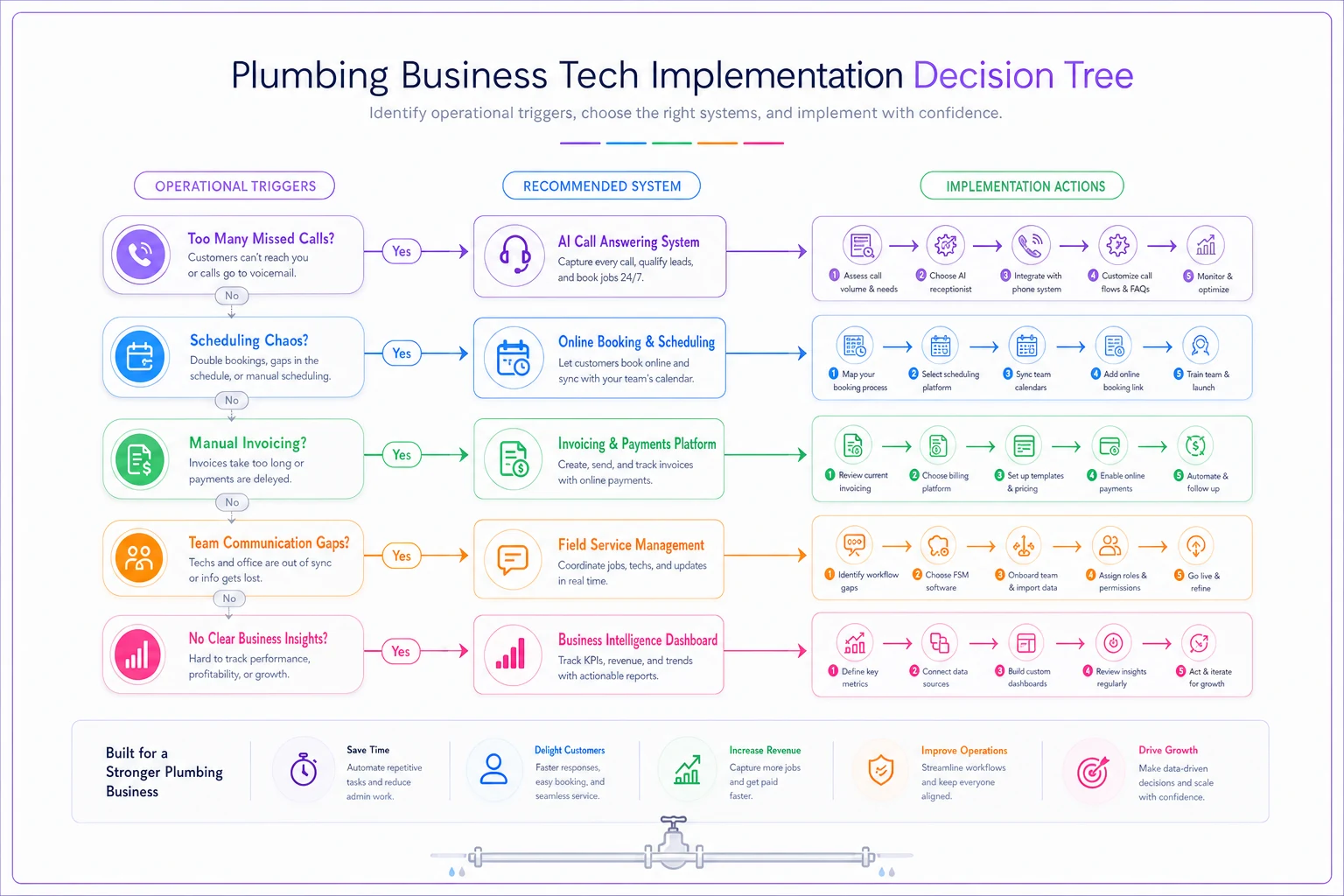
The key point: implement technology just before the breaking point, not after. If you wait until manual processes completely fail, you're implementing under crisis conditions and the rollout usually fails too.
Building Your Scaling Roadmap
Creating your own scaling roadmap starts with an honest assessment of where you actually are today. Not where you want to be — actual current state.
Current State Analysis
-
Actual weekly call volume (3-month average)
-
True tech utilization (billable hours ÷ paid hours)
-
Real revenue per truck
-
Actual cash in bank
-
Current organizational capabilities
Compare these against the stage indicators above. Most companies think they're further along than they are. A company doing $950k might assume they're Stage 3 based on revenue, but if the owner still dispatches and quotes everything, they're functionally Stage 2.
Gap Identification Process
-
Turning away work but haven't hired?
-
Dispatch is chaotic but still using spreadsheets?
-
Techs quoting different prices but no standardization?
Each gap represents either lost revenue or unnecessary cost. Quantify them. If inconsistent pricing costs $1k weekly and dispatch software costs $400 monthly, the ROI math isn't complicated.
Implementation Sequencing
-
Stabilize current operations
-
Implement missing basic systems
-
Hire to relieve bottlenecks
-
Add technology for efficiency
-
Expand into new areas
Don't skip steps. A company can't successfully implement AI-powered scheduling if they haven't defined basic job types. You can't hire effectively without clear roles. You can't expand territories if your core market isn't profitable yet.
Progress Monitoring Framework
-
Weekly
Operational KPIs
-
Monthly
Stage progression metrics
-
Quarterly
Strategic milestone review
-
Annually
Full maturity assessment
When you hit a gate trigger, you have roughly 30 days to plan and 60 days to implement. Longer delays mean lost opportunity; rushing it means poor execution.
The Reality of Scaling
Scaling a plumbing business isn't about inspiration or motivation. It's about recognizing specific operational triggers and responding with the right changes. Most owners overcomplicate it. They read about culture and leadership and vision when what they actually need is something more concrete: when do I hire a dispatcher, what software matters, and which processes need documentation first.
The maturity model isn't rigid — every business progresses differently. But the gates are surprisingly consistent. Revenue per truck drops below threshold, you need operational changes. Call volume exceeds capacity, you need more resources. Quality metrics slip, you need process control.
What separates successful scaling from painful growth is preparation. Knowing you'll need dispatch software at around 80 calls weekly means you can evaluate options at 60. Understanding that tech utilization above 85% predicts burnout helps you hire proactively. Recognizing that $1.5M revenue requires significant working capital prevents cash crunches from blindsiding you.
Companies that scale well don't just hit triggers and react — they see them coming and prepare. They build systems before they're desperate, hire before they're overwhelmed, implement technology before manual processes completely break down. Whether you're running two trucks or twenty, the principles stay consistent: measure what matters, respond to triggers systematically, and build operations that can run without you.
Ready to optimize your plumbing operations?
Join 500+ plumbing businesses using Plummerly to save time, reduce scheduling errors, and improve customer satisfaction.