

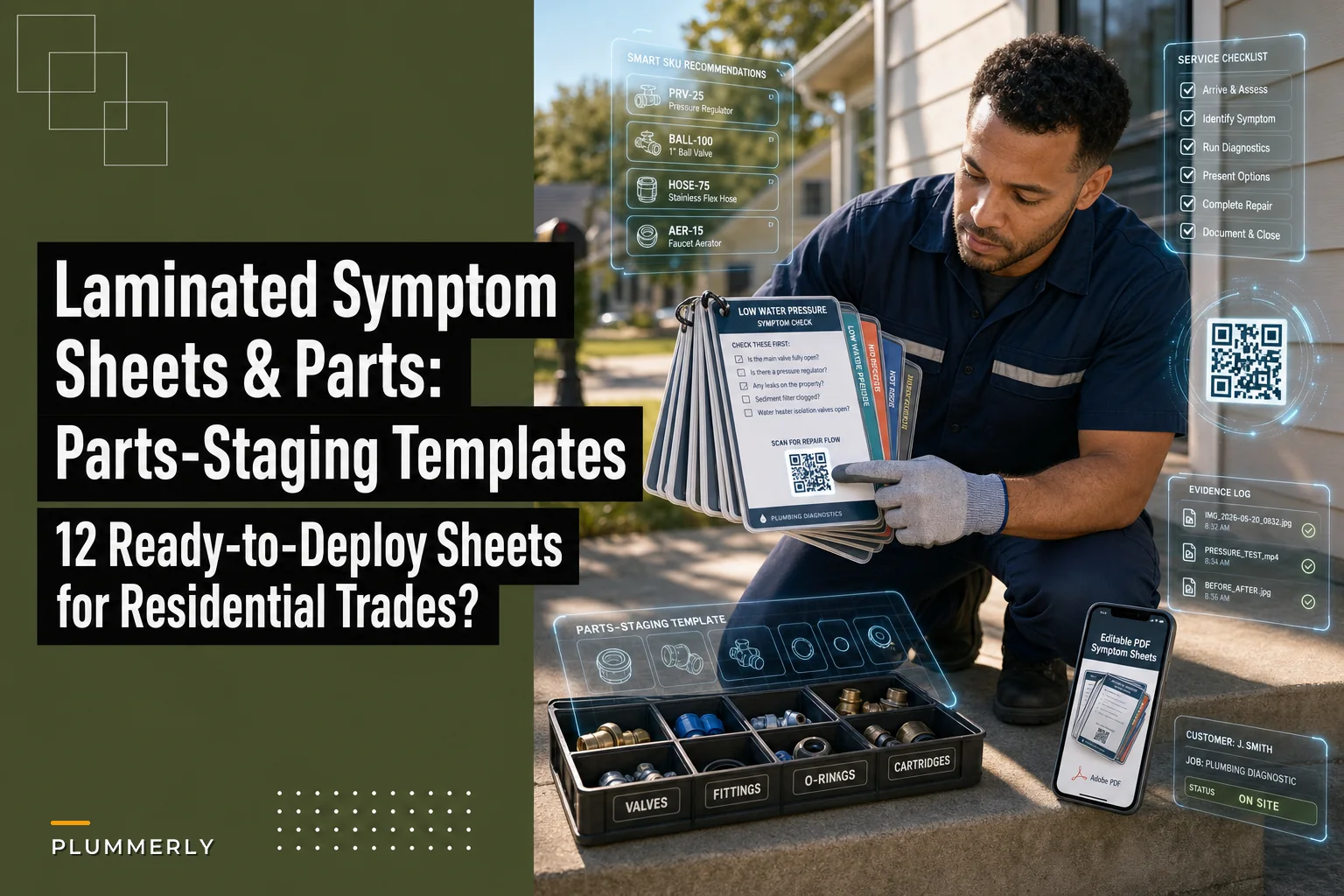

The gap between your best technician and your newest hire isn't knowledge. It's sequence. Your 15-year guy walks into a "no hot water" call and runs the same mental checklist every time without thinking about it. Your six-month hire guesses, pokes around, calls you twice, and still drives back the next day for a part he should've had on the truck.
That gap is expensive, and it's fixable without a training budget. A one-page laminated symptom sheet — dropped in the door pocket or loaded in the mobile app — forces the sequence onto the page so the newer tech runs the job like the veteran does. Not perfectly. But close enough to kill most callbacks.
This post breaks down what actually goes on those 12 sheets, why each block earns its space on a single laminated page, and how to deploy them without turning your trucks into a paperwork operation.
Why a single laminated page beats a 40-page manual
Nobody reads the manual. You know this. The binder lives under the passenger seat, swollen from a coffee spill, and the only time anyone opens it is to prop up a tablet.
Laminated symptom sheets work where manuals fail because of friction — or the lack of it. A tech standing at a water heater with a flashlight in his mouth is not going to scroll a PDF to page 23. He'll glance at a laminated card clipped to the unit, check three boxes, and keep moving. The whole interaction is under ten seconds of reading.
What shops that actually stick with these find: format matters more than content. A perfect diagnostic tree buried in a document gets ignored. A decent one on a card that lives where the work happens gets used every single call. You're not optimizing for completeness. You're optimizing for the thing getting touched.
There's a deeper version of this in the First‑Time‑Fix Diagnostic Playbook for Common Residential Issues, which goes into the diagnostic logic itself. This post is about the physical and mobile artifact — the sheet that carries that logic into the field.
The 12 calls that earn a dedicated sheet
You don't make sheets for everything. You make them for the high-frequency, high-callback calls — the ones that repeat weekly and go sideways when a tech freelances the diagnosis.
Stop missing service calls and double bookings.
Plummerly helps you schedule, assign, and manage every plumbing job efficiently.
- Centralized job scheduling
- Technician dispatch & tracking
- Customer notifications
No credit card required
| # | Trade | Symptom Sheet | Why it makes the cut |
|---|---|---|---|
| 1 | Plumbing | No hot water / inconsistent hot water | High volume, multiple root causes, easy to misdiagnose |
| 2 | Plumbing | Running / phantom-flushing toilet | Tiny part cost, huge callback rate if staged wrong |
| 3 | Plumbing | Slow/clogged drain (sink, tub, main) | Scope creep from local clog to main line |
| 4 | Plumbing | Low water pressure (whole house vs fixture) | Techs skip the isolation test constantly |
| 5 | Plumbing | Water heater leaking / weeping | Safety + warranty documentation needs |
| 6 | HVAC | No cooling / no cold air | Refrigerant vs electrical vs airflow confusion |
| 7 | HVAC | No heat / furnace won't ignite | Ignition sequence has a clear branch logic |
| 8 | Electrical | Tripping breaker / dead outlet | Load vs fault vs device failure |
| 9 | Electrical | Flickering lights / partial power | Easy to chase the wrong circuit |
| 10 | Appliance | Dishwasher not draining | Pump vs hose vs filter — staged parts matter |
| 11 | Appliance | Refrigerator not cooling | Multiple sealed-system vs airflow causes |
| 12 | Broadband | No internet / intermittent drops | ONT vs router vs line vs provider — handoff rules |
The pattern worth noting: nearly every one of these has a branch point where a tech either isolates the problem correctly or wastes 40 minutes chasing the wrong thing. That's the sheet's whole job — force the isolation test before the guessing starts.
What actually goes on each sheet
A good symptom sheet has five blocks and not one more. Add a sixth and techs stop reading. Here's the anatomy, using the "no hot water" plumbing sheet as the working example.
1. Symptom checklist (top of the card)
Three to five checkboxes that pin down the actual complaint before any tools come out. For no hot water:
-
No hot water at any fixture
-
Hot water runs out faster than normal
-
Lukewarm only / never gets hot
-
Discolored or smelly hot water
-
Visible leak or pooling at base
This block exists because the customer's description and the actual symptom are often two different things. "No hot water" turns out to be "lukewarm after five minutes" — which is a completely different branch.
2. Stepwise diagnostic branch (the core)
A short decision tree with checkboxes, not a wall of text. Each step has a yes/no fork pointing to the next step. For a gas water heater:
-
Pilot/igniter lit? → No → go to ignition branch
-
Thermostat setting correct? → Verified → continue
-
Gas supply confirmed at valve? → Yes → continue
-
Dip tube / crossover test → documents a mixing fault
-
Recovery test (measure temp rise over 10 min)
The design rule: no step should require interpretation. Either the pilot is lit or it isn't. The moment you write "check if it seems okay," the sheet is dead.
3. Required tools & instruments
A short line listing exactly what the job needs so the tech grabs everything in one trip from the truck. For this sheet: multimeter, combustion analyzer (if applicable), thermometer, pipe wrench, voltage tester. No mid-diagnosis scavenger hunts.
4. Pre-stage parts list with SKUs and minimum pull quantities
This is the block most shops skip, and it's the one that kills callbacks. It tells the tech which parts to pull before leaving, based on the most probable fixes:
-
Thermocouple — SKU WH-TC-24 — pull min 2
-
Dip tube — SKU WH-DT-075 — pull min 1
-
Gas control valve — SKU WH-GCV-NG — pull min 1
-
T&P relief valve — SKU WH-TP-075 — pull min 2
-
Drain valve — SKU WH-DV-034 — pull min 1
Minimum pull quantities matter more than people realize. A tech who pulls one thermocouple and finds it's the wrong thread pitch is now making a supply-house run. Pulling two of the common variants costs a few dollars of staged inventory and saves a two-hour round trip.
Minimum pull quantities matter more than people realize.
5. Mobile evidence requirements + sign-off block
Exact photo and video specs so documentation stays consistent and claim-ready — file naming, angles, timestamps. For this sheet:
-
WHdataplate[jobID].jpg— straight-on, model/serial legible -
WHleak[jobID].jpg— base of unit, wide angle -
WHreading[jobID].jpg— multimeter/thermometer display with unit in frame -
Timestamp on all shots, captured before and after repair
Then a two-line sign-off block: tech signature, customer signature, and a QR code linking to the full procedure for anything the card doesn't cover.
The QR code is doing more than you think
That QR in the sign-off block is the quiet hero of the system. The laminated card handles 90% of the call. The QR handles the 10% where the tech hits something the branch didn't anticipate — an uncommon model, a weird crossover symptom, a code question.
Instead of calling the office or guessing, the tech scans and lands on the full procedure, warranty notes, or manufacturer bulletin. The card stays short because the depth lives one scan away. This is the whole reason the sheet can fit on a single laminated page without dumbing down the diagnosis.
One practical note worth emphasizing: keep the QR pointing to a stable URL you control, not a manufacturer link that breaks when they redesign their site. Host the procedure yourself and update behind the same QR.
How to deploy without creating a paperwork problem
The failure mode here is predictable. A shop prints the pack, zip-ties it into the trucks, and three weeks later nobody's using them because there was no actual rollout plan — just a stack of cards sitting in the cab.
-
Start with your two worst callback categories. Don't deploy all 12 at once. Pick the two call types generating the most repeat visits and run only those sheets for a month.
-
Laminate for the truck, load the editable text into the mobile app. Physical card for the hands-on diagnosis, digital version for the sign-off, photos, and evidence capture that needs to sync to the job record.
-
Run a 60-second ride-along check. Watch one tech use the sheet on a real call. You'll immediately see which step is confusing or which part SKU doesn't match your supplier.
-
Edit the SKUs to match your actual vendor. The pack ships with example SKUs — they're placeholders. Swap in your supply house's part numbers and your real par-level quantities.
-
Review callbacks against the sheets weekly. When a callback happens, pull the sheet for that call type and ask which step got skipped. Usually it's the isolation test or a missing staged part.
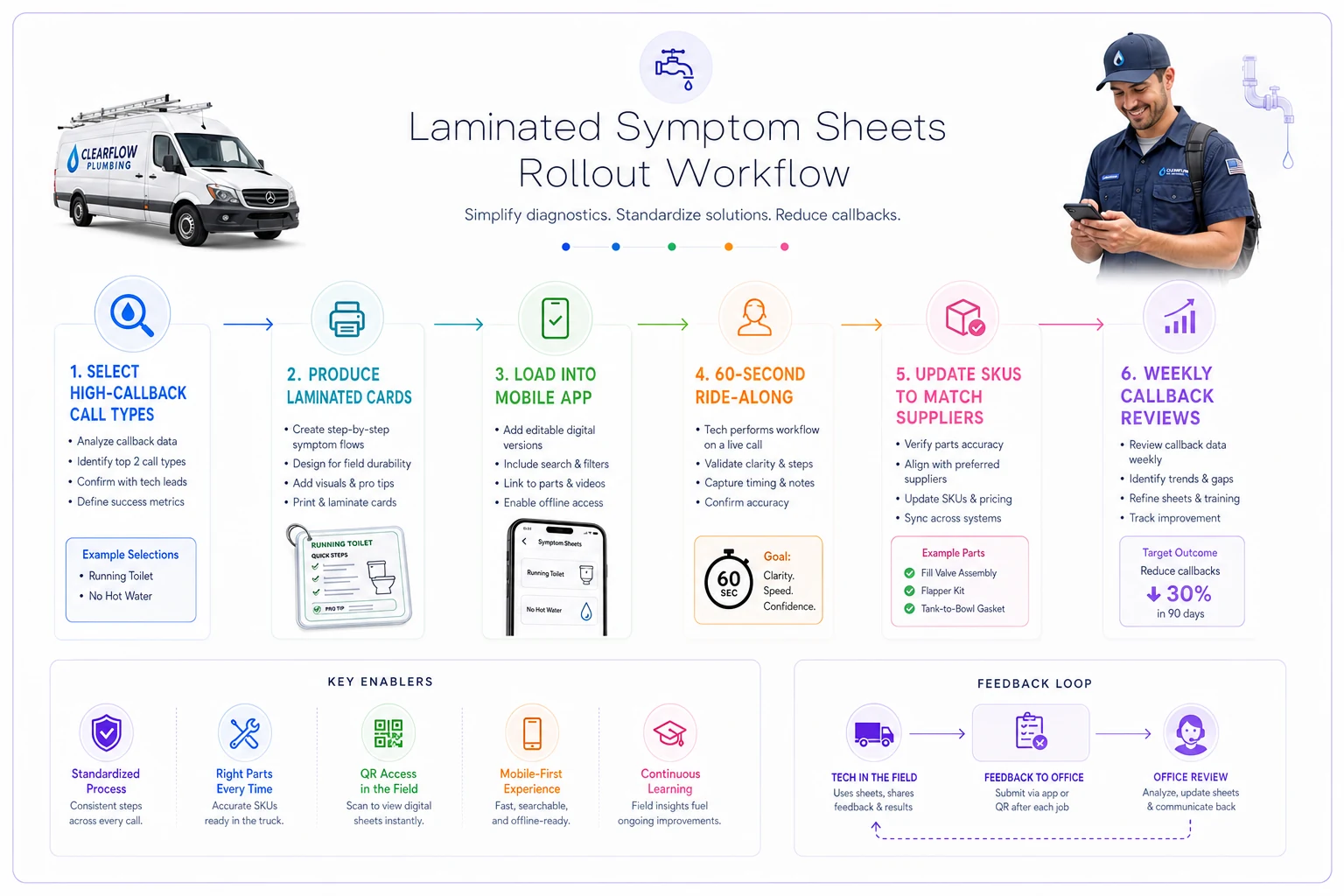
A simple visual of the rollout steps helps everyone see the sequence.
Step 4 matters more than it sounds. A symptom sheet with generic SKUs is a template, not a tool. The value shows up when the parts list reflects your truck and your vendor. A dishwasher drain sheet that says "pull drain pump SKU DW-DP-01" only works if that SKU exists on your shelf.
Where field-service software quietly carries the load
The laminated card lives in the physical world. The editable version lives in your mobile app — and this is where a modern field-service platform earns its keep without anyone really noticing.
When the digital sheet is built into the job workflow, evidence photos auto-attach to the record with the right naming convention, the staged-parts list cross-checks against truck inventory, and the sign-off block feeds straight into the invoice. The tech isn't doing double entry. He runs the sheet, the data lands where it needs to, and the office sees a complete, documented job without chasing anyone for photos.
AI-assisted workflows take a bit more off the tech's plate here — flagging when a required evidence photo is missing before the job can close, or nudging a parts restock when a staged SKU drops below its minimum. Nothing dramatic. Just fewer dropped balls between the truck and the office. The sheet stops being a piece of paper and becomes part of how the job actually closes out.
A real scenario
A four-truck plumbing shop was running close to a 14% callback rate on water heater and toilet calls — the two categories that made up a big chunk of their residential volume. Most callbacks traced back to the same pattern: techs diagnosing on gut feel and showing up without the right part staged, which meant a second visit.
They deployed two laminated sheets — water heater and running toilet — and loaded the editable versions into their app. They swapped the example SKUs for their actual supplier part numbers and set minimum pull quantities of two on the high-failure parts.
Over the next couple of months, callbacks on those two categories dropped to somewhere around 5–6%. Nothing magic happened. Techs just started pulling the right parts before leaving and running the isolation test instead of skipping it. The staged inventory cost them maybe a few hundred dollars extra sitting on the trucks. The saved return trips were worth several times that in recovered drive time and schedule capacity.
The owner's honest take on why it worked: the sheets didn't make his techs smarter, they just stopped the newer guys from skipping steps.
When this makes sense — and when it doesn't
This makes sense when your callback rate is concentrated in a handful of repeating call types, you've got a mix of experienced and newer techs, and you're losing time to return trips for parts that should've been staged.
This is a bad idea when you only run one or two trucks with veteran techs who already have the sequence memorized and your callback rate is already low. The overhead of maintaining sheets won't pay back if there's no gap to close.
Who should skip it: highly specialized shops where every job is custom. If no two calls look alike, there's no repeatable sequence to laminate. Symptom sheets reward volume and repetition — the opposite of bespoke work.
The one thing to get right
If you take nothing else from this: the parts-staging block is where the money is. Anyone can print a diagnostic checklist. The shops that actually cut callbacks are the ones whose sheets tell the tech exactly which parts to grab, in what quantity, before the truck leaves the shop.
A diagnostic tree tells you what's wrong. A staged parts list means you can fix it without coming back. Build the sheets around that second part and the callbacks take care of themselves.
A diagnostic tree tells you what's wrong. A staged parts list means you can fix it without coming back. Build the sheets around that second part and the callbacks take care of themselves.
Ready to optimize your plumbing operations?
Join 500+ plumbing businesses using Plummerly to save time, reduce scheduling errors, and improve customer satisfaction.