

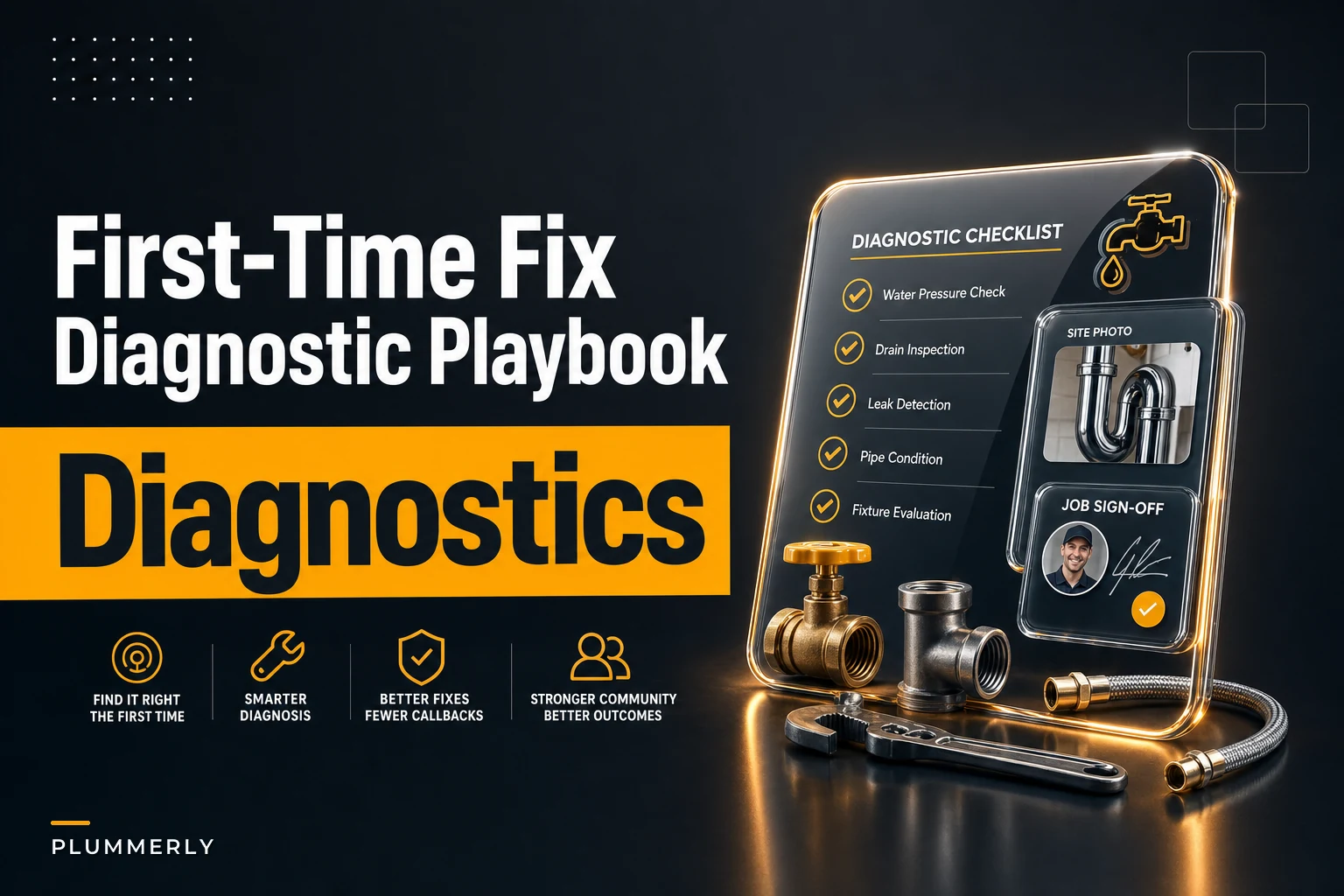

The number that kills small plumbing shops isn't call volume. It's callback rate. Every truck that rolls back to a house it already visited burns a dispatch slot, an hour of drive time, and whatever was left of the customer's goodwill. And most of those return trips trace back to one of two moments in the original visit: a rushed diagnosis, or a missing part.
A first time fix plumbing checklist closes both gaps. Not a generic "steps to fix a leak" document — an actual laminated sheet, one per common symptom, that walks the tech from the customer's complaint down to a confirmed diagnosis, tells them exactly which parts to stage before they touch anything, and defines what "done" looks like before they leave. This article is about building those sheets so they hold up in the field, not just on paper.
Why techs misdiagnose even when they know the trade
Skill usually isn't the problem. Experienced techs misdiagnose because they anchor on the first plausible cause and stop looking. Customer says "my water heater isn't working," tech sees a tripped high-limit, resets it, collects payment, leaves. Three days later the high-limit trips again because the real failure was a shorted lower element pulling the tank into a thermal loop. The reset fixed the symptom, not the problem.
This happens because the diagnostic sequence lives in the tech's head, and heads get tired and overconfident by 3 PM on a Friday. What you see across small shops is that both the best techs and the newest techs benefit from a written symptom tree — the newbie because they don't have the sequence yet, the veteran because the sheet forces them past their first assumption.
The sheet isn't there to teach plumbing. It's there to remove the decision of whether to keep checking.
Anatomy of a symptom→diagnostic sheet that actually works
A usable sheet has four zones, and they need to be in this order because that's how a tech's brain moves through a job.
Stop missing service calls and double bookings.
Plummerly helps you schedule, assign, and manage every plumbing job efficiently.
- Centralized job scheduling
- Technician dispatch & tracking
- Customer notifications
No credit card required
-
Symptom as the customer describes it — in their words, not yours. "Toilet keeps running," not "flapper seal failure." The tech matches the sheet to what the intake notes and the homeowner actually said.
-
Diagnostic branch — a short yes/no path that separates the two or three real root causes. Each branch dead-ends at a confirmed diagnosis, not a guess.
-
Required parts staging — the specific parts to physically pull onto the work surface before starting, tied to whichever branch the tech landed on.
-
Sign-off criteria — the photos and the test that prove the fix held, plus a clear rule for what counts as first-time-fix-complete.
Here's a stripped-down example for one of the most common residential calls:
| Zone | Content for "Running Toilet" sheet |
|---|---|
| Customer symptom | "Toilet runs constantly / won't stop / runs randomly" |
| Diagnostic branch A | Water in bowl trickling → check flapper seal & flush valve seat |
| Diagnostic branch B | Water at overflow tube → check fill valve height & float |
| Diagnostic branch C | No visible water movement, meter spinning → check tank-to-bowl gasket & supply |
| Stage before starting | Flapper (2–3 common sizes), fill valve, tank bolts + gaskets, supply line |
| Photo sign-off | (1) dye test clear after 10 min, (2) fill valve shutoff at correct level, (3) dry base + connections |
| First-time-fix rule | No meter movement over a 5-minute static test with hands off |
Branch C matters more than most techs realize. "Running toilet" can hide a silent leak — meter spinning, no visible drip, tech leaves thinking the job's done. The branch forces that check instead of leaving it to judgment.
The parts staging rule that eliminates half your callbacks
Most callbacks aren't diagnostic failures. They're inventory failures. The tech found the problem, quoted it correctly, then discovered the part wasn't on the truck.
The fix is to tie parts staging to the diagnostic branch, not to the job type. "Leaking faucet" is useless as a stocking category — that call could need a ceramic cartridge, a compression stem, a brand-specific cartridge, or a whole valve body. But once the sheet routes the tech to "single-handle cartridge failure, Moen 1225 family," the required parts are three SKUs, not thirty.
This is where your truck stocking and your diagnostic sheets have to work together. If your sheets call for a part your trucks never carry, the sheet is fiction. Building the sheets and the truck parts par-level matrix at the same time makes sense for exactly this reason — every "stage before starting" line becomes a required par-level SKU. If a part shows up on three or more high-frequency sheets, it belongs on every truck.
-
Pull parts before touching the fixture, not mid-repair after diagnosis. Staging first means the tech confirms availability while the customer is still present — so a missing part becomes a scheduled return with the customer's buy-in, not an awkward surprise.
-
Stage the failure family, not a single guess. Three flapper sizes, not one. The extra 20 seconds of pulling beats a return trip every time.
-
If staged parts aren't on the truck, treat it as a flagged event, not a shrug. It means either the par-level is wrong or the sheet needs a substitute path.
Stage the failure family, not a single guess.
A quick real scenario
A two-truck shop was running a callback rate just over 18% on residential service — close to one in five jobs generating a return visit. When they dug into it, most returns were faucet and toilet calls where the right cartridge or fill valve wasn't stocked.
They built eight laminated symptom sheets for their highest-volume calls and rebuilt truck par-levels off the "stage before starting" lines. Over the next couple of months, the callback rate dropped to somewhere around 7–8%. Nothing about the technical work changed — techs just stopped getting caught without the part. With each avoided callback running somewhere between $60–$90 in labor and drive time plus a lost booking slot, the lamination investment paid for itself quickly.
Photo sign-off: the part everyone skips and later regrets
Without a defined "prove it's fixed" step, first-time-fix becomes an opinion. The tech feels like it's fixed. The homeowner hopes it's fixed. Nobody actually tested it under the failure conditions.
Every diagnostic sheet should end with two things: a test and a photo set. The test recreates the failure — run the water for five minutes, cycle the flush ten times, watch the meter static. The photos capture the result so a callback can be judged fairly.
-
Before shot of the failure condition — timestamped, so warranty disputes have a baseline.
-
Diagnostic proof shot — the failed part removed and laid out, showing the wear or crack. This turns "he said he replaced it" into actual evidence.
-
After shot under test — the completed repair with the test running (dye clear, connection dry, meter still).
-
Wide context shot of the finished, clean work area.
The diagnostic proof shot is the one techs push back on most, and it's the one that matters most. When a customer calls back three weeks later claiming the same problem, that photo tells you immediately whether it's the same failure or a new one. Without it, you eat every argument.
Writing the first-time-fix acceptance rule
The acceptance rule decides whether a job counts as first-time-fixed, and it needs to be objective. "Tech thinks it's good" isn't a rule. The test should be something anyone could reproduce.
Good acceptance rules follow a consistent shape: a specific condition, held for a specific duration, with the tech's hands off. Meter static for five minutes. No drip through ten flush cycles. Water heater reaching set temp and holding without the high-limit tripping across a full recovery cycle.
The "hands off" part matters more than it sounds. Techs unconsciously stabilize a repair — holding a fitting, keeping slight pressure on a seal — and it reads as fixed while they're standing there. The acceptance test has to run while they step back. A lot of same-week callbacks are fixes that only worked while a hand was on them.
One more rule worth writing down: if the diagnostic branch dead-ends at something the tech can't resolve on this visit — specialty part, permit needed, second person required — that's not a failed first-time-fix, it's a correctly scoped return. The distinction matters for how you evaluate techs. Punishing someone for a legitimately two-visit job teaches them to force bad single-visit fixes, which is exactly what generates callbacks.
When laminated sheets make sense — and when they don't
When this pays off: shops running mixed-experience crews, high residential service volume, and a callback rate they can't explain. The more repetitive your call mix — toilets, faucets, water heaters, disposals, hose bibs, shutoff valves — the more eight to twelve sheets cover the bulk of your day.
When it's overkill: solo owner-operators doing mostly custom remodel or repipe work. Your jobs aren't repetitive enough to template, and you're already carrying the diagnostic tree in your head with no handoff problem to solve.
Who shouldn't bother yet: shops that haven't stabilized intake. If dispatch notes are inconsistent and techs show up not knowing the actual symptom, the sheet has nothing to match against. Fix the front of the pipeline first. Standardizing that intake-to-tech handoff is part of your broader operations playbook and dispatch SOPs — the sheets plug into that system, they don't replace it.
Rolling it out without your crew hating it
Techs resist sheets when they feel like a report card. Frame them as a tool that protects the tech — the photo proof that shields them from unfair callback blame, the parts staging that keeps them from looking unprepared in front of a customer. That framing makes a real difference in how fast people actually use them.
Start narrow. Build sheets for your top five call types by volume, not all fifteen at once. Laminate them, one per symptom, and keep them in a ring binder in each truck or as saved photos on the tech's phone.
Here's a quick rollout workflow to follow.
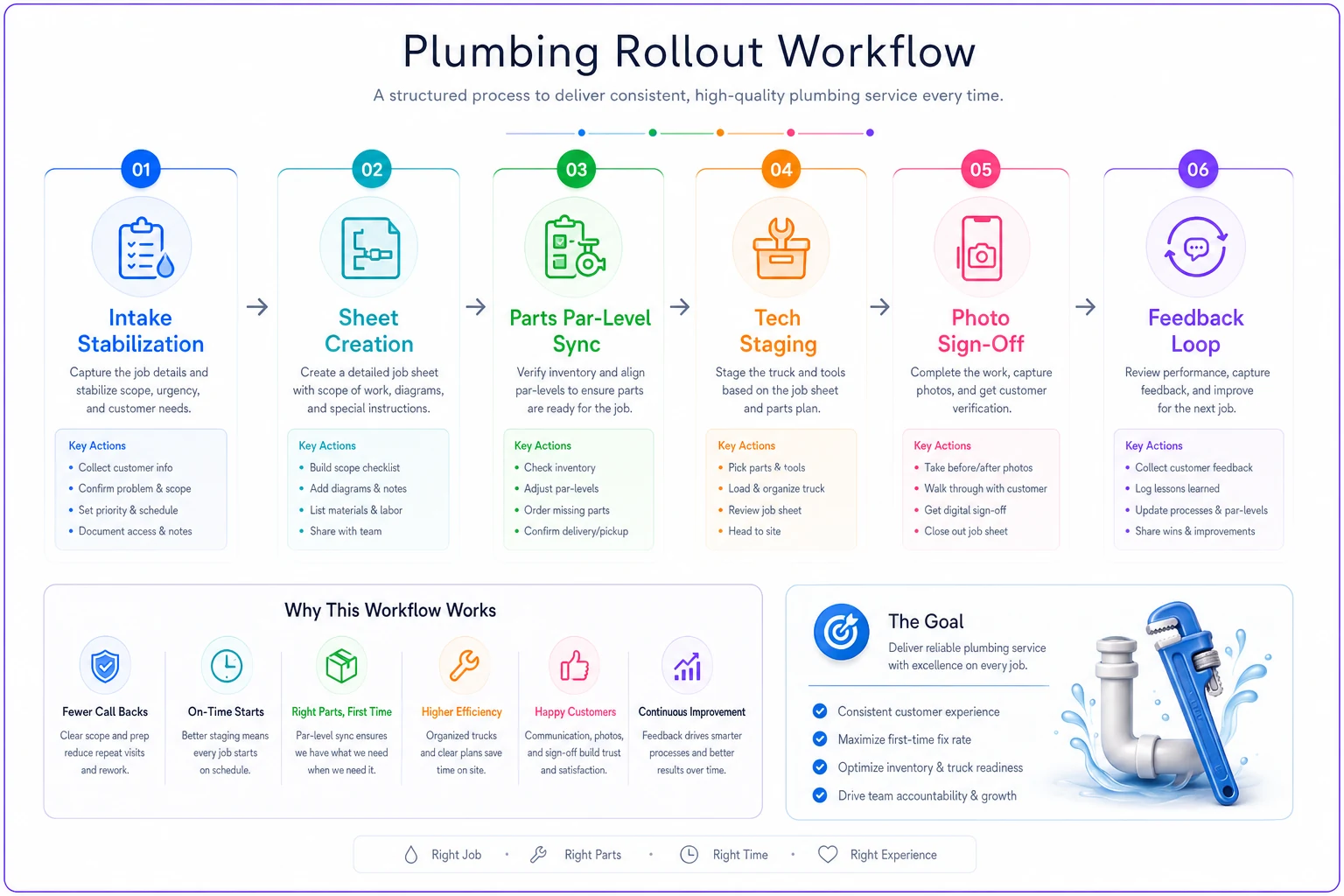
Run them for a month, then pull the ones nobody uses and rewrite any branches techs consistently work around — because a branch techs ignore is usually a branch that's wrong, not a tech being lazy.
The whole system only holds if the sheets, the truck stock, and the photo standard stay in sync. When a sheet changes, the par-level and sign-off criteria should change with it. Keep them as one connected set and the callback rate tends to take care of itself — the sheets aren't magic, they just stop the two mistakes that generate almost every return trip: guessing at the cause, and not having the part.
Ready to optimize your plumbing operations?
Join 500+ plumbing businesses using Plummerly to save time, reduce scheduling errors, and improve customer satisfaction.