

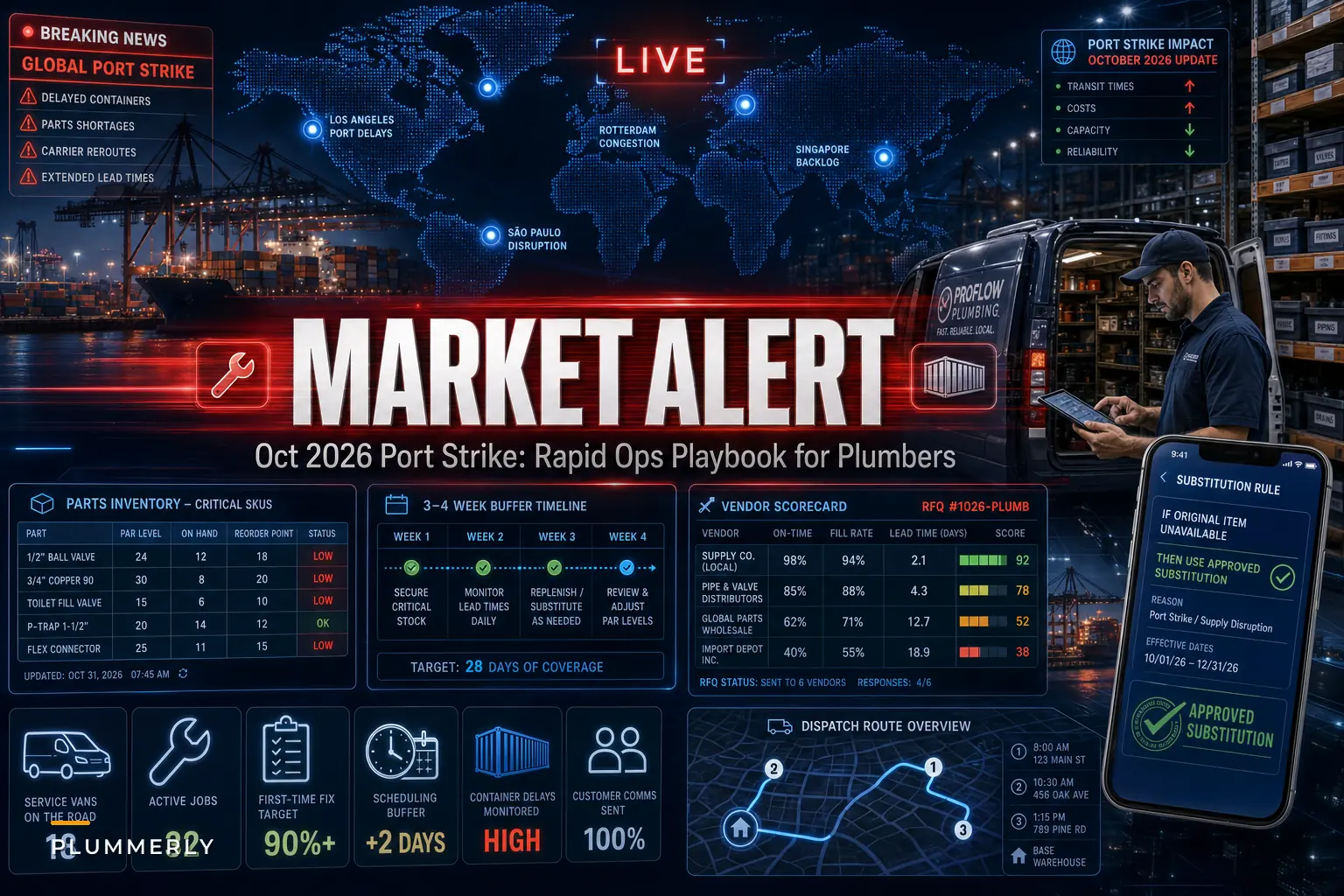

What most plumbing owners underestimate about supply disruptions isn't the shortage itself. It's the delay between when something goes wrong upstream and when it actually wrecks a job on your schedule. By the time a backordered flush valve blows up a Tuesday appointment, the event that caused it happened weeks ago.
That gap is forming right now.
On October 30, 2026, a coordinated dockworker action hit more than 100 ports across roughly 22 countries, with reported disruption at terminals in Europe, India, Mexico, and some U.S. west-coast facilities. Reuters reported that the action spanned a wide range of international ports, and a client advisory from C.H. Robinson flagged potential downstream effects on North American operations, including congestion risk at west-coast ports.
You don't need to follow the geopolitics. You need to know that a significant portion of imported fixtures, specialty fittings, and OEM repair parts move through those lanes — and the lead-time math on your next few restocks is about to get complicated.
This isn't a "stock up on everything" post. That's how shops blow their cash position chasing panic inventory. This is about responding in the right order so the disruption costs you as little as possible.
First, understand how this actually reaches your truck
Most owners hear "port strike" and picture empty shelves the next morning. That's not how it works.
Imported product doesn't come to you directly. It goes port → distributor warehouse → your local supply house → your truck. Each step has its own buffer. When the port backs up, the distributor's buffer absorbs the first wave, the supply house's buffer absorbs the second, and then you feel it.
That's why shelves won't be empty this week. You'll see it in three to six weeks, right as holiday-season service calls ramp up. The real risk isn't the strike day — it's the lag.
Worth naming another pattern: the first thing that disappears is never the common stuff. It's the mid-volume SKUs. Supply houses keep deep stock on fast movers and almost nothing on the "we sell four a month" items — and a lot of imported OEM cartridges, specialty trim, and European-fixture parts live exactly in that zone. The parts that quietly wreck your first-time-fix rate are the ones nobody's tracking.
The exposure audit you should run this week
Before you touch a purchase order, figure out what's actually at risk. Most shops have no idea which of their stocked parts are import-dependent because the box doesn't say "shipped through a contested port."
Stop missing service calls and double bookings.
Plummerly helps you schedule, assign, and manage every plumbing job efficiently.
- Centralized job scheduling
- Technician dispatch & tracking
- Customer notifications
No credit card required
Run a quick classification on your top 40–60 moving SKUs. Sort each into one of three buckets:
| Risk tier | What belongs here | Action |
|---|---|---|
| High exposure | Imported fixtures, brand-specific OEM cartridges, specialty fittings with a single foreign source | Pre-buy a buffer, line up a substitute now |
| Medium exposure | Parts with both domestic and imported variants, or multiple distributor sources | Confirm which source your supply house actually uses |
| Low exposure | Domestically produced commodity items, generic PVC/copper/brass | Leave alone — don't tie up cash here |
The mistake shops make constantly: they buffer the wrong tier. Panic-buying copper and fittings they can get anywhere, while the one $38 brand-specific cartridge that'll cause six return trips gets ignored entirely. Put your cash and attention on the high-exposure column.
One more thing worth flagging. "Exposure" isn't just about the part — it's about where that part shows up in your work. A rare import that only matters for planned remodels can wait. A rare import that shows up in no-hot-water calls cannot. Weight your buffer toward parts tied to emergency and SLA-bound work.
Build temporary substitution rules before you need them
The second return trip is where margin dies. A tech shows up, the exact OEM part isn't available anywhere, and now you're rescheduling a job you've already touched. Each of those re-visits quietly eats $90–$160 in drive time, admin overhead, and lost scheduling capacity — before the customer gets annoyed.
The fix is boring but it works: approved substitution rules, written down, before the shortage bites.
-
Which cross-reference part is an acceptable swap
-
Whether the swap changes the price, and by how much
-
Whether the swap affects warranty or needs customer sign-off
-
Which brands you will not substitute under any circumstances
Without this, every substitution becomes a judgment call made by a tech standing in a customer's bathroom — the worst possible place to make a pricing-and-warranty decision. Half will undercharge. The other half will call the office and burn 15 minutes per job waiting for an answer.
Get the rules into whatever system your techs actually look at — your field-service platform's parts notes, the job template, wherever. The substitution decision should get made once, by you, not forty times in the field under pressure.
Re-examine your vendors while the pressure is on
A disruption like this is an unintentionally honest test of your suppliers. You find out quickly which distributor communicates proactively about delays, which one goes quiet, and which one ships a partial PO without flagging it.
That last one is the killer. Partial fulfillment without notice is how a shop thinks it's stocked, loads the truck, and discovers at 8 a.m. that the reorder came in at 60%.
Now's the time to score vendors on what actually matters in a squeeze: fill rate, delay communication, substitution flexibility, and whether they'll prioritize a contract customer over a walk-in. If you've never formalized this, the vendor scorecard framework for plumbers walks through the KPIs and contract clauses worth tracking — and a shortage window is the best time to see which vendors deserve to stay on the list.
A practical move most owners skip: open a second account at a backup supply house now, before you need it.
Setting up a new distributor relationship mid-crisis, when everyone's chasing the same stock, means you're at the back of the line. A dormant backup account opened early is worth more than any amount of last-minute scrambling.
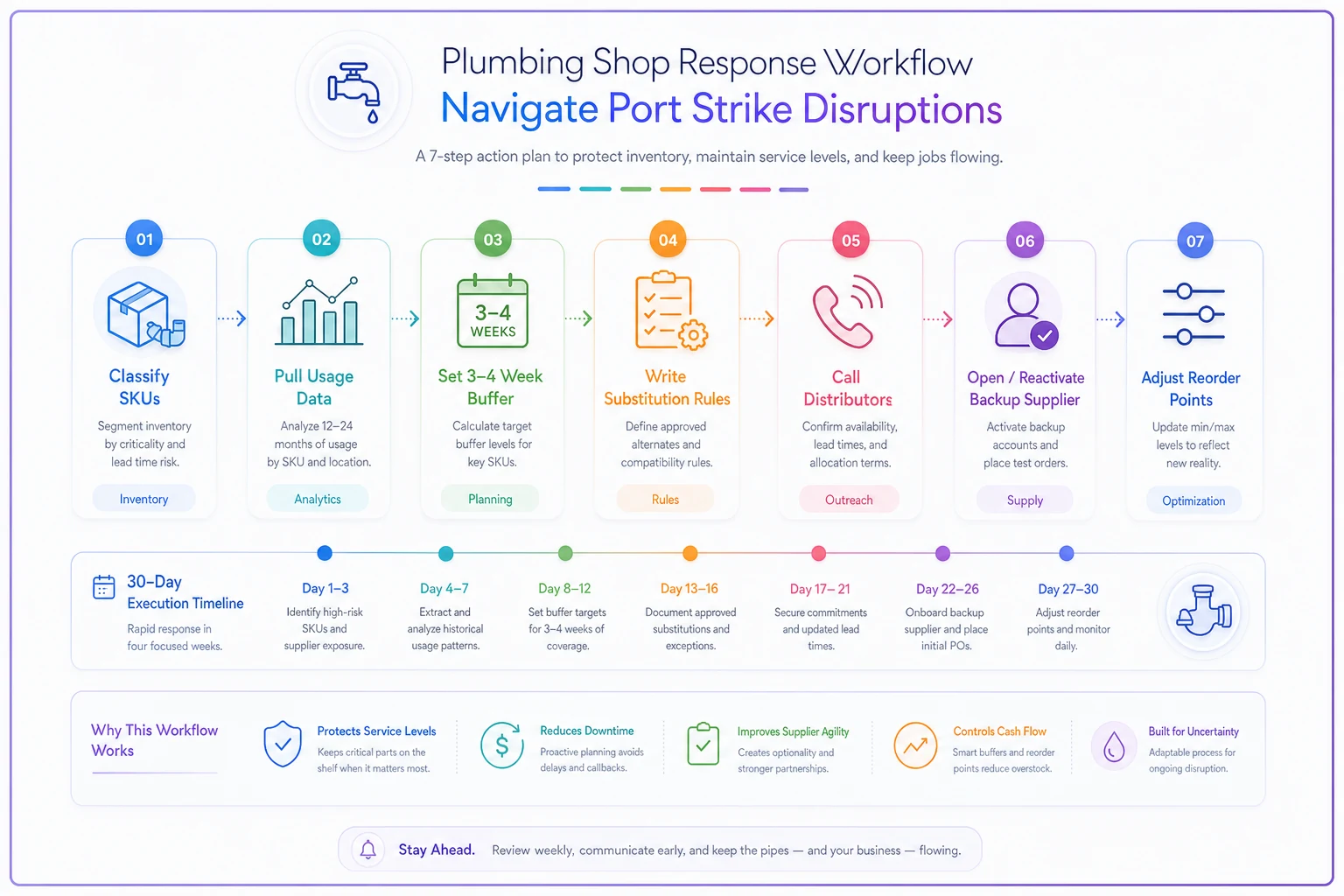
A 7-step response sequence for the next 30 days
Order matters here. Do these in sequence.
A quick visual of the sequence:
-
Classify your top SKUs into the three exposure tiers above. Half a day, max.
-
Pull your actual usage data for high-exposure parts — how many you move per week, not what you think you move.
-
Set a 3–4 week buffer only on high-exposure, emergency-linked parts. Don't buffer everything.
-
Write substitution rules for each high-exposure SKU and get them into the field.
-
Call your primary distributors and ask two direct questions
current lead times on your key SKUs, and their partial-fulfillment notification policy.
-
Open or reactivate a backup supplier account.
-
Adjust reorder points in your inventory system so the lag doesn't catch you blind in week five.
That last step is where a lot of shops lose the thread. If your par-levels and reorder triggers are static, they were calibrated for normal lead times. When lead times stretch from 3 days to 3 weeks, a reorder point that used to be safe now fires too late. Bump trigger quantities on exposed parts temporarily — and set a calendar reminder to put them back once things normalize, so you're not carrying bloated inventory indefinitely.
When buffering is smart — and when it's a trap
Buffering feels responsible, so owners overdo it. A few honest guardrails:
When pre-buying makes sense: the part is import-dependent, tied to emergency or SLA work, has a clean substitute you'd rather avoid relying on, and is inexpensive enough that a few weeks of extra stock won't strain cash. Brand-specific cartridges and common imported trim fit this profile.
When it's a bad idea: the item is bulky, slow-moving, or tied to a specific design trend. Locking up $4k–$6k in fixtures you might install over the next quarter is how a cash-flow problem sneaks up on an otherwise profitable shop.
Who should mostly sit tight: 1–2 truck operations running lean on cash. Your better play is tighter substitution rules and a backup supplier, not a warehouse full of hedged inventory you can't afford to float.
Over-buffering and under-buffering both cost money — one in dead cash, one in return trips. Shops that handle disruptions well aren't the ones that stockpile. They're the ones that know exactly which 15 parts matter and leave the rest alone.
A real scenario
Consider a four-truck shop doing mostly residential service and light remodels, heavy on a couple of imported fixture brands, with their most common repeat part being a brand-specific mixing cartridge — moving roughly 20–25 units a month.
During a prior supply crunch, they got caught flat. The cartridge backordered, nobody had flagged it as import-dependent, and over about three weeks they absorbed close to a dozen return trips — somewhere in the range of $1,100–$1,400 in lost time and re-dispatch costs, plus two maintenance-plan customers who expected same-visit fixes and didn't get them.
The second time around, they'd done the exposure audit. That cartridge was in the high-exposure tier, they carried a 3-week buffer on it specifically, and they had a written substitute approved with a small price adjustment and a customer sign-off line already in the job template. When the shortage hit, return trips on that part dropped to almost nothing.
Same disruption, very different month. The difference wasn't more inventory overall — it was targeted inventory plus a decision made before the crisis, not during it.
The deeper problem this exposes
Port strikes are temporary. The weaknesses they reveal aren't.
Most small plumbing shops run their parts strategy on memory and habit. Par-levels were set once and never touched. Nobody knows which SKUs are import-dependent. Substitution happens ad hoc in the field. There's one supplier and no backup. Under normal conditions, all of that functions fine — the system's slack hides the gaps.
A disruption removes the slack. Suddenly the undocumented substitution rule matters. The single-supplier dependency matters. The static reorder point matters. The strike didn't create those problems. It just made them visible.
Treat this as a stress test rather than an emergency. Run the exposure audit, write the substitution rules, open the backup account, and tune your reorder points. Keep the parts of that work that stay useful once the ports clear — because the next disruption, whatever its cause, will hit the exact same seams.
Shops that close those seams now won't just survive this one. They'll barely notice the next.
Ready to optimize your plumbing operations?
Join 500+ plumbing businesses using Plummerly to save time, reduce scheduling errors, and improve customer satisfaction.