

Most plumbing shops track everything about their techs and almost nothing about their suppliers. You know your first-time-fix rate, your average ticket, maybe your close ratio. But ask a three-truck shop which of their two supply houses actually delivers on time more often, and you'll usually get a shrug and a gut feeling. "The one on Fifth Street is better, I think."
That gut feeling costs money. When a water heater shows up a day late and you have to reschedule a customer who took time off work, that's not the supplier's problem on paper — but it becomes your problem in every way that matters. A vendor scorecard replaces the "I think" with numbers you can act on.
This isn't about building some corporate procurement department. It's about a one-page tracking system that tells you which supplier to call first, which one to renegotiate with, and which one to quietly drop.
The specific problem: you're loyal to suppliers based on the wrong signals
What drives supplier loyalty at most small plumbing shops? The counter guy is friendly, they gave you net-30 when you were starting out, or they're five minutes from the shop. None of that measures whether the supplier is actually helping or hurting your operation.
A typical scenario looks like this. A shop runs about 80% of its parts spend through one wholesaler because "they've always taken care of us." But when you actually track it, that wholesaler fills roughly 84% of a given order complete on the first pass. The other 16% shows up as backorders or substitutions — which means return trips and scrambling. The second supplier the shop barely uses? They fill closer to 95% complete, but nobody noticed because nobody was counting.
The relationship feels good. The numbers say something else. Without a scorecard, the feeling wins every time — and the feeling is expensive.
The three KPIs that actually matter for plumbing procurement
You don't need fifteen metrics. For a small contractor, three numbers tell you almost everything about whether a supplier deserves your volume.
Stop missing service calls and double bookings.
Plummerly helps you schedule, assign, and manage every plumbing job efficiently.
- Centralized job scheduling
- Technician dispatch & tracking
- Customer notifications
No credit card required
On-Time Delivery (OTD). The percentage of orders (or will-call pickups) ready by the promised time. This is the one that directly wrecks your schedule. Define it tight: "on time" means the full order, ready or delivered by the committed window — not "most of it showed up eventually."
Fill Rate. The percentage of line items delivered complete on the first attempt — no backorders, no "we'll have it Thursday." Fill rate is the quiet killer because a partial order still feels like a win at the counter. You walked out with something. But if two of your six fittings are missing, your tech is making a second trip or improvising on-site.
Invoice Accuracy. The percentage of invoices that match the quoted price with no surprise line items, wrong quantities, or phantom freight charges. This one bleeds you slowly. A $14 overcharge here, a double-billed elbow there — nobody catches it on a busy week, and it adds up across a year.
Here's how those three break down in terms of what they protect:
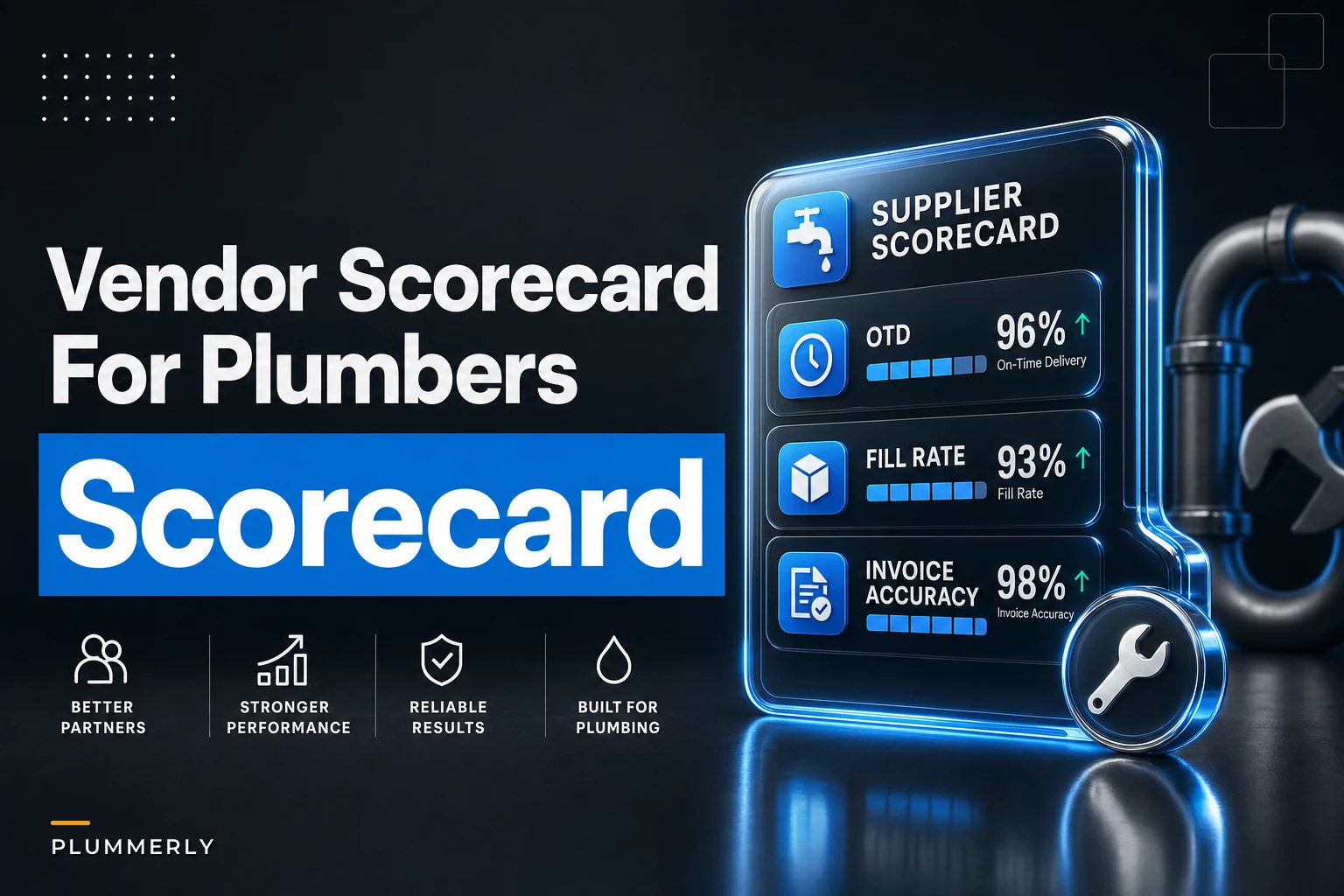
| KPI | What it protects | How to measure it | Target for a small shop |
|---|---|---|---|
| On-Time Delivery (OTD) | Your schedule and customer trust | Orders on time ÷ total orders | 95%+ |
| Fill Rate | Return trips and tech productivity | Complete lines ÷ ordered lines | 93%+ |
| Invoice Accuracy | Your margins and A/P time | Correct invoices ÷ total invoices | 98%+ |
The targets aren't sacred — adjust them for your market. In a rural area, 95% OTD might be a fantasy and 88% is your reality. The point is having a number to compare suppliers against each other, not chasing a benchmark from some national distributor.
Building the scorecard itself
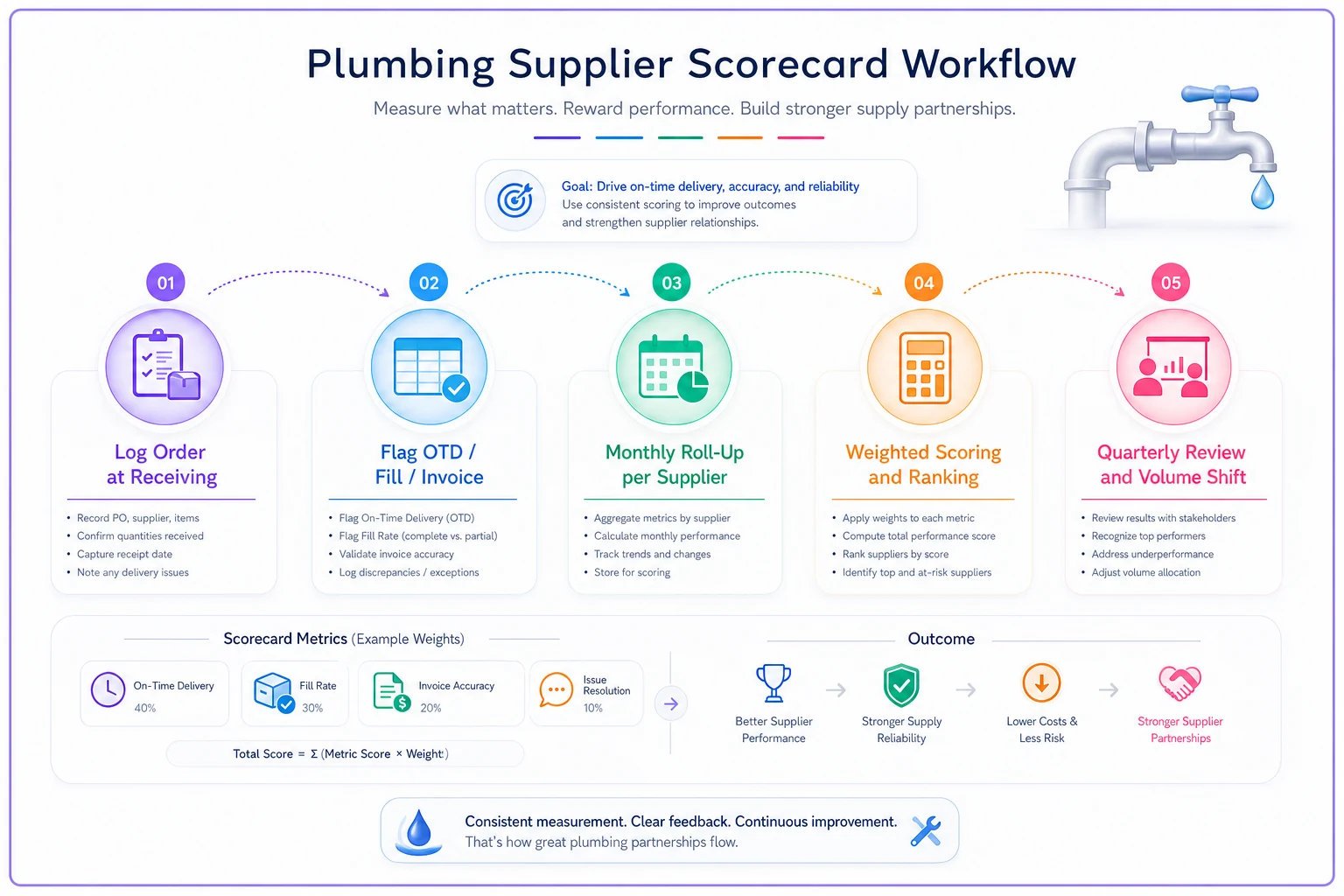
The scorecard is a running tally, not a one-time audit. Every order becomes a data point. You're logging four things per order: was it on time (yes/no), were all lines filled (yes/no), did the invoice match (yes/no), and any notes worth keeping.
At the end of the month you roll those up per supplier. A shop doing 40–60 supply orders a month has more than enough data after 60 days to see clear patterns.
A simple scoring approach that works:
-
1. Log every order with the three yes/no checks plus a notes field for anything unusual — wrong item, rude counter interaction, surprise freight.
-
2. Roll up monthly into per-supplier percentages for OTD, fill rate, and invoice accuracy.
-
3. Weight the score based on what hurts you most. Most shops weight OTD heaviest because schedule disruption cascades. Try 40% OTD, 35% fill rate, 25% invoice accuracy.
-
4. Rank suppliers by their weighted composite score.
-
5. Set a floor. Any supplier below a composite of around 85% goes on a watch list and gets a direct conversation.
-
6. Review quarterly and actually shift volume toward the top performer.
The discipline is in step 6. Plenty of shops build the scorecard, see the truth, and then keep ordering from the friendly-but-mediocre supplier anyway. The data only helps if you let it change behavior.
Where this gets tedious is the logging. If someone has to remember to fill out a spreadsheet after every counter run, it won't happen consistently. Tying the scorecard to your existing purchasing workflow matters — the same system where you're already tracking parts against your truck parts par-level matrix can capture on-time and fill-rate flags at the moment of receiving, so the data collects itself instead of relying on memory.
A quick visual of the logging-to-review workflow can make it easier to hand off responsibility and keep it consistent.
Tying the scorecard to your existing purchasing workflow matters — the same system where you're already tracking parts against your truck parts par-level matrix can capture on-time and fill-rate flags at the moment of receiving, so the data collects itself instead of relying on memory.
RFQ templates that make suppliers compete on the right terms
Most plumbing RFQs are a phone call: "Hey, what's your price on a 50-gallon gas water heater?" You get a number, maybe you call one other place, and you go with the lower one. That's a price check, not a request for quote — and it leaves everything else undefined.
A real RFQ, even a simple one, forces suppliers to commit to the stuff that actually affects your job. Here's the structure that works for a small contractor without turning into paperwork:
Header block:
-
Your shop name and account number
-
Date and quote-valid-through date
-
Delivery location or will-call
-
Required date/time
Line items: part number, description, quantity, manufacturer if it matters.
The terms you actually need answered:
-
Unit price and any volume break
-
Lead time / availability (in stock vs. days out)
-
Delivery fee or freight, if any
-
Substitution policy — will they swap brands without asking?
-
Return/restocking terms
-
Payment terms
That substitution line is the one nobody includes and everybody regrets. When a supplier quietly ships a different brand of valve because yours was out, your tech opens the box in a crawlspace and has to decide whether the substitute is acceptable — on the clock, in front of the customer. Requiring "no substitutions without approval" in writing prevents that entire scenario.
Send the same RFQ to two or three local suppliers for anything above a certain dollar threshold — a lot of shops use around $500 for parts, or any special-order item. Below that threshold, use your scorecard ranking and go with the top supplier. You don't need to competitively bid a box of wax rings.
A note on local supplier RFQs specifically
Local wholesalers push back on formal RFQs at first because they're used to the phone-call-and-handshake rhythm. Frame it as helping them win more of your business, not as bureaucracy. "I'm sending the same list to a couple places so I can commit more volume to whoever's got the best availability" is a sentence that gets counter managers to sharpen their pencils fast.
Contract clauses small contractors actually need
You're not signing a defense contract. But even a two-page supply agreement should have a handful of clauses that protect you when things go sideways. These are the ones that earn their keep:
-
Price protection window. Quoted prices hold for a defined period — 30–90 days on non-commodity items. Copper's going to move, accept that, but you shouldn't get a different price on a stocked fitting than you were quoted last week.
-
Lead-time commitment with a remedy. Not just "we'll try to deliver by X," but what happens if they don't. Even a modest remedy — expedited shipping at their cost, or a credit — changes behavior.
-
Substitution approval. No brand or spec swaps without your written okay. Puts the substitution problem in the contract, not just the RFQ.
-
Return and restocking terms. Defined restocking fee cap and a return window. You order wrong sometimes; you shouldn't eat a 40% restock on a part you're bringing back the next morning.
-
Invoice dispute window. You get a defined period — say 15 days — to flag billing errors without it counting against your account standing.
-
Volume-based pricing tiers. If you're committing real volume, get the price to reflect that, spelled out.
The mistake isn't failing to negotiate — it's negotiating verbally and never writing it down. Six months later the friendly counter guy who promised you 5% off has moved to another branch, and nobody at the supply house has any record of your deal.
When a formal contract isn't worth it
If a supplier represents less than 10% of your spend and you use them occasionally for niche items, don't bother with a signed agreement. The RFQ discipline and scorecard tracking are enough. Contracts are worth the effort only for suppliers carrying real volume — the two or three houses running the bulk of your parts. For everyone else, the paperwork costs more than it saves.
Audit cadence tailored to a shop that's already busy
The reason most vendor programs die is that they're built for someone with time to run them. A three-truck shop owner doesn't have a procurement analyst. The cadence has to be light enough to survive a busy season.
A realistic rhythm:
-
Weekly (5 minutes) Glance at any flagged orders — late deliveries, wrong items, invoice mismatches. Just note them. No analysis.
-
Monthly (20 minutes) Roll up the scorecard. See where each supplier landed on the three KPIs. Flag anything that dropped noticeably.
-
Quarterly (45 minutes) Real review. Rank suppliers, decide where volume shifts, have the direct conversation with anyone on the watch list. Re-run RFQs on your highest-spend categories.
-
Annually Revisit contract terms and pricing tiers before renewal. This is when volume commitments get renegotiated.
The weekly touch is what makes the rest work. If you wait until month-end to remember that three orders were late, you've lost the detail. A quick flag at the moment it happens — logged wherever you're already handling receiving — keeps the monthly rollup honest. This ties naturally into the receiving and purchasing SOPs in your operations playbook, so the audit isn't a separate task but a byproduct of work you're already doing.
A real scenario: what the numbers looked like
A four-truck residential shop was running about 90% of its parts through one longtime wholesaler. No scorecard, pure loyalty. After tracking for two months, the picture wasn't pretty: OTD around 87%, fill rate near 85%, and invoice accuracy — the surprise — sitting around 94% because of repeated small overcharges on freight and quantities.
Those numbers translated to real disruption. Roughly three or four rescheduled jobs a month traced back to late or incomplete deliveries. The invoice slippage was harder to see but added up to somewhere around $200–$300 a month in charges nobody was catching.
They ran RFQs on their top parts categories to a second local house, wrote a short agreement with substitution and price-protection clauses, and shifted about a third of their volume based on the scorecard. Within a quarter, the primary supplier — now aware they were being measured and losing volume — pulled their OTD back above 93% just to keep the business. The invoice overcharges stopped almost immediately once there was a dispute window and someone was actually checking.
The win wasn't dramatic in dollars. Maybe a couple thousand a year in caught overcharges, plus a handful of jobs a month that stopped falling apart. But the schedule got noticeably more predictable, and predictable is what lets a small shop stop firefighting.
Who should skip most of this
If you're a solo owner-operator buying from one supply house five minutes away, a full scorecard-and-contract system is overkill. Track invoice accuracy — because that one is pure money — and keep an informal mental note of late deliveries, but don't build the whole apparatus.
The scorecard earns its keep once you're at two-plus trucks, spending enough that supplier performance actually swings your schedule, and using more than one supply house. That's the threshold where the "I think the Fifth Street place is better" guessing starts costing you real jobs, and where a page of numbers pays for the hour a quarter it takes to maintain.
The goal was never to build procurement bureaucracy. It's to stop making a five-figure annual decision — which supplier gets your volume — based on whether the counter guy remembers your name.
The goal was never to build procurement bureaucracy. It's to stop making a five-figure annual decision — which supplier gets your volume — based on whether the counter guy remembers your name.
Ready to optimize your plumbing operations?
Join 500+ plumbing businesses using Plummerly to save time, reduce scheduling errors, and improve customer satisfaction.