

Every plumbing owner knows the feeling. A cold snap hits on a Friday night, pipes start bursting across three zip codes, and suddenly you've got 40 calls stacked against four trucks. Or a sewer main backs up after a storm and half your scheduled maintenance gets blown apart by emergency reroutes. The calls don't stop. Your crew does — because they're human, because trucks need parts, because dispatch can only juggle so much at once.
What separates shops that handle these peaks from shops that burn out and eat bad reviews isn't luck. It's whether they've written down — before the storm — what happens when demand hits certain thresholds. That's what resilience governance actually means. Not a binder nobody reads. A small set of rules that tell your team what to do when things cross lines you've defined ahead of time.
Most shops run their peaks on vibes. The owner stays up until 11pm texting techs, calling a buddy's shop to take overflow, and bumping maintenance customers with no consistent logic. It works until it doesn't. A real plumbing surge staffing plan replaces that improvisation with triggers, templates, and pre-agreed mutual-aid arrangements so the whole thing runs without you being the single point of failure.
Why peaks break small fleets specifically
Big regional companies absorb surges because they have bench depth. If three techs are swamped, there are nine more. Small fleets — one to ten trucks — don't have that slack. When you're running four trucks at 90% utilization on a normal Tuesday, a 30% demand spike doesn't mean "work a little harder." It means you physically cannot serve the demand without changing something structural.
The pattern that shows up across small operations: the surge doesn't break the field first. It breaks the office. Dispatch becomes the bottleneck. One person is trying to triage incoming emergencies, re-sequence existing jobs, call customers to push appointments, check parts availability, and decide who gets overtime — all at once, all in their head. The techs are actually fine. The coordination layer collapses.
And because nobody wrote down the decision rules, every surge gets handled differently. One week you bump maintenance customers. Next week you bump the wrong emergency and a loyal commercial account walks. The inconsistency is what erodes trust, not the fact that you were busy.
There's also a quieter failure point: cash and legal exposure. Surge pricing applied inconsistently, overtime that blows your labor math, subcontracting to another shop with no written agreement about liability or warranty — these create messes that surface weeks later when an invoice gets disputed or a job done by your "mutual-aid partner" goes wrong and nobody's sure who's responsible.
The three layers of a resilience system
A working surge plan has three layers that connect. Skip one and the others don't hold.
Stop missing service calls and double bookings.
Plummerly helps you schedule, assign, and manage every plumbing job efficiently.
- Centralized job scheduling
- Technician dispatch & tracking
- Customer notifications
No credit card required
Layer one is your internal buffer — the slack you build into your own operation so a small spike doesn't require outside help. This is your micro-buffer: reserved capacity, a daily emergency float, a weekly cushion you don't book against. If you haven't built this yet, start with the micro-buffer rules for very small fleets, because everything above it assumes you've got a defined float to activate.
Layer two is surge activation — the rules that say "we are now in surge mode" and change how you price, schedule, and staff. This is the layer most shops are missing entirely. They know they're busy, but there's no formal switch that flips, no shared understanding that today's rules are different from a normal day.
Layer three is mutual aid — pre-arranged agreements with other shops to take overflow or lend capacity, with the legal and operational details sorted out before you need them, not during a 7am panic call.
If you haven't built this yet, start with the micro-buffer rules for very small fleets.
The whole thing works like a staircase. Normal demand runs on normal rules. A moderate spike burns your internal buffer. A serious spike flips surge mode. A severe spike activates mutual aid. Each step has a defined trigger, so nobody has to guess which gear you're in.
Defining your activation thresholds
The single most useful thing you can do is write down the numbers that move you from one gear to the next. Vague thresholds — "when we get really busy" — are useless because they mean something different to every person on your team.
A typical threshold structure for a four-truck residential shop looks something like this:
| Gear | Trigger | What changes |
|---|---|---|
| Normal | Booked under ~85% of daily capacity | Standard pricing, standard scheduling |
| Buffer burn | 85–100% booked, emergencies filling the day's float | Protect maintenance slots, draw from daily float |
| Surge | Demand exceeds capacity by ~20%+, float exhausted | Surge pricing on non-contract work, overtime authorized, triage tightens |
| Mutual aid | Demand exceeds capacity by ~40%+ for 2+ days | Activate partner shop agreements, formal overflow routing |
The exact percentages matter less than the fact that they exist and your team knows them. The point is removing the judgment call from a stressed dispatcher at the worst possible moment. When you're booked past 100% and the float's gone, surge mode isn't a debate — it's already defined.
One pattern worth flagging: shops tend to activate surge mode too late and deactivate it too early. They wait until they're drowning before flipping the switch, then drop back to normal rules the moment they catch up — right before the second wave hits. Build a little hysteresis in. Stay in surge mode until demand drops clearly below the trigger, not the instant it touches it.
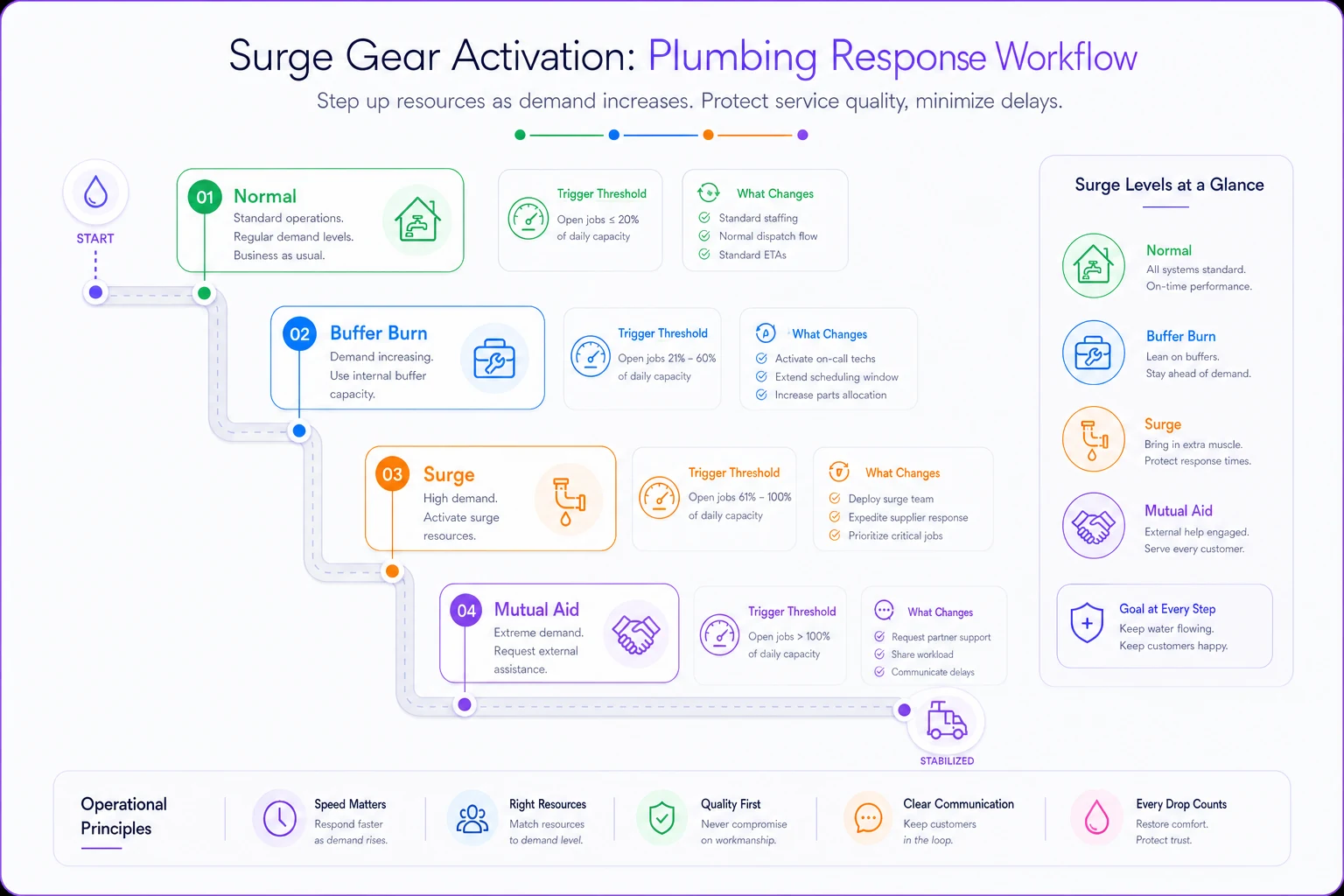
A simple visual like this helps make the activation flow obvious to dispatch and leadership so there's no argument when the numbers cross the line.
Surge pricing rules that don't feel like gouging
Surge pricing in plumbing is legitimate — after-hours emergency work genuinely costs more to deliver. But it falls apart when it's applied inconsistently or feels arbitrary to the customer. The fix is to make it rule-based and disclosed, not improvised.
-
Contract and maintenance-plan customers are protected from surge rates. This is the entire point of having them on a plan. Honoring that during a peak is what makes those plans worth selling.
-
Surge applies to a defined category of work — typically after-hours emergency dispatch — not to everything just because you're busy.
-
The surcharge is a known number, disclosed before the tech is dispatched, not a surprise on the invoice. "Our after-hours emergency dispatch rate during high-demand periods is X" is a sentence your intake person should be able to say cleanly.
-
You document when surge pricing was active. If a rate ever gets disputed, you want a record showing the shop was in a declared surge window with a consistent rule applied to everyone.
The mistake here is emotional pricing — charging more because you're annoyed and overwhelmed rather than because a rule triggered it. Customers can tell the difference. A rate that applies uniformly during a declared window reads as policy. A rate that varies by how stressed your dispatcher was reads as gouging, and that's exactly what generates the one-star reviews.
Mutual-aid agreements: get the paper done early
Mutual aid is the layer most small shops improvise and later regret. The informal version — "I'll call Dave if I get slammed" — fails precisely when you need it, because Dave is also slammed by the same storm that hit you, and neither of you worked out the terms beforehand.
-
Who takes overflow in which direction, and the rate the receiving shop charges the sending shop (usually a wholesale/trade rate, not retail).
-
Warranty responsibility. If the partner shop does the work, who owns the callback? Pin this down. The default should be that whoever performs the work warranties it, but say so explicitly.
-
Insurance and liability. Both shops should carry their own coverage and confirm it in writing. A handshake deal leaves you exposed if a partner's tech floods a basement.
-
Customer communication. Does the customer know a partner shop is coming? In residential work, usually yes — they should. Decide the script ahead of time.
-
Billing flow. Does the original shop invoice the customer and pay the partner, or does the partner bill direct? Keeping the customer relationship with the original shop is almost always the right call.
Set these up with two or three shops that serve adjacent territory, not direct door-to-door competitors. The goal is geographic overlap without head-to-head rivalry — shops that are busy when you're busy but can occasionally flex because their mix is different.
The legal and operational checklist
Before your next predictable peak season, run this check. It's the stuff that quietly creates liability or lost revenue during a surge:
-
[ ] Written mutual-aid agreements signed with 2–3 partner shops
-
[ ] Surge pricing rates defined, disclosed in your intake script, and documented when active
-
[ ] Overtime rules and caps agreed with your crew in advance (and compliant with your state's labor rules)
-
[ ] Insurance coverage confirmed for subcontracted/overflow work in both directions
-
[ ] Warranty ownership defined for any work performed by partner shops
-
[ ] Customer communication templates written for bumped appointments and partner-shop dispatch
-
[ ] Clear triage rules for which jobs get priority when you're over capacity
-
[ ] A named person authorized to declare surge mode (and a backup)
That last one matters more than it looks. If flipping into surge mode requires the owner's sign-off and the owner is on a job with no signal, the whole system stalls. Name a backup who can pull the trigger. Your triage logic during a surge should lean on the same decision framework you use for normal job routing. If you've already built a service delivery model with decision rules for SLAs and routing, surge triage is just a tighter version of that same logic — same categories, stricter cutoffs.
Rostering for peaks: a worked example
Here's how the staffing side plays out in practice. Say you run five techs across four trucks (one floater), normal daily capacity around 20–24 jobs. A winter cold snap pushes incoming emergency volume to roughly 35 calls a day for three straight days.
-
Buffer burn triggers automatically. Your daily emergency float — say three slots held open — absorbs the first wave. By midday the float's gone and you're booked past 100%.
-
Surge declares. Non-contract after-hours work moves to surge rate. You authorize staggered overtime — not everyone at once, which burns the crew out by day two. Two techs work extended hours day one, the other three day two, rotating so nobody does three brutal days back to back.
-
You pull in more hours by shifting your floater from standby to full dispatch, and you move your most experienced tech into a "diagnose and stage" role — doing rapid triage visits to confirm scope and stage parts so the newer techs can run faster behind them.
-
Demand holds above the 40% line into day two, so mutual aid activates. Your partner shop takes 6–8 overflow jobs a day at trade rate. You keep the customer relationship and the invoicing; they supply the labor.
The outcome in a scenario like this isn't "you served every call perfectly." You won't. The outcome is that you served the genuine emergencies, protected your plan customers, didn't torch your crew, and didn't improvise pricing you'll regret. The difference between that and a bad surge is usually just whether the rules existed before the storm.
When formal resilience governance isn't worth it
If you're a solo owner-operator with one truck, most of this is overkill. Your surge plan is "I work late and refer overflow to a buddy." Writing a four-gear activation matrix for a one-person shop is theater. You do want one thing: a couple of shops you can hand overflow to, with a quick verbal understanding of rates. That's enough at that size.
The formal version starts earning its keep around three trucks and up, where dispatch becomes a real coordination job and the cost of inconsistent surge handling — lost accounts, disputed invoices, crew burnout — starts adding up to real money. It's also a bad fit if your demand is genuinely flat year-round with no real peaks. Some commercial-maintenance-heavy shops have smooth, predictable volume. If you've never had a day where demand blew past capacity, don't build machinery for a problem you don't have. Build the micro-buffer, skip the rest until you see real spikes.
Where the coordination layer tends to fail
The practical bottleneck in all of this is information. During a surge, the shops that hold together are the ones where dispatch can see — in one place — what's booked, what float is left, which techs are maxed on hours, what parts are staged, and which jobs are actual emergencies versus pushable. The shops that fall apart are the ones where that information lives in four different places and one person's head.
This is where having your scheduling, dispatch, and job data centralized actually earns its cost. Not because software makes decisions for you, but because when you're over capacity, the difference between a controlled surge and chaos is often just whether your dispatcher can see the whole board at once. When thresholds, float levels, and tech availability are visible in the same system, flipping into surge mode is a decision you make with facts instead of guesses. When that data is scattered, every surge becomes a scramble regardless of how good your written rules are.
The written rules and the visibility reinforce each other. Rules without data mean your dispatcher knows what should happen but can't see when the trigger's been hit. Data without rules means you can see the chaos clearly but still don't know what to do about it. You need both working together — and the shops that figure that out early tend to come out of peak season with their crew intact and their customer relationships still standing.
The real test
You'll know your resilience system works the first time a serious peak hits and you don't get the midnight panic call. Dispatch flips into surge mode because the trigger was clear. Overflow routes to a partner shop whose paperwork was already signed. Your maintenance customers keep their protected rates and stay loyal. The crew gets stretched but not broken because overtime rotated instead of piling onto the same two people.
None of that happens by accident, and none of it happens during the storm. It happens in the quiet weeks beforehand, when you take an afternoon to write down the thresholds, sign the mutual-aid agreements, and agree on who gets to say "we're in surge mode now." The peak is coming either way — the only question is whether your shop meets it with a plan or improvises its way through one more exhausting weekend.
None of that happens by accident, and none of it happens during the storm. It happens in the quiet weeks beforehand, when you take an afternoon to write down the thresholds, sign the mutual-aid agreements, and agree on who gets to say "we're in surge mode now." The peak is coming either way — the only question is whether your shop meets it with a plan or improvises its way through one more exhausting weekend.
Ready to optimize your plumbing operations?
Join 500+ plumbing businesses using Plummerly to save time, reduce scheduling errors, and improve customer satisfaction.