



Running a plumbing operation with just a handful of trucks feels like walking a tightrope. One broken transmission or a tech who woke up sick can derail your entire day. And most scheduling advice out there assumes you've got 20+ trucks and can absorb disruptions through sheer volume.
That's just not the world a 1–5 truck operation lives in. You need emergency float rules that work at small scale—not complex routing algorithms or enterprise dispatch software that treats your three trucks like a municipal fleet.
Why Traditional Dispatch Rules Break Down at Small Scale
Standard dispatch wisdom says maintain 15–20% capacity buffer. Sounds reasonable until you do the math on a three-truck operation. That's half a truck. You can't run half a vehicle.
Small fleets face a completely different pressure than larger ones. When you've got 30 trucks and one breaks down, you're at 96.7% capacity. When you've got three trucks and one breaks, you're at 66%. That's the difference between a minor hiccup and telling multiple customers you can't come today.
The math gets uglier during busy season. A five-truck operation running at full capacity during summer AC drain line season has zero flexibility. One tech gets food poisoning and suddenly you're scrambling to reschedule eight appointments while fielding angry calls.
What makes this particularly hard is that small operations can't justify keeping an extra truck sitting idle. Insurance, maintenance, depreciation—those carrying costs eat into already thin margins. You need buffer strategies that don't require expensive redundancy.
The Real Cost of Running Without Float
Most owners underestimate what operating without buffer capacity actually costs them. It's not just the immediate lost revenue from cancelled appointments.
Stop missing service calls and double bookings.
Plummerly helps you schedule, assign, and manage every plumbing job efficiently.
- Centralized job scheduling
- Technician dispatch & tracking
- Customer notifications
No credit card required
Consider a typical scenario: your lead tech's truck breaks down Monday morning. You shuffle appointments to your other two trucks, pushing non-urgent calls to Tuesday. But Tuesday was already 80% booked, so now you're pushing to Wednesday. By then, the water heater replacement that the customer was patient about has become a genuine emergency because the unit finally failed. Now they're calling a competitor who can come today.
The cascade effect adds up fast. Customers who get bumped once might forgive you. Customers who get bumped twice rarely come back. And in a small market where word travels, those lost customers tell their neighbors.
Beyond customer loss, running without buffers burns out your team. Techs working 12-hour days to cover a sick colleague make more mistakes. Dispatchers constantly juggling crisis scheduling miss chances to book profitable work. And the owner—probably you—ends up back in a truck instead of running the business.
Building Your Emergency Float Framework
The solution isn't spare trucks—it's building buffer rules that actually match your capacity. After seeing a lot of small plumbing operations struggle with this, some clear patterns emerge about what works.
Start by understanding your true capacity points. A three-truck operation doesn't have three units of capacity—it has multiple capacity types:
-
Geographic capacity
How much ground can you realistically cover?
-
Skill capacity
Which techs can handle which job types?
-
Time capacity
How many labor hours do you actually have?
-
Equipment capacity
What specialized tools limit certain jobs?
Your emergency float rules need to account for all four, not just vehicle count.
The most practical approach uses graduated buffer zones based on probability. Instead of maintaining constant excess capacity, you build triggers that activate different buffer strategies as risk increases.
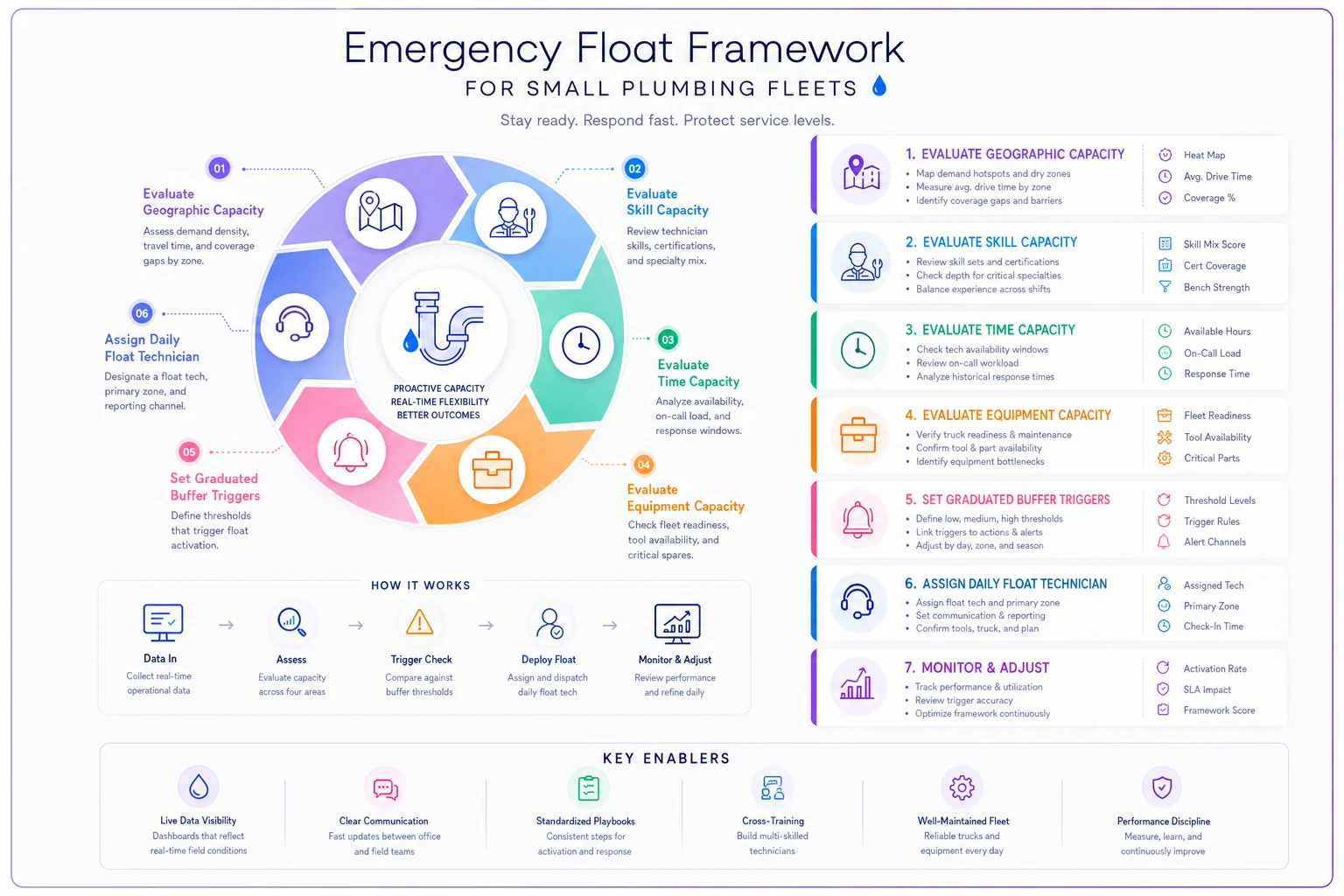
This diagram walks through the steps from assessing capacity types to activating graduated buffer triggers and assigning a daily float tech.
Focus initial buffers on time capacity first—overruns hit your schedule fastest, so time-based float is the highest-leverage place to start.
The most practical approach uses graduated buffer zones based on probability. Instead of maintaining constant excess capacity, you build triggers that activate different buffer strategies as risk increases.
Daily Buffer Rules by Fleet Size
Single Truck Operations
With one truck, traditional buffer concepts don't really apply—you're either working or you're not. Your emergency float becomes about time management and outside partnerships.
Reserve two or three appointment slots daily for same-day emergency calls. This does two things: it keeps you available for genuine emergencies and creates natural buffer when jobs run long. If no emergencies show up, fill those slots with quick-turn work like faucet replacements you can knock out in under an hour.
Build reciprocal coverage agreements with two non-competing plumbers in adjacent areas. Not direct competitors—find someone who specializes in commercial while you do residential, or someone focused on new construction while you handle service work. When either of you has truck trouble, the other provides backup for a day at predetermined rates.
Keep one lighter day per week—typically Wednesday or Thursday. Book it at 60% capacity max. This becomes your catch-up day when Monday's breakdown pushes everything back.
Two Truck Operations
Two trucks give you minimal redundancy, but only if you're careful about load balancing. The mistake here is running both trucks at 100% simultaneously.
Staggered scheduling where trucks operate at different capacity levels throughout the week works better: Monday/Tuesday: Truck A at 90%, Truck B at 70% Wednesday/Thursday: Truck A at 70%, Truck B at 90% Friday: Both at 80%
This rotation ensures you always have some surge capacity without sacrificing too much revenue. The lighter-loaded truck handles emergencies and overflow.
It's also worth maintaining a "technical assistant float" arrangement with a qualified handyperson or apprentice plumber who can handle basic calls independently. They might not replace a water heater, but they can diagnose leaks, swap flappers, and buy you time on non-critical issues.
Three to Five Truck Operations
At this scale you can implement actual buffer math, but it needs to stay simple enough to manage without dedicated dispatch software.
The "Rule of Fives" works well here: for every five scheduled hours across your fleet, keep one hour unscheduled. With three trucks working 8-hour days, that's 24 scheduled hours daily—roughly 5 hours of float time distributed across the fleet.
-
New installation jobs
10% buffer (rarely run over)
-
Standard service calls
20% buffer (moderate overrun risk)
-
Diagnostic/emergency calls
35% buffer (high uncertainty)
Don't spread that evenly. Concentrate buffer time based on job type risk:
A daily "float technician" rotation also helps at this size—one team member starts their day without scheduled calls. They handle emergencies, overflow, and callback issues. The role rotates daily so no single tech is always stuck with unpredictable work.
Weekly Planning Tables for Different Call Volumes
Your emergency float rules need to flex around predictable volume patterns. Small operations see real swings—Monday might bring 15 calls while Wednesday brings 6.
Low Season (November–February)
| Day | Expected Calls | Schedule Target | Float Hours | Notes |
|---|---|---|---|---|
| Monday | 8–10 | 7 calls | 3 hours | Post-weekend emergencies |
| Tuesday | 6–8 | 6 calls | 2 hours | Standard flow |
| Wednesday | 4–6 | 5 calls | 2 hours | Maintenance window |
| Thursday | 5–7 | 6 calls | 2 hours | Standard flow |
| Friday | 7–9 | 6 calls | 3 hours | Weekend prep buffer |
Peak Season (June–August)
| Day | Expected Calls | Schedule Target | Float Hours | Notes |
|---|---|---|---|---|
| Monday | 12–15 | 10 calls | 4 hours | Heavy emergency load |
| Tuesday | 10–12 | 9 calls | 3 hours | Overflow from Monday |
| Wednesday | 8–10 | 8 calls | 2 hours | Mid-week lighter |
| Thursday | 9–11 | 8 calls | 3 hours | Building to Friday |
| Friday | 11–14 | 9 calls | 4 hours | Must maintain buffer |
Scheduling below your expected volume during peak season feels wrong when the phone is ringing. But it's what prevents the cascade failures that damage your reputation and break your team's morale.
Geographic Buffer Strategies
Small fleets waste enormous capacity on drive time. Unlike larger operations that can dedicate trucks to zones, you need flexible geographic rules that maximize coverage without complicated routing.
The "Anchor Point System" works better than traditional zones for small fleets. Each truck gets a daily anchor point—typically the neighborhood with their first and last scheduled calls. All mid-day additions need to be within 15 minutes of that anchor.
This creates natural geographic buffers. When emergency calls come in, you're not sending someone 45 minutes across town and wrecking the whole day. The truck already in that area handles it.
For two-truck operations, anchors should sit roughly 20–30 minutes apart—enough overlap in the middle, but distinct coverage on the edges. Three or more trucks can use triangulated anchors that create natural response zones without rigid boundaries.
Also worth building a simple "drive time tax" into scheduling. Every call more than 20 minutes from the previous one costs an extra 30-minute schedule block. This stops optimistic scheduling that assumes perfect routing.
Simple Dispatch Checklists That Actually Work
Forget dispatch software designed for large operations. You need checklists that a part-time office manager—or your spouse—can execute when things go sideways.
Morning Validation Checklist (7:00 AM)
-
Confirm all scheduled techs are actually working today
-
Check weather for outdoor work impacts
-
Review yesterday's incomplete calls
-
Identify which jobs could be postponed if needed
-
Note which customers absolutely cannot be moved
Breakdown Response Checklist
-
Identify all affected appointments
-
Sort by
Emergency vs. Routine
-
Call emergency customers first with immediate alternatives
-
Redistribute must-do work to operating trucks
-
Call routine customers with reschedule options
-
Document everything for follow-up
End-of-Day Recovery Checklist (4:00 PM)
-
Confirm all emergency calls were addressed
-
Schedule callbacks for incomplete work
-
Adjust tomorrow's schedule based on today's overruns
-
Text customers their confirmed tomorrow appointments
-
Flag any trucks showing mechanical issues
These checklists seem basic, but they prevent panic decisions when disruption hits. The morning validation alone catches enough problems early that it probably eliminates half your scheduling crises before trucks even roll.
Seasonal Adjustments to Buffer Rules
Your emergency float needs change dramatically between seasons. What works during slow January will cripple you in busy July.
Winter operations—assuming you're not in a freeze-prone area—can run tighter buffers. Calls tend to be planned maintenance, water heater replacements, fixture updates. Predictable stuff. You might maintain just 10–15% daily buffer and be fine.
Spring and fall call for moderate buffers around 20–25%. Seasonal maintenance, sump pump issues, some weather-related problems, but nothing extreme.
Summer is where small operations often fall apart. Between AC condensate line problems, irrigation breaks, and staff taking vacation, you need 30–35% buffer capacity. It feels like leaving money on the table, but it's what protects your ability to serve customers reliably when it counts most.
During peak season, implement "protected time blocks" where no routine work gets scheduled. Every truck keeps 11 AM–1 PM open for emergencies and overflow. It gives you natural buffer without completely sacrificing capacity.
Technology Integration Without Complexity
The right operational software can make buffer management much less manual without requiring expensive routing systems. Platforms built for small operations can track capacity in real-time, flag when you're trending toward overbooking, and quickly surface which calls to move when disruption hits.
What you're actually looking for isn't complex optimization—it's visibility. Can you see at a glance that Tuesday is overbooked while Wednesday has space? Can you quickly tell which customers have already been rescheduled and shouldn't be moved again?
AI-powered scheduling tools have gotten genuinely useful for this. They learn your patterns, understand which techs handle which work, and can help maintain appropriate buffers based on historical data—without requiring a dedicated dispatcher to manage it all. That kind of automation means a small operation can run smarter buffer rules than they could manage manually.
The key is choosing tools built for small fleets, not scaled-down enterprise software. You want something your team learns in an afternoon, not a three-week implementation project.
Common Mistakes That Destroy Small Fleet Efficiency
The biggest mistake small plumbing operations make is trying to maximize daily revenue by eliminating all buffers. This works for about three days before something breaks and the whole system collapses.
Another critical error is treating all buffer time as equal. An hour of morning buffer is worth three hours of end-of-day buffer. Emergencies cluster in the morning when people discover problems. Building your float time late in the day means constantly pushing into overtime or rescheduling the next morning.
Many owners also never communicate the buffer strategy to their team. Techs see a light schedule and assume business is slow—potentially start looking around. Make it clear that buffer time is strategic, not a sign of problems.
And the "hero complex" kills more small operations than any scheduling issue. When the owner jumps in a truck every time there's a capacity crunch, they're not fixing the problem—they're hiding it. Build emergency float rules that work without you abandoning everything else.
Measuring Buffer Effectiveness
Track three simple metrics to know if your emergency float rules are working: Same-day completion rate: What percentage of scheduled calls get completed on the scheduled day? Target 85% minimum, 92% if you're running well. Reschedule frequency: How often does the same customer get moved? Anyone rescheduled twice in a month is at real risk of switching providers. Tech overtime hours: Consistent overtime means your buffers aren't sufficient. Occasional overtime is normal; weekly overtime is a systemic problem.
Don't bother tracking complex utilization metrics designed for large fleets. Focus on customer impact and team sustainability.
Building Your Custom Buffer Rules
Start by pulling your last 30 days of actual operations. Count how many times you had to reschedule, how many emergency calls you couldn't take, and how many days required overtime just to finish what was scheduled.
That baseline tells you whether you need aggressive buffers or can afford to run tighter. Most small plumbing operations find they're running about 15–20% too tight, creating constant stress without meaningfully more revenue.
Then implement graduated buffer rules based on your specific patterns. If Mondays are always chaotic, build in 40% buffer. If Wednesdays are reliably quiet, maybe 15% is enough. Don't use generic formulas—use your actual data.
Test the rules for two weeks without exception. No "just this once" overbooking. No squeezing in one more call. Two weeks of strict adherence will show you pretty clearly whether the buffer levels are right.
Emergency float rules for plumbing operations aren't about having excess capacity—they're about having the right capacity at the right time. A single-truck operation with smart buffer rules outperforms a three-truck operation running at 100% every time.
The plumbing businesses that actually scale aren't the ones squeezing every minute of capacity from their teams. They're the ones that build sustainable operations with intelligent emergency response capability built into their daily workflows. That starts with emergency float rules that match your operation's reality.
Ready to optimize your plumbing operations?
Join 500+ plumbing businesses using Plummerly to save time, reduce scheduling errors, and improve customer satisfaction.