



On-highway diesel crossing $6 a gallon isn't a line item you can absorb quietly. For a plumbing shop running three to six trucks, fuel just went from an annoying cost to a number that can quietly eat a point or two off your net margin before you even notice. The EIA's latest weekly fuel update confirms the spike is real and regional, and several states are now scrambling to respond — Reuters reported that multiple states are rolling out steps to curb diesel and gasoline prices, while federal relief options are still being weighed.
What most owners miss is that policy relief, if it comes at all, will be slow and uneven. Your diesel bill is fast and immediate. So this post isn't about waiting for a tax waiver to save you — it's about the operational moves you can make this week to stop the bleeding, and the deeper problem this spike exposes in how small fleets actually cost and price their work.
Start with the move almost nobody wants to make first.
1. Recalculate your true cost-per-job before you touch pricing
Most plumbing shops price off a flat-rate book or a loose markup. That works fine when fuel is stable. The problem with a sudden spike is that your underlying cost assumptions are now wrong — and you probably don't know by how much.
A typical example: say a tech averages 60–70 miles a day across five jobs, and the truck gets around 12–14 mpg loaded. At $4 diesel, that's maybe $18–$22 in daily fuel. At $6+, you're closer to $28–$34. Spread across those jobs, you just added roughly $2–$3 of pure fuel cost per ticket — before you account for idling, generator use, or the extra return trips nobody logs.
That sounds small until you multiply it. Four trucks, 20 jobs a day, 22 working days a month — somewhere between $900 and $1,500 a month in fuel cost that appeared out of nowhere and isn't in your pricing.
The mistake is reaching for a price increase before you know the actual number. Pull your real mileage and real mpg first. If you've been treating fuel as a fixed overhead line instead of a per-job variable, this is the week that assumption finally hurts you.
2. Add a fuel surcharge — but structure it so you can remove it
A temporary surcharge is the fastest lever you have. But the way most shops implement it creates a long-term problem: they bury it in the base price, and when fuel drops, the increase never comes back out. Customers who notice feel misled, and you've quietly made your pricing harder to defend.
Stop missing service calls and double bookings.
Plummerly helps you schedule, assign, and manage every plumbing job efficiently.
- Centralized job scheduling
- Technician dispatch & tracking
- Customer notifications
No credit card required
| Surcharge approach | How it works | When it makes sense |
|---|---|---|
| Flat per-visit fee | Add $8–$15 per dispatch | Simplest; good for high-volume residential |
| Percentage of labor | 3–5% added to labor line | Scales with job size; fairer on large jobs |
| Mileage-tiered | Higher fee for jobs outside core zones | Best if you serve a wide, spread-out area |
The flat per-visit fee is what most small fleets land on because it's easy to explain on the phone and easy to drop later. The key word is drop. Tie it explicitly to a fuel threshold in your own notes — "surcharge active while diesel > $5.25" — so you have a clear, non-emotional trigger to remove it when prices normalize.
When a surcharge is a bad idea
If you work heavily with property managers or commercial accounts under existing contracts, a surprise surcharge can breach terms or sour a relationship worth far more than the fuel savings. For those accounts, you renegotiate at renewal or use a contract clause — not a fee slapped on mid-cycle.
3. Tighten your routing before you blame the fuel price
A diesel spike exposes something uncomfortable: a lot of small fleets were already wasting fuel on bad routing, and cheap diesel was hiding it. At $4, a sloppy route costs you a little. At $6+, the same sloppiness becomes a real margin problem.
In practice, this usually shows up as zig-zag dispatch — a tech finishes a job on the north side, gets sent 25 minutes south for the next call, then comes back north again two hours later. Nobody notices because the jobs got done. But that's double the drive time and double the fuel for the same revenue.
This is where geographic clustering stops being a nice-to-have. Grouping jobs by zone, batching same-area calls onto the same half-day, and resisting the urge to send your closest truck to every "urgent" call that isn't actually urgent — these moves cut miles directly. We broke down the full approach in our guide on zone-based route clustering to cut technician drive time, and if you've been putting it off, a $6 diesel environment is the forcing function.
A quick visual of a zone-based route-clustering workflow:
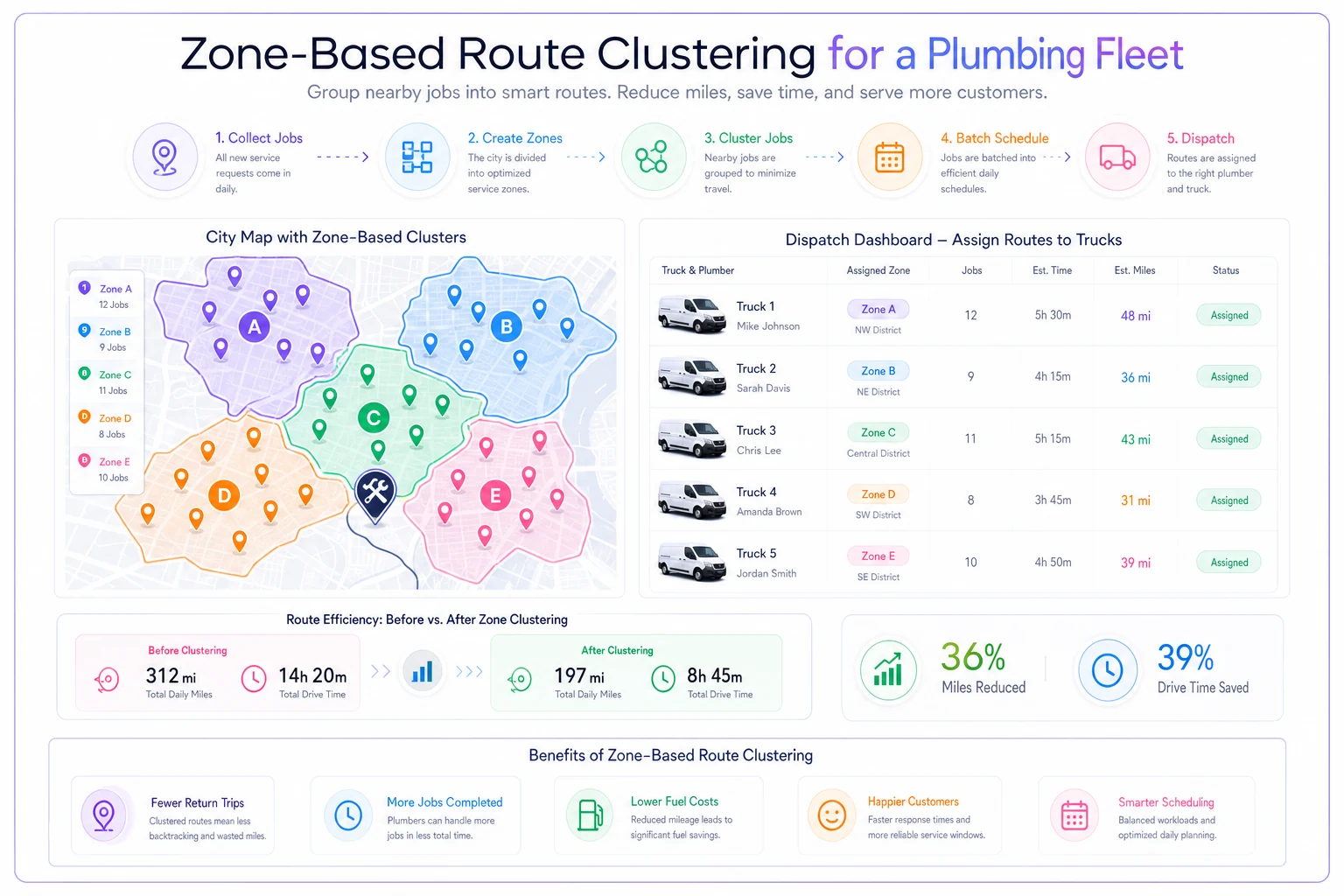
Shops that move from reactive dispatch to zone clustering commonly cut drive time somewhere in the 15–25% range. At current prices, that's not just hours saved — it's real fuel dollars back in your pocket every week.
4. Revisit your parts par-levels to kill return trips
Every return trip for a part you didn't stock is now a double hit: the labor of the second visit and the fuel to drive back. At $6 diesel, "just grab it from the supply house" costs a lot more than it used to.
Walk through what actually happens. Tech arrives, diagnoses, realizes the part isn't on the truck:
-
Drive to the supply house (fuel + time)
-
Wait and purchase
-
Drive back to the job (more fuel + time)
That's easily 45–90 minutes and several dollars of fuel for one missing fitting. When diesel was cheap, owners tolerated it because the fuel cost was negligible. Now the return trip is expensive enough to justify stocking deeper on your highest-frequency SKUs.
The adjustment isn't "stock everything." It's identifying the 15–20 parts that cause the most return trips and raising their par-levels on each truck. The carrying cost of a few extra fittings is trivial compared to the fuel and lost-job cost of a second trip.
5. Make idling and generator use a visible metric
Idling is a silent fuel killer that almost nobody tracks. A truck running the engine for cab comfort, or a tech leaving it idling while jetting a line with a truck-mounted unit, burns fuel that produces zero billable output.
A diesel engine idling burns roughly half a gallon to a full gallon per hour depending on load. If each of your trucks idles even 45 minutes a day unnecessarily, that adds up to real money across a full month at current prices.
Start by pulling last week's idle minutes from telematics and sharing the numbers with techs — visible metrics change behavior fast.
The fix is mostly behavioral, but it only sticks if it's visible. Pull idle data from your telematics or spot-check it manually. Make it a weekly number your techs actually see. Techs who know idle time is being watched cut it almost immediately — that's just how it works.
6. Reprice your out-of-zone and emergency work deliberately
Not all jobs cost the same to serve, and a fuel spike widens that gap. A call 8 minutes away and a call 40 minutes away used to have a tolerable cost difference. At $6+ diesel, the far job might genuinely be unprofitable at your standard rate.
This is the moment to introduce — or actually enforce — a distance tier in your pricing:
-
Core zone (your dense service area)
standard pricing, no adjustment.
-
Extended zone (15–30 min out)
a modest trip fee that covers the real fuel and time cost.
-
Outer zone (30+ min)
higher trip fee, or only serve on days you already have a job in that direction.
That last point matters more than people realize. The cheapest outer-zone job is the one you schedule alongside an existing call in the same area. If you have to send a truck 40 minutes out, try to pair it with another nearby call so the drive gets amortized across two tickets instead of one.
7. Don't over-hire into the uncertainty
A fuel spike often lands alongside softer demand or seasonal shifts, and owners tend to panic-adjust their crew either way. The disciplined move is to run your existing trucks tighter before adding a fifth — because a new truck isn't just a wage, it's another fuel bill at record prices.
The shops that handle cost shocks best are the ones that squeeze more billable hours out of the trucks they already have — through better routing, fewer return trips, and tighter dispatch — before taking on additional fixed cost. A new truck at $6 diesel needs to generate noticeably more margin to justify itself than it did six months ago. Run the utilization numbers before you run the hiring ad.
8. Watch the policy window — but don't build your plan around it
Relief may be coming. Reuters reported the White House is weighing red-dyed diesel tax relief, and several states are moving on their own fuel measures. If a state tax waiver lands in your area, that's real savings per gallon worth capturing.
Two cautions though. First, red-dyed diesel is off-road fuel — relevant for certain equipment, not for your on-highway trucks, so read the fine print on what any relief actually covers. Second, policy moves are slow, temporary, and sometimes get reversed. Build your margin plan assuming no relief arrives. If it does, treat it as upside.
The owners who get hurt are the ones who delay repricing because "the state might waive the tax soon." By the time relief arrives — if it arrives — you've already eaten a quarter of thin margins waiting for it.
A real scenario: four trucks, one bad month avoided
A residential-and-light-commercial shop running four trucks in a mid-sized metro saw their monthly fuel line climb from roughly $3,400 to around $4,900 when diesel crossed $6 — an extra ~$1,500 hitting a net margin that was already thin.
They didn't panic-raise prices across the board. In the first two weeks they did three things: added a flat $12 per-visit fuel surcharge on residential tickets, enforced zone-based scheduling so techs stopped crossing the metro twice a day, and raised par-levels on their top return-trip parts.
The surcharge recovered most of the direct fuel increase on residential work. The routing change cut drive time enough to fit roughly one extra billable job per truck per week. The parts adjustment killed a handful of return trips a month. Net effect: instead of losing a point of margin, they held roughly flat — and the routing discipline stuck around as a permanent improvement even after fuel eventually eased.
The lesson isn't any single move. Stacking a few small, fast adjustments beats waiting for one big external fix.
The deeper problem a fuel spike reveals
What the $6 diesel moment really exposes is that most small plumbing fleets don't actually know their per-job cost in real time. They know it roughly, annually, in hindsight. So when a variable cost spikes, they're guessing at how much to reprice and how much they're actually losing.
The shops that respond fastest are the ones whose job-costing, routing, and parts data live in one place instead of scattered across a whiteboard, a spreadsheet, and someone's memory. When scheduling, dispatch, and job-costing are connected — often through operational software that ties these workflows together — repricing and re-routing becomes a 20-minute adjustment instead of a month-long scramble. That's the real advantage here. Not predicting diesel prices, but being able to react to them without flying blind.
Diesel will settle eventually. The question is whether you come out of this spike with a tighter operation or just a worse month. Recalculate your real costs, tighten your routes, stop the return trips, and price the far jobs honestly. Do all that, and $6 diesel becomes the thing that finally forced you to run a leaner, more measurable shop — which pays off long after fuel prices come back down.
Ready to optimize your plumbing operations?
Join 500+ plumbing businesses using Plummerly to save time, reduce scheduling errors, and improve customer satisfaction.