


Most plumbing owners don't lose money on bad trucks. They lose money on badly timed trucks, financed under terms they didn't fully read, approved by nobody in particular, at the exact moment cash was tight.
A capital decision in a small fleet doesn't feel like a capital decision. It feels like "the 2016 van just died and we need something by Monday." That's the whole problem. The vehicle that carries your revenue gets bought under the same emotional pressure as a broken water heater call — fast, reactive, and expensive. And you'll live with that truck decision for five to seven years.
This piece is about building a system for those decisions. Not a one-off "should I lease or buy this one van" answer, but a repeatable way to evaluate capital that holds up whether you're buying your second truck or your ninth. The lease vs buy trucks plumbing business question is the obvious headline, but it's actually the smallest part. The bigger wins come from who approves what, how you model the real cost, and how capital decisions connect to the rest of your operation.
Why capital decisions break in small fleets
The pattern is almost always the same. At 1–3 trucks, the owner is the finance department. Every purchase is a gut call, and gut calls work fine when there's one truck and the owner knows the exact bank balance.
Then you hit 4–6 trucks and something quietly changes. There's a lead tech who "needs" a bigger van. There's a service manager pushing for a second box truck for jet work. The owner is in the field half the time and no longer has the balance memorized. Decisions start getting made in fragments — a verbal yes here, a financed purchase there — and nobody's tracking the total monthly debt service creeping up.
What breaks isn't the math on any single truck. It's the absence of a gate. Three separate "small" financed decisions — a van, a trailer-mounted jetter, a camera rig — can add $2,400–$3,000 a month in payments without anyone ever sitting down and approving that number as a whole. Each one looked reasonable alone. Stacked, they eat your slow-season cushion.
This is the same coordination failure you see everywhere as a shop grows — it shows up in scheduling, parts, pricing. Capital just hides longer because the pain arrives on a delay. If you've read the maturity roadmap for scaling plumbing operations, this is the financial layer of that same growth story: the informal systems that worked at three trucks actively hurt you at seven.
Lease vs buy: the comparison nobody models correctly
Most lease-vs-buy advice online compares the sticker price of buying against the monthly payment of leasing and calls it a day. That's useless for a working fleet, because a plumbing truck isn't a passenger car. It gets upfit. It gets wrapped. It gets abused. The upfit alone — shelving, bins, ladder racks, inverter, sometimes a crane — can run $8k–$18k on top of the chassis, and that dramatically changes the math.
Stop missing service calls and double bookings.
Plummerly helps you schedule, assign, and manage every plumbing job efficiently.
- Centralized job scheduling
- Technician dispatch & tracking
- Customer notifications
No credit card required
Here's what actually matters in the decision:
| Factor | Leaning toward BUY | Leaning toward LEASE |
|---|---|---|
| Annual mileage | Under ~25k miles/yr | High, predictable mileage with maintenance bundled |
| How long you keep trucks | 6–8+ years (you run them into the ground) | 3–4 year refresh cycle, always-newer fleet |
| Upfit investment | Heavy custom upfit you want to keep | Light upfit, or lease includes upfit amortization |
| Cash position | Strong cash or good equipment loan rate | Want to preserve cash for growth/hiring |
| Maintenance appetite | You have a reliable shop/relationship | You want predictable all-in monthly cost |
| Tax situation | Want to use Section 179 / bonus depreciation | Prefer straightforward monthly deductible expense |
The tax piece deserves real attention, because it's where owners either overreact or ignore it entirely. Buying can let you depreciate the vehicle aggressively — Section 179 and bonus depreciation can let you write off a large chunk of a heavy work truck in year one, and heavier GVWR vehicles get better treatment than light passenger-style vans. Leasing generally lets you deduct the lease payment as an operating expense: cleaner but less front-loaded.
The mistake isn't picking wrong. The mistake is letting the tax tail wag the dog. Buying a $65k truck to save $15k in taxes is still spending $50k you may not have needed to spend. Depreciation is a timing benefit, not free money. Talk to your actual accountant before you let a dealer's finance desk explain your tax strategy to you.
When buying actually makes sense
You keep trucks a long time, you drive moderate miles, you've got a custom upfit dialed in exactly how your techs work, and you either have cash or a solid equipment loan rate. A paid-off van in year six that still runs clean is one of the best assets a small shop owns — zero payment, pure capacity.
When leasing actually makes sense
You're in a high-mileage, high-visibility market where a beat-up truck costs you jobs, you want predictable monthly costs, and you'd rather keep cash flexible for hiring or a second location. Leasing also quietly solves the "I never maintain my trucks properly" problem for owners who know that's them — and more of you know that than would admit it.
Who should NOT be making this call alone
A lead tech who wants the nicest truck in the yard. A salesperson at the dealership. And the owner at 11pm the day a van blew its transmission. Pressure plus emotion plus a financing offer is how shops end up over-leveraged.
A worked example with real numbers
Say you're a four-truck residential and light-commercial shop. Your third van is at 190k miles and starting to nickel-and-dime you — call it $400–$700 a month in repairs plus the occasional day out of service. You need to decide: replace with a purchase, or move to a lease.
Option A — Buy. New 3/4-ton cargo van around $48k, upfit at $12k, so roughly $60k all in. Equipment loan, 60 months, roughly $1,150/month depending on rate. You plan to run it 7 years. Years 6 and 7: no payment, maybe $3k–$5k/yr in maintenance. First-year tax benefit from depreciation is meaningful if the shop is profitable.
Option B — Lease. Comparable upfit-included lease landing around $1,000–$1,250/month over 48 months, maintenance bundled, mileage cap you're comfortably under. Always a newer truck, clean wrap, predictable cost, no resale hassle.
Over a 7-year horizon, buying usually wins on total dollars if — and this is the whole thing — you actually keep and maintain the truck for 7 years. If you're the kind of shop that trades every 4 years anyway, the lease often comes out ahead and saves you the resale and downtime headaches. The right answer isn't in the spreadsheet. It's in honestly knowing your own behavior.
The real failure worth flagging: shops run Option A's math, then behave like Option B — buying trucks they intend to keep forever and trading them at year four out of frustration because they skipped maintenance. You get the worst of both worlds.
The part that actually scales: governance gates
A calculator helps one decision. A governance gate fixes the system. Once you're past three trucks, you need a tiered approval structure so capital stops leaking through a hundred small verbal yeses.
-
Tier 1 — Under $2,000. Service manager or lead can approve. Logged, but no formal process. Tools, small equipment, minor upfit tweaks.
-
Tier 2 — $2,000 to $15,000. Requires a one-page capital request and owner sign-off. This is where jetters, cameras, trailers, and used vehicles live. No verbal approvals.
-
Tier 3 — Over $15,000 or anything financed. Requires the full scenario template (below), owner approval, and a check against total existing debt service. New trucks, major equipment, anything adding to monthly payments.
The point of tiers isn't bureaucracy — a four-truck shop doesn't need a procurement committee. The point is that financed decisions get treated differently than cash decisions, and that someone always looks at the stacked monthly obligation, not just the individual purchase.
The one-page capital request
-
What is it and what does it replace or add? (Capacity question — are we growing or maintaining?)
-
Lease, buy cash, or buy financed? With the rough all-in number including upfit.
-
New monthly obligation and what total monthly equipment/vehicle payments become after this.
-
What breaks if we DON'T do this? (Forces the real urgency out — "van is unreliable" vs "would be nice.")
-
Payback / utilization. How many billable hours or jobs does this asset need to produce to justify itself?
-
Slow-season check. Can we still cover this payment in our two worst months?
Model the obligation against your worst months, not your average.
That last point is the one owners skip and regret most. Plumbing has seasonal swings. A payment that's comfortable in July can be a genuine problem in February. Model the obligation against your worst months, not your average.
How capital decisions connect to the rest of the operation
Capital doesn't live in a spreadsheet by itself. A truck decision is really a capacity decision, which means it touches scheduling, routing, hiring, and parts.
Buy a fifth truck before you have the call volume to keep it busy, and you've got a $1,100 monthly payment sitting idle in the yard. Wait too long, and you're turning away work or running techs into the ground with overtime. The right timing on capital is downstream of knowing your real utilization — which is why this ties directly into dispatch and route density. A truck only earns when it's carrying profitable jobs, not just driving around.
This is also where your systems either help you or leave you guessing. If your scheduling, job costing, and asset tracking all live in disconnected spreadsheets, you genuinely cannot answer "is truck three busy enough to justify truck four?" Shops that have centralized their operational data — the kind of consolidation covered in the software stack guide for 1–10 truck plumbing businesses — can pull utilization by truck, revenue per vehicle, and maintenance cost per asset. That turns the capital question from a gut call into a data-backed one. The decision still belongs to you; the facts should just be sitting in front of you when you make it.
Here's a simple visualization of that decision loop.
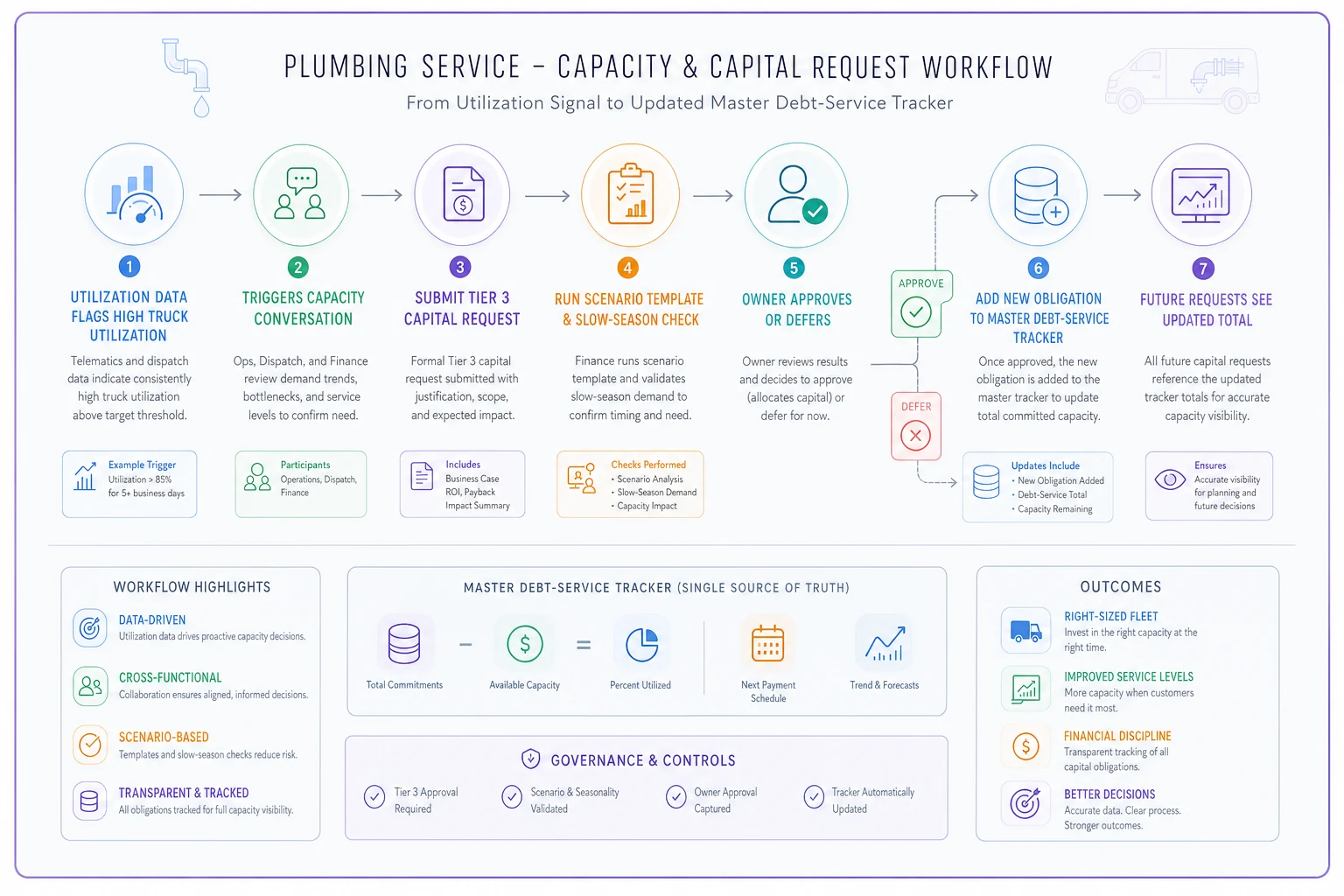
That loop — data triggers request, request runs the gate, gate updates the record — is what keeps a seven-truck shop from over-leveraging one van at a time.
A short real scenario
A six-truck shop in a mid-size metro, mostly residential service and repair. Over about 18 months they'd financed a new box truck, a trailer jetter, and two replacement vans — each decision made separately, each one defensible on its own. Nobody had ever added them up. Total vehicle and equipment payments had crept to around $6,800/month.
It didn't bite until a soft winter. Call volume dropped in January and February, revenue dipped maybe 25–30% from their fall average, and suddenly that $6,800 was genuinely uncomfortable. They made payroll, but it was tight, and the owner realized he'd never once looked at the combined number.
The fix wasn't dramatic. They put in a simple two-tier approval gate and a running debt-service tracker — just a shared sheet showing every payment and the total. Next time a tech pushed for a new specialty truck, they ran the slow-season check and realized the utilization wasn't there yet. They deferred it six months, let call volume justify it, and then bought used instead of new to keep the payment down. Nothing fancy. Just a system that forced the whole number into view before a yes.
The outcome wasn't "they saved $40k." It was quieter than that — they stopped making stacked decisions in the dark, and the next slow season didn't feel like a crisis.
The capital discipline checklist
Run through this before any financed purchase over your Tier 3 threshold:
-
- [ ] All-in cost modeled including upfit, wrap, and taxes/fees — not just sticker or monthly payment
-
- [ ] Both lease and buy options modeled over the realistic holding period, based on how you actually behave
-
- [ ] New monthly obligation added to total existing debt service — the stacked number is visible
-
- [ ] Slow-season stress test passed (can you cover it in your two worst months?)
-
- [ ] Utilization data supports the capacity add (for growth purchases, not replacements)
-
- [ ] Tax treatment discussed with your actual accountant, not the dealer finance desk
-
- [ ] Approval gate followed — right tier, right sign-off, logged
-
- [ ] Payback/utilization expectation written down so you can check it later
The lease vs buy trucks plumbing business question gets all the attention, but the governance around that decision is what actually separates shops that scale cleanly from ones that quietly over-leverage. One well-modeled truck won't sink you. A year of unexamined, stacked, emotionally-timed capital decisions can.
Bringing it together
The fix isn't complicated or expensive. A tier structure so financed decisions get real scrutiny, a one-page request that forces the honest questions, a running total so you always see the stacked obligation, and a slow-season check so July optimism doesn't write February's checks. Tie those decisions to real utilization data instead of gut feel, and you'll time your capital almost as well as you time your crews.
Trucks are the single biggest recurring capital item in most plumbing businesses. Treat them like a system, not a series of emergencies, and they'll carry your revenue instead of dragging your cash.
Trucks are the single biggest recurring capital item in most plumbing businesses. Treat them like a system, not a series of emergencies, and they'll carry your revenue instead of dragging your cash.
Ready to optimize your plumbing operations?
Join 500+ plumbing businesses using Plummerly to save time, reduce scheduling errors, and improve customer satisfaction.