

The gap between a first-time fix and a return trip is often just one part. Not the labor, not the diagnosis — the part. A tech has the right skills, the right tools, the customer standing there ready to pay, and then the moisture cartridge on the truck doesn't match the trim on the wall. Now it's a second visit, a second drive, and a customer who's slightly less confident in you than they were an hour ago.
Most shops treat parts lookup as a memory problem. The good techs "just know" what crosses to what. The newer guys call a supply house or text a photo to whoever picks up first. That works until it doesn't, and the cost shows up quietly in your schedule as extra trip windows you didn't need to give away.
This is a workflow problem, and it's fixable. Below is a mobile parts lookup process for plumbing techs, plus the cross-reference and substitution rules that actually hold up in the field.
Why parts lookup breaks down in the field (and it's not the tech's fault)
The typical failure isn't that a tech can't identify a part. It's that identification and authorization to substitute are two different decisions, and most shops only train for the first one.
Here's how it plays out. A tech pulls a failed Delta 1400-series cartridge. He knows the RP46074. It's not on the truck. He knows a generic equivalent exists. But does he:
-
Install the generic and risk a warranty callback?
-
Drive to the supply house for the OEM?
-
Quote the customer both options and let them decide?
-
Call the office and wait 15 minutes for someone to weigh in?
Without a clear rule, every tech answers that differently — and half of them answer it differently depending on the day. That inconsistency is the real leak. The return-trip problem usually isn't "we didn't have the part." It's "the tech wasn't sure if the part he did have was allowed."
A related failure is search input. Techs standing in a cramped vanity cabinet with wet hands don't type long model numbers cleanly. They mistype, get a wrong result, order the wrong thing, and the mistake surfaces two days later when the box shows up.
The mobile lookup workflow that actually gets used
A lookup process only works if it survives bad lighting, one-handed, customer-watching conditions. Long processes get skipped. Here's a tight version that holds up.
Stop missing service calls and double bookings.
Plummerly helps you schedule, assign, and manage every plumbing job efficiently.
- Centralized job scheduling
- Technician dispatch & tracking
- Customer notifications
No credit card required
-
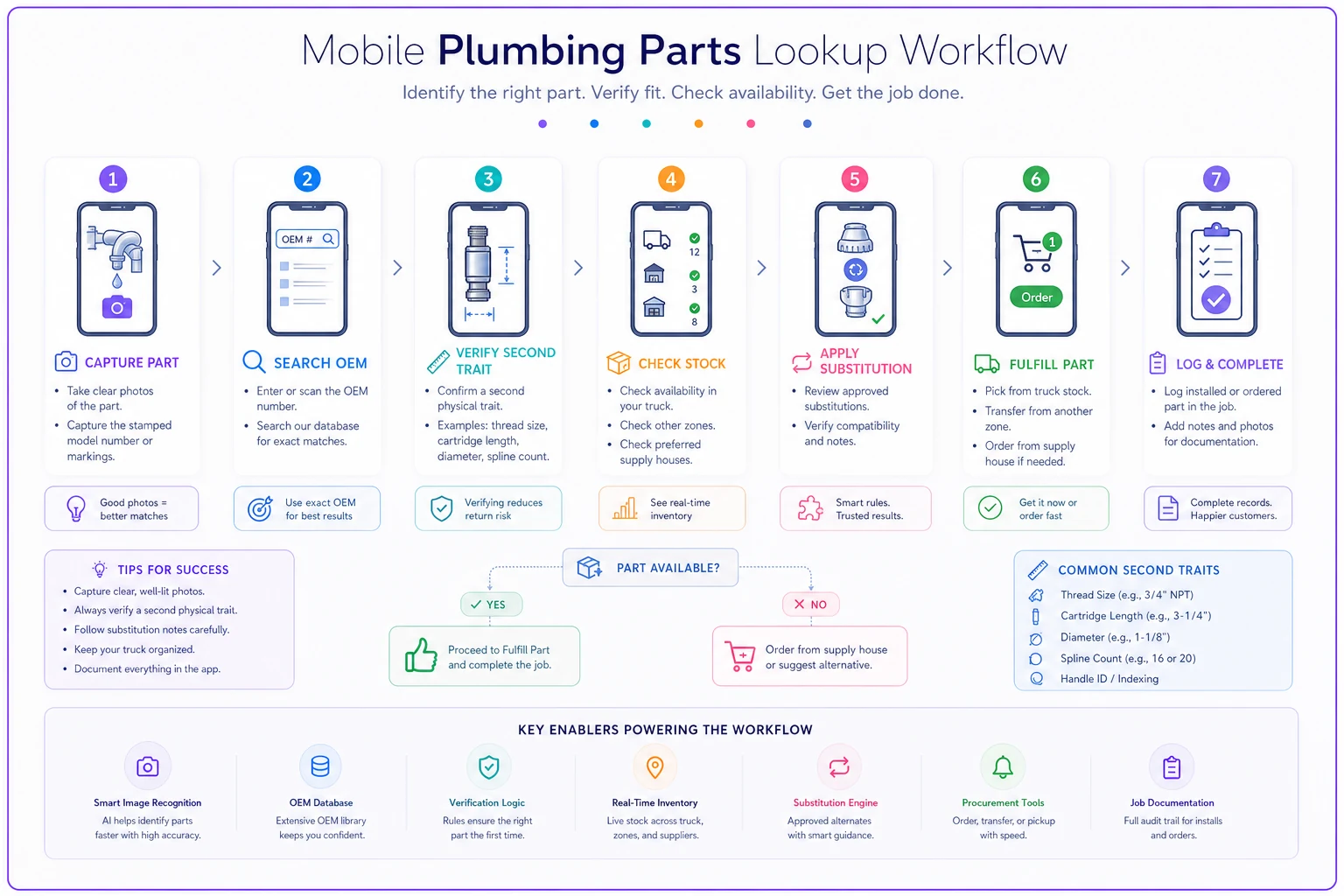
Capture the identity first, before searching. Photo of the part, photo of any stamped model number, and photo of the surrounding install (trim, valve body, brand plate). Photos beat memory and give the office something to verify against later.
-
Search by the most reliable identifier available. Stamped OEM number first, brand + series second, dimensions/spec last. Never lead with a guess.
-
Confirm the match with a second signal. If the number returns a result, verify one physical trait — thread size, cartridge length, stem broach. One confirmation cuts most wrong-part orders.
-
Check truck stock and nearby stock in the same view. Is it on your truck? On another truck in the zone? At the closest supply house? The decision changes completely depending on the answer.
-
Apply the substitution rule (below) before committing. Don't decide OEM-vs-generic on instinct. Run it through the table.
-
Log what you installed or ordered. Whatever gets swapped needs to land somewhere searchable so the next tech isn't solving the same puzzle blind.
The step people consistently skip is #3. Confirming a second physical trait feels redundant right up until the moment a cartridge is technically "compatible" per the catalog but 4mm too long for the pocket. The verification takes ten seconds. The return trip takes ninety minutes.
Take the part photos first and confirm a second physical trait — it takes ten seconds and prevents most wrong-part orders.
Here's a quick visual of the workflow to keep on hand while you're training or rolling this out.
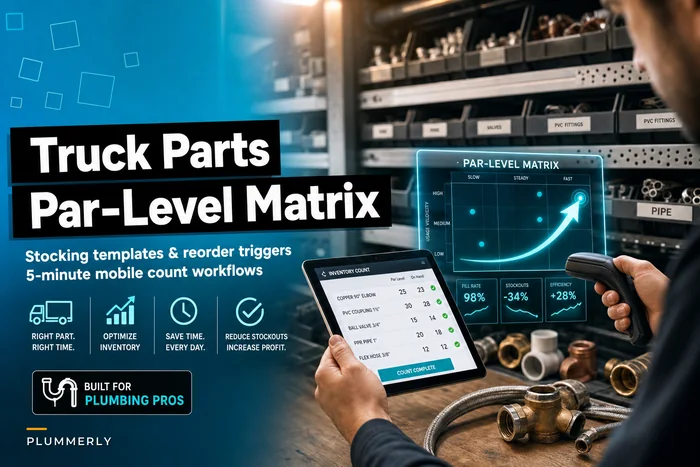
This lookup discipline pairs directly with how you stock the truck in the first place. If your par levels are dialed in, the lookup ends at "it's on the truck" far more often — the Truck Parts Par‑Level Matrix for Plumbers covers how to build stocking templates so the common jobs don't trigger a lookup-and-drive at all.
The cross-reference fallback ladder
When the exact OEM part isn't available, techs need an ordered set of fallbacks — not a coin flip. A ladder removes the "depends how I'm feeling" factor.
Fallback order for a missing OEM part:
-
Exact OEM on your truck — install, done.
-
Exact OEM on a truck in your zone — quick swap if a coworker is nearby; often faster than a supply house run.
-
Manufacturer-approved OEM equivalent (same brand, superseding part number) — usually a safe, warranty-clean swap.
-
Vetted aftermarket equivalent on your pre-approved list — only for part categories you've explicitly cleared.
-
Supply-house pickup of exact OEM — when the job is warranty-sensitive or high-visibility.
-
Order and schedule a return — last resort, and it should feel like one.
The mistake shops make is letting techs jump straight to #4 because it's the fastest option in the moment, without any category rules in place. Some part categories tolerate aftermarket fine. Others don't. Mixing those up is how you turn a saved trip today into a warranty callback next month.
The rapid part-substitute decision table
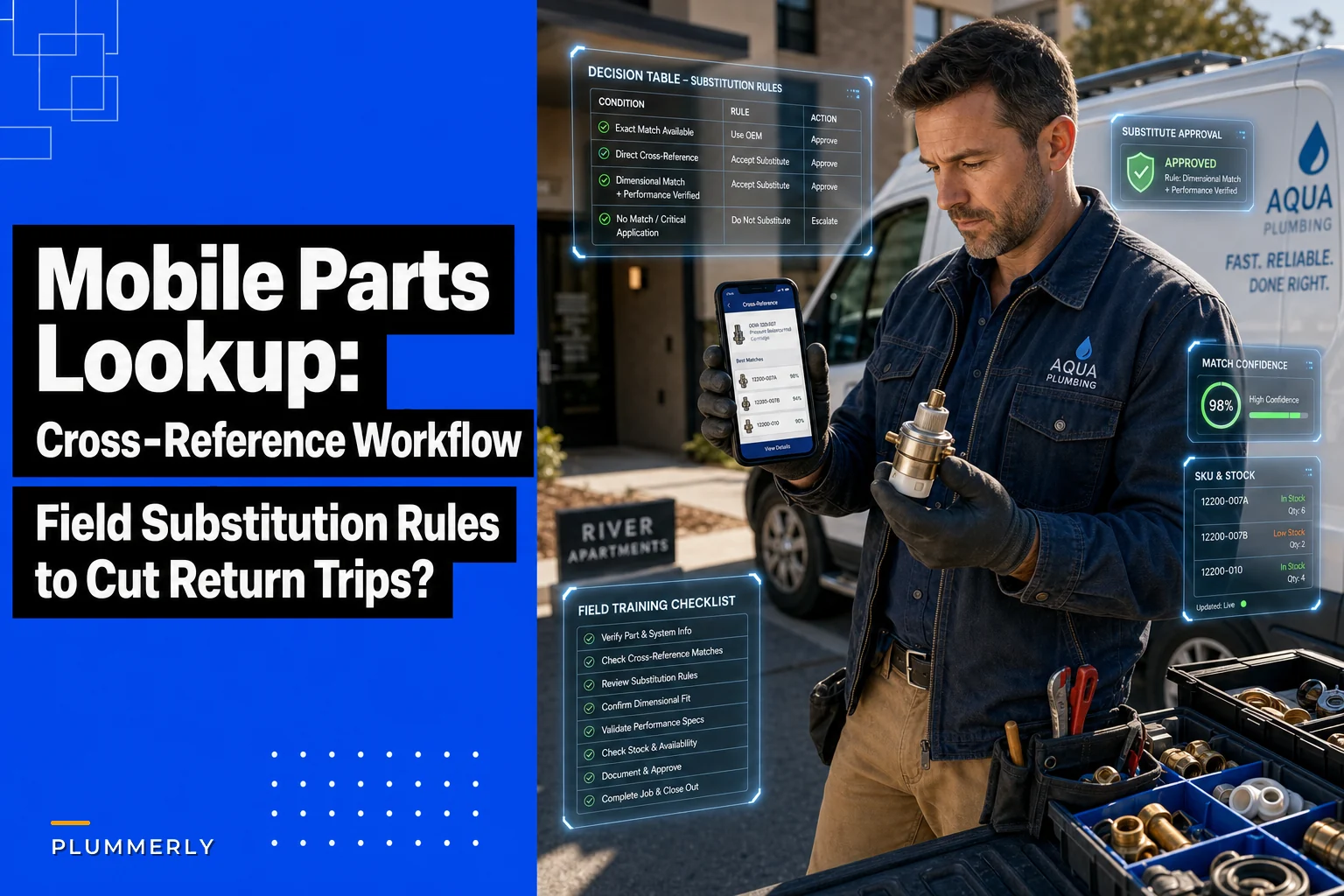
This is what techs actually want — something they can glance at and act on. Sort part categories by substitution risk, then attach a clear rule and an approval level.
| Part category | Substitution risk | Default rule | Approval needed? |
|---|---|---|---|
| Supply lines, angle stops, basic valves | Low | Vetted aftermarket OK if in spec | No |
| Wax rings, flanges, basic fittings | Low | Any quality equivalent | No |
| Faucet cartridges (mixing/moisture) | Medium | OEM or mfr-approved equivalent only | No if approved-equiv; yes for aftermarket |
| Toilet fill/flush internals | Medium | Brand-matched or universal-rated | No for universal-rated |
| Cartridge/valve trim (visible) | Medium-High | OEM only if trim is visible/branded | Yes if deviating |
| Water heater gas valves, controls | High | OEM only | Yes, always |
| Anything under active manufacturer warranty | High | OEM only, document part # | Yes, always |
| Specialty/luxury fixtures (imported, high-end) | High | OEM only, verify before touching | Yes, always |
The point isn't these exact rows — it's that every category has a default and a named approval threshold. When a tech hits a medium or high row and wants to deviate, there's a clear "call before you swap" line. That single rule prevents most warranty surprises while still letting low-risk stuff move fast without interrupting anyone.
Build your own version using the categories you actually stock, then keep it somewhere techs already look — ideally inside your broader SOPs rather than as a random PDF nobody opens. The Plumbing Operations Playbook Template is a solid home for it alongside your dispatch and quoting standards.
Approval rules for substitutes: who decides what, and how fast
The reason substitution approval bottlenecks is that everything routes to the owner or lead, who's elbow-deep in a job with their phone in a bag. So the tech waits, the customer waits, and eventually the tech just makes a call — sometimes the wrong one.
A workable approval structure:
-
Green (no approval) Low-risk categories, in-spec aftermarket, non-warranty work. Tech proceeds and logs it.
-
Yellow (async approval) Medium-risk deviations. Tech sends the part photo, proposed substitute, and reason. Any lead can approve. Target response under 10 minutes. If nothing comes back in that window, the tech defaults to the conservative option — OEM pickup or scheduled return — not the aggressive one.
-
Red (live approval) High-risk categories, active warranty, luxury fixtures, or anything over a set dollar threshold. Requires a real conversation before touching it.
The under-appreciated detail is that default-to-conservative rule for yellow. Without it, "no response in 10 minutes" quietly becomes "tech installed the generic and hoped." With it, the worst case is a controlled return trip, not a warranty landmine.
Set a dollar threshold too — something like "any substitute part over roughly $150 needs a yes." The exact number depends on your average ticket, but the principle holds: money and warranty status are the two things that force escalation, and everything below those lines should move on its own.
When aggressive substitution is a bad idea
Some jobs aren't worth trying to save the trip, and techs need to recognize them on sight.
-
Active manufacturer warranty. Installing a non-OEM part can void it. You're not saving a trip — you're transferring liability to yourself.
-
High-visibility trim. If the customer sees the finish daily, a "close enough" match becomes a complaint. Chrome vs. brushed nickel that doesn't quite match is a callback waiting to happen.
-
Luxury or imported fixtures. Tolerances vary in ways generic catalogs don't capture. Verify OEM, don't improvise.
-
Anything where the customer explicitly asked for OEM. Some do. Honor it and quote accordingly.
The pattern worth noticing: the categories where substitution saves the most money are almost always the ones where it costs the most when it goes wrong. That's exactly why the decision table separates them.
A real scenario
A three-truck shop running mostly residential repair had a first-time-fix rate sitting somewhere in the low 70s. When they dug into the misses, most weren't diagnostic failures — they were parts problems. Wrong cartridge ordered, a generic installed and then swapped after a callback, or a tech driving to a supply house mid-job because nobody knew a coworker two zones over had the exact part on his truck.
They made three changes. Standardized the lookup steps (photo-first, confirm a second trait), built a one-page substitute decision table taped inside every truck door, and set the yellow/red approval structure with the default-to-conservative fallback.
Over the next couple months, return trips tied to parts dropped by roughly a third. First-time-fix climbed into the high 70s. Nothing dramatic on paper, but a few recovered trips a week across three trucks added up to noticeably more completed jobs without adding a single hour of drive time. The quieter win was fewer warranty callbacks — techs stopped freelancing substitutions on medium and high-risk parts.
Training checklist to make it stick
A workflow that lives in a document nobody reads changes nothing. New and existing techs should be checked out on this the same way you'd check them out on a diagnostic procedure.
Substitution & lookup competency checklist:
-
[ ] Can capture the three-photo part identity (part, model stamp, install context) in under a minute
-
[ ] Searches by stamped OEM number first, guesses last
-
[ ] Confirms a match with a second physical trait before ordering
-
[ ] Checks truck, zone, and supply-house availability before deciding
-
[ ] Can classify a part into low/medium/high substitution risk from the table
-
[ ] Knows which categories are green/yellow/red for approval
-
[ ] Knows the dollar threshold that forces escalation
-
[ ] Applies the default-to-conservative rule when no approval comes back
-
[ ] Logs every substitution so it's searchable later
-
[ ] Can explain OEM-vs-substitute to a customer without over-promising
Run this as a ride-along verification, not a written quiz. Watch a tech handle two or three real lookups and one deliberate "OEM's not available" scenario. You'll learn more from those three jobs than any test would tell you.
Where the leaks quietly hide
Two patterns worth watching once the workflow is in place.
First, the "almost always on the truck but occasionally not" part. These are the sneaky ones — common enough that nobody thinks to check stock, rare enough to be missing at the worst moment. Track which lookups end in a drive, and you'll usually find a handful of parts that belong at a higher par level.
Second, stale cross-references. Manufacturers supersede part numbers constantly. A cross-reference a tech memorized two years ago can be quietly wrong by now. Whatever reference your techs lean on needs to reflect current supersessions, or you'll get confidently-ordered wrong parts landing on doorsteps.
Bringing it together
Cutting return trips isn't about buying more inventory or hiring better techs. It's about removing that moment of hesitation when a tech is holding a failed part that isn't on the truck. Give them a lookup process that survives real field conditions, a decision table that pre-answers the OEM-vs-substitute question, and an approval structure that doesn't bottleneck on one person's phone.
The shops that get this right don't have smarter techs — they've just made the parts decision boring. And boring, repeatable decisions are exactly what keep you off the second drive.
Cutting return trips isn't about buying more inventory or hiring better techs. It's about removing that moment of hesitation when a tech is holding a failed part that isn't on the truck. Give them a lookup process that survives real field conditions, a decision table that pre-answers the OEM-vs-substitute question, and an approval structure that doesn't bottleneck on one person's phone.
The shops that get this right don't have smarter techs — they've just made the parts decision boring. And boring, repeatable decisions are exactly what keep you off the second drive.
Ready to optimize your plumbing operations?
Join 500+ plumbing businesses using Plummerly to save time, reduce scheduling errors, and improve customer satisfaction.