

Most plumbing owners treat pricing like a light switch. Pick a number, flip it on across every truck and every zip code, then spend the next quarter arguing about whether revenue moved because of the price change or because furnace season kicked in early.
That's the real problem with pricing experimentation that rarely gets talked about: it's almost never a pricing problem. It's a measurement problem. You can't tell if a price works if you change five things at once, measure it over the wrong window, and let every technician improvise the quote at the door.
This article is about building the discipline around price testing — the sampling rules, measurement windows, guardrails, and rollback triggers — so you can actually learn something from a price change instead of just hoping. And more importantly, how all of that ties back into the systems you already run: dispatch, job costing, technician coaching, and territory management.
Why "just raise prices and see what happens" quietly fails
Here's a pattern that shows up constantly in small fleets. An owner reads that their flat-rate book is 12% under market, bumps the whole thing 12% on a Monday, and watches close rates dip for two weeks. Panic sets in. Prices roll back by Friday. Now you've got techs who quoted three different prices for a water heater swap in the same week, confused repeat customers, and zero usable data.
The failure isn't the price. It's that nothing was controlled. When you change pricing fleet-wide and simultaneously:
-
hit a seasonal demand shift,
-
onboard a new tech who's shaky on the quote,
-
and run a Google Ads promo pulling in price-shoppers,
…you have no way to isolate what caused what. The number went up, the close rate went down, and the two might have nothing to do with each other.
In real operations, this usually happens because pricing lives in someone's head or in a spreadsheet, not in a structured pricebook with version control. If you can't point to exactly which jobs got the new price and which didn't, you're not experimenting. You're guessing with extra steps.
The whole point of experimentation discipline is to make a price change reversible and attributable. You want to be able to say: "On these specific jobs, in this territory, over these three weeks, held against a comparable baseline, the new price produced X." That's a sentence you can actually make decisions with.
The parts of a pricing experiment that actually matter
Before getting into field mechanics, it helps to see the moving pieces as a system. A clean experiment has five components, and skipping any one of them is where most tests fall apart.
Stop missing service calls and double bookings.
Plummerly helps you schedule, assign, and manage every plumbing job efficiently.
- Centralized job scheduling
- Technician dispatch & tracking
- Customer notifications
No credit card required
| Component | What it controls | What breaks if you skip it |
|---|---|---|
| Sampling rule | Which jobs/territories get the new price | You compare apples to furnaces; results are noise |
| Measurement window | How long before you judge results | You react to a bad week instead of a real trend |
| Guardrails | The limits techs can't cross mid-test | One rogue quote poisons the dataset |
| Rollback triggers | Pre-agreed "stop the test" conditions | You ride a losing price too long out of stubbornness |
| Measurement template | How you record and compare outcomes | Everyone remembers the test differently |
Notice these aren't pricing concepts — they're operational ones. This is why pricing experimentation is really an extension of your existing governance work. If you've already built a structured pricing architecture and governance framework, you're halfway there. Experimentation is just the controlled way you change that architecture without burning it down.
Sampling: don't test on your whole fleet
The single most useful shift for small fleets is to stop testing fleet-wide and start testing by segment.
-
Territory/zone — the zip clusters you already route around.
-
Job category — drain clears, water heaters, repipes, service calls.
-
Technician cohort — your steady senior guys vs. newer hires.
-
Customer type — first-time vs. repeat, residential vs. light commercial.
The trick is to change the price in one cell while holding a comparable cell as your baseline. If you run two trucks on the north side and two on the south, and the demographics and job mix are similar, you can roll the new water heater price out to the north territory only and let the south run as-is.
A typical example: a 6-truck shop wants to test a $180 increase on standard 50-gallon water heater installs. Instead of fleet-wide, they apply it only to jobs booked in three northern zip codes for four weeks. Southern zips stay at the old price. Same season, same marketing, same install crews rotating through both. Now the close-rate difference between north and south actually means something.
A few sampling rules worth holding to:
-
Pick cells with enough volume. If a category only sees 4–5 jobs a month, you won't learn anything meaningful in that time. Test high-frequency work first.
-
Keep job mix comparable. Don't test a price in a zone that's mostly emergency after-hours calls against one that's all scheduled maintenance.
-
Change one variable. If you're testing price, don't also change the quote script that same week.
-
Don't cherry-pick which jobs get the new price. The sampling rule has to be mechanical — "all water heaters in these zips" — not "whichever ones the tech thinks will fly."
That last point is where fleets quietly cheat themselves. If a tech only applies the new price when the customer "seems like they can afford it," your test now measures the tech's judgment, not the price.
Measurement windows: the week you react is usually the wrong week
Plumbing demand is lumpy. One bad weather week, one holiday, one competitor running a promo, and your numbers swing. If your measurement window is too short, you'll react to noise every single time.
A reasonable window for most residential price tests is three to six weeks — long enough to smooth out weekly volatility, short enough that the season doesn't shift underneath you. For high-ticket, low-frequency work like repipes, you may need longer or a larger territory just to accumulate enough jobs.
Two things matter inside the window:
-
Don't peek and panic. Set the window up front and commit to not making the kill/keep decision before it closes — unless a rollback trigger fires (more on that below). The first week of any price increase almost always looks rough because easy, price-insensitive jobs and hard-core shoppers hit in random order.
-
Measure a baseline from the same calendar period last year if you can. Comparing this October to last September tells you nothing. Comparing this October's north zone to this October's south zone, and glancing at last October's overall numbers, gives you two anchors.
One pattern worth naming: owners tend to run the measurement window way too short and trigger the rollback reflex way too fast. They'll give a new marketing channel 90 days but kill a price test in 6. That instinct should probably be flipped.
Operational guardrails: the rules techs can't break mid-test
A pricing experiment only works if the price actually holds in the field. Guardrails are the non-negotiables that keep one truck from contaminating the whole dataset.
Good guardrails are specific and written down before the test starts:
-
No off-book discounting during the test window. If a customer balks, techs follow the normal escalation path — not a freelance 15% chop.
-
Discount authority caps stay fixed. If a senior tech can normally waive a trip charge, that stays the same. You're not changing two things at once.
-
Every tested job gets logged the same way. Same fields, same notes, every time. A job with no recorded outcome is a hole in your data.
-
Emergency/after-hours jobs are excluded unless that's specifically what you're testing. They distort price sensitivity badly.
-
A hard floor on margin. No tested price, up or down, drops a job below your minimum acceptable margin. This is the one guardrail that protects you even if everything else goes sideways.
Lock discount authority in the field software for the test period to enforce guardrails.
The margin floor connects straight back to job costing. If you don't actually know your loaded cost on a standard install, you can't set a safe floor — and a "discount test" can quietly sell work at a loss. That's the same discipline behind avoiding the common flat-rate pricing mistakes that erode margin without anyone noticing until it's way too late.
Rollback triggers: decide how you'll quit before you start
This is the part almost nobody sets up, and it's the part that saves you.
A rollback trigger is a pre-agreed condition that ends the test early — no debate required. You define them before the test so you're not making emotional calls in the middle of it.
-
Close rate drops more than X points below baseline for two consecutive weeks. Pick your X ahead of time — something in the 10–12 point range works for most residential work.
-
Complaint or callback volume spikes in the tested cell beyond normal range.
-
Technician pushback becomes consistent — if your crew stops believing in the number, they'll undersell it anyway.
-
A major external shock hits mid-test (storm, big competitor promo, supply disruption). Pause, don't push through — the data's compromised.
And one for a discount test, which people forget they need: roll back immediately if margin on tested jobs falls below floor, regardless of how much volume ticked up. Cheap work that fills the schedule can bankrupt you slower, but just as surely.
A workflow for running one clean test
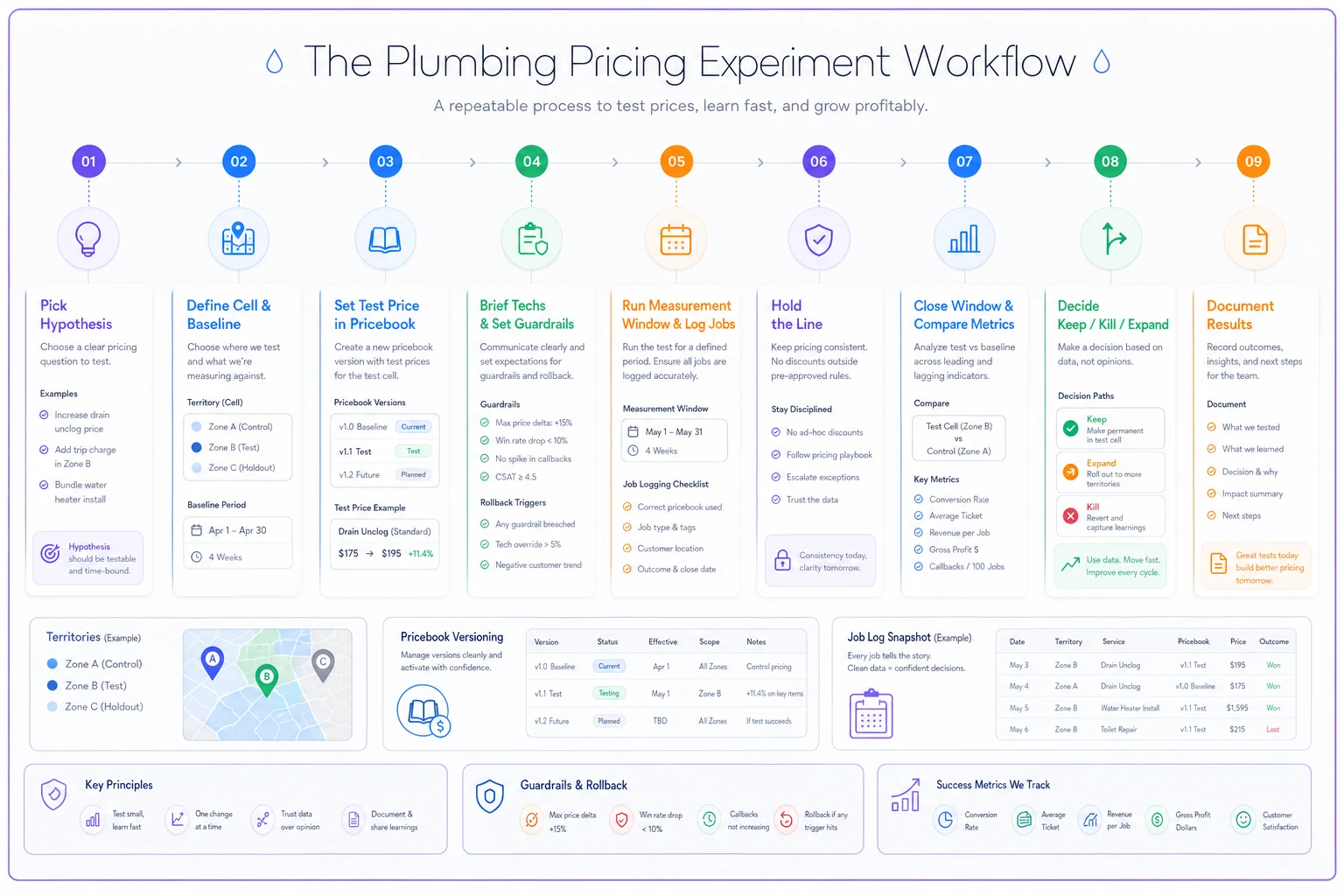
Here's how a single experiment actually flows through a small shop, start to finish:
Below is a workflow diagram for running a pricing test.
-
Pick the hypothesis. "Raising standard water heater installs by $180 in high-income north zips won't drop close rate below baseline." Specific, testable.
-
Define the cell and the baseline. North zips = test. South zips = control. Four-week window.
-
Set the price in the pricebook, flagged as a test version so it's attributable later.
-
Brief the techs. Everyone quoting in the test zone uses the new number. Guardrails read out loud. Rollback triggers named.
-
Run the window. Log every tested job identically — quoted price, outcome, customer type, any objection noted.
-
Hold the line. No peeking-and-panicking. Only rollback triggers can stop it early.
-
Close the window and compare. Test cell vs. control cell
close rate, average ticket, margin, callbacks.
-
Decide
keep, kill, or expand.
If it held, roll it to the next territory and watch again. If it didn't, revert and note why you think it failed. -
Document the result so the next person who wants to test water heaters doesn't re-run your mistake.
Step 9 is the one that compounds over time. Most shops run informal price experiments constantly and remember none of them. The ones that write down what they learned build a real internal pricing knowledge base over a couple of years — and that's genuinely hard for a competitor to copy.
A short real scenario
A 4-truck shop in a mixed suburban/rural market was convinced their drain-clearing price was leaving money on the table but were scared of losing volume. Instead of a fleet-wide jump, they ran a controlled test.
-
Setup Standard main-line clear moved from the mid-$300s to the low-$400s, applied only to their two suburban zones. The two rural zones held the old price as control. Five-week window.
-
Guardrails margin floor set, no off-book discounting, emergency calls excluded.
-
Rollback trigger close rate down more than 10 points in the test zones for two straight weeks.
What happened: close rate in the suburban zones dipped around 4–5 points — noticeable, but nowhere near the trigger. Average ticket on those jobs rose enough that total gross margin on drain work in the test zones came out meaningfully ahead over the window, something in the range of a few thousand dollars monthly once annualized. Rural control zones stayed flat, which confirmed the lift wasn't just seasonal.
They kept the suburban price, left rural alone, and then ran a separate test in the rural zones a month later. The key wasn't the increase itself — it was that they could prove the increase caused the result, and they didn't bet the whole business to find out.
When this makes sense — and when it doesn't
This makes sense when:
-
You have enough job volume in at least one category to see a signal in a few weeks.
-
Your pricebook is structured enough to version and segment.
-
You know your loaded costs well enough to set a real margin floor.
This is a bad idea when:
-
You're a 1–2 truck shop doing wildly varied work with no category hitting consistent volume. You'll get noise. Test informally and trust your gut until volume grows.
-
Your job costing is a guess. Fix that first — experimenting on unknown costs is how you discover you've been selling at a loss across a whole zone.
-
You're in the middle of a season you can't account for. Don't start a test the week a heat wave or hard freeze is about to scramble demand.
Shops that probably shouldn't run formal tests yet: brand-new operations with no baseline at all. You need some history to compare against. Run clean for a quarter, build your baseline, then experiment.
How this connects to the rest of your operation
Pricing experimentation doesn't live alone. The sampling cells you use are your dispatch territories. The guardrails lean on your discount-authority rules and technician coaching. The margin floors come straight out of job costing. The logging depends on everyone recording jobs the same way in whatever field software you run.
AI-powered operational software can help here — not by making the pricing decisions for you, but by making the mechanical parts less painful. Version-controlled pricebooks, territory-level job tagging, margin tracking at the job level — these are the things that turn a messy after-the-fact analysis into something you can actually act on. When your systems are set up to capture the right data at the point of booking and completion, running a clean experiment stops feeling like extra work.
That's the real takeaway: a shop that can run clean price experiments is a shop whose systems already talk to each other. If your pricebook is versioned, your territories are defined, your costs are known, and your field logging is consistent, experimentation is almost trivial to layer on top. If those things are messy, no amount of testing discipline will save you — you'll just be measuring chaos more carefully.
So before you chase the "right" price, get the plumbing of your own operation tight. Then change one number, in one place, for a set window, with a line you won't cross and a rule for when to quit. That's the whole discipline — less exciting than a fleet-wide price hike, and the only version that actually tells you the truth.
Ready to optimize your plumbing operations?
Join 500+ plumbing businesses using Plummerly to save time, reduce scheduling errors, and improve customer satisfaction.