

Most plumbing companies treat pricing like a cost worksheet—markup on parts, labor hours, overhead calculation. That's half the equation. The other half is a governance framework that tells your team exactly which prices apply to which customers, which techs can quote what jobs, and when pricing exceptions need to escalate.
That's what pricing architecture actually means in plumbing operations. Not just what you charge, but the entire decision framework around who quotes what, when, and under what circumstances. It's the difference between a price book sitting in a drawer and an operational system that actually governs field decisions.
The Missing Layer Between Price Books and Field Execution
You've probably seen this scenario: Your apprentice tech shows up to a water heater replacement. The customer mentions they're on a fixed income. The tech, wanting to help, quotes a discount. Meanwhile, that same customer has called you three times this year for emergency service at premium rates. Your senior tech would have known the history. Your apprentice didn't.
Or this one: a master plumber quotes a complex repipe at standard rates because "that's what's in the book." But this particular property manager owns twelve buildings and refers two new clients a month. Your pricing should reflect that relationship value, but your governance framework doesn't capture it.
These aren't training failures. They're architecture failures. Your pricing exists, but the decision rules around that pricing don't.
A proper pricing architecture for plumbing connects three core elements most shops treat separately:
Customer segmentation — Who gets what pricing and why Technician authority bands — Which techs can quote which job types at what dollar thresholds Escalation triggers — When pricing decisions move up the chain
Without this, you're essentially sending techs into the field with a calculator and hoping they make the right call.
Building Customer Segments That Actually Drive Pricing Decisions
Customer segmentation in plumbing isn't about demographics. It's about operational patterns and lifetime value. The residential customer who calls once for a toilet repair operates completely differently than a property manager handling six units. Your pricing governance needs to reflect that.
Stop missing service calls and double bookings.
Plummerly helps you schedule, assign, and manage every plumbing job efficiently.
- Centralized job scheduling
- Technician dispatch & tracking
- Customer notifications
No credit card required
Functional segmentation looks something like this:
Transactional residential — Single-service customers, no maintenance agreement, typically price-sensitive. Standard book pricing, no field discretion below supervisor level.
Maintenance plan members — Predictable revenue, lower acquisition cost per visit. Automatic 15% service discount applies, pre-authorized in your dispatch system. Any tech can apply this without approval.
Multi-property managers — Volume buyers with referral potential. Custom pricing tiers based on annual volume, but only senior techs or the office can quote. Apprentices must escalate.
Commercial accounts — Complexity varies wildly. Pricing requires both technical assessment and relationship consideration. Master plumber or operations manager approval required for all quotes above $2,500.
Emergency/after-hours callers — Premium pricing applies automatically, but loyalty status can trigger exceptions. Maintenance plan members get emergency fees waived. The system should flag this automatically—not rely on tech memory.
The architecture part is the handoffs and decision rights. An apprentice arriving at a multi-property site shouldn't be making pricing calls. The system should recognize the customer segment and either auto-populate approved pricing or trigger an escalation before the tech ever generates a quote.
Most shops try to handle this through training—"remember to check if they're a regular customer." That's not architecture, that's hope.
Mapping Technician Skill Bands to Pricing Authority
Techs have different technical skills—that's obvious. But they also need different pricing authority based on experience and business judgment. Pricing architecture creates clear authority bands that remove the guesswork.
An apprentice can competently replace a faucet. Should they have authority to discount that faucet replacement 30% because of a sob story? Probably not. A master plumber can diagnose complex sewer issues. Should they have unlimited authority to waive diagnostic fees on potential large jobs? That depends on your business—and the architecture should make that explicit.
A practical banding structure:
Apprentice Band (0–2 years)
-
Can quote
Book prices for basic repairs under $500
-
Cannot quote
Any discounts, custom pricing, any job over $500
-
Escalation
Anything outside book pricing goes to journeyman or dispatch
Journeyman Band (2–5 years)
-
Can quote
Book prices for all standard repairs, 10% discretionary discount
-
Cannot quote
Custom commercial pricing, full-system replacements, discounts over 10%
-
Escalation
Complex diagnostics, commercial accounts, discounts over 10%
Senior Tech Band (5+ years, proven judgment)
-
Can quote
All residential work, standard commercial repairs, 20% discretionary discount
-
Cannot quote
Commercial installations over $10k, service agreements, payment plans
-
Escalation
Major commercial projects, chronic problem customers, warranty disputes
Master/Lead Tech Band
-
Can quote
Essentially everything in the field
-
Cannot quote
Service agreements (office only), major commercial contracts (owner approval)
-
Escalation
Relationship-sensitive accounts or six-figure projects only
This isn't about technical capability. Your journeyman might be fully capable of installing a water heater. That doesn't mean they should have authority to cut a deal on a $3,000 installation for a customer claiming hardship.
The key is making these bands systematic, not situational. When dispatch sends a journeyman to a commercial property for a "simple faucet repair," the system should flag that commercial pricing requires escalation—before the tech is standing in front of the customer.
When Pricing Exceptions Become Training Triggers
Every pricing override tells you something. Either your book pricing is wrong, your tech needs development, or you've found an edge case worth codifying. A pricing architecture captures these moments systematically instead of letting them disappear.
Override patterns worth paying attention to:
If apprentices consistently call for approval on water heater quotes, your book pricing might be too complex. Simplify it.
If senior techs override prices down for the same ZIP codes repeatedly, you might need geographic pricing bands.
If multiple techs discount for the same reason—senior citizen, single parent, whatever—you need a policy decision: either formalize the discount or prohibit it. Leaving it in a gray zone just creates inconsistency.
The architecture connects overrides to training triggers. When a tech requests several overrides in a week, that triggers a pricing review session. When a customer receives different quotes from different techs for similar work, that triggers process training.
A practical override tracking framework:
| Override Type | Frequency Threshold | Triggered Action |
|---|---|---|
| Discount request > 20% | 2 per month | Pricing authority review with ops manager |
| Same customer, different prices | Any occurrence | Immediate investigation + tech coaching |
| Geographic discount pattern | 3+ in same area/month | Market analysis + potential zone pricing |
| Technical complexity escalation | 5+ per month | Skills assessment or book simplification |
| Customer complaint on price | 2 per quarter | Customer service training + pricing communication |
This isn't punitive. The apprentice who keeps escalating commercial quotes might need commercial pricing training. The senior tech who never uses their discount authority might need coaching on relationship-based selling. The data tells you which is which.
Escalation Rules That Protect Margins and Relationships
Escalation in pricing isn't about lack of trust—it's about protecting both margins and customer relationships. Your pricing architecture needs escalation triggers that make operational sense, not just financial sense.
Financial thresholds are obvious: quotes over $5,000 need approval, discounts over 25% need authorization, payment plans need office involvement. But relationship thresholds matter just as much.
Relationship-based escalations worth building into your system:
-
New customer, major repair (>$2,000) — Escalate to senior tech or office. First impressions matter, and sticker shock on call #1 can kill a potential long-term relationship.
-
Maintenance member, third call this month — Escalate to service manager. Something systemic might be happening, and they might need a different solution than another band-aid repair.
-
Property manager, any installation quote — Escalate to ops manager or owner. These decisions affect multiple properties and future referrals.
-
Any customer disputing previous work — Immediate escalation to service manager, pricing authority suspended for that call. Mixing warranty disputes with new pricing is a recipe for disaster.
-
Repeat customer showing price sensitivity — Escalate to a senior tech who can evaluate lifetime value versus current margin.
The architecture also needs reverse escalation—knowing when to push authority down. If every $1,000 quote needs approval, you'll bottleneck the operation. The framework should expand authority based on demonstrated judgment, not just tenure.
Progressive authority expansion works something like this:
-
Tech quotes five jobs in their authority band with no callbacks → Increase authority by $500
-
Tech maintains 95% customer satisfaction for three months → Add 5% discretionary discount authority
-
Tech generates zero pricing complaints for six months → Add authority for payment plan discussion (not approval)
This creates a development pathway where pricing authority grows with demonstrated business judgment, not just years on the job.
Technology Bridges: When Systems Should Override Human Judgment
Some pricing decisions shouldn't require human judgment at all. Your pricing architecture should include automatic rules that protect the business from predictable mistakes.
Automatic pricing rules worth enforcing at the system level:
-
Warranty period active — System blocks any charge for covered work. No field discretion.
-
Maintenance plan member — Discount auto-applies. Tech can't forget or choose not to apply it.
-
Third emergency call, same issue, 30 days — System flags for warranty review before any pricing is shown.
-
Customer with open balance >60 days — Premium pricing only, no discounts available.
-
Property flagged for legal action — No quotes generated without office approval.
These aren't suggestions—they're system-enforced rules. The tech literally cannot generate a quote outside these parameters without override codes from management.
But good architecture is smarter than just blocks. It should guide better decisions too.
When a customer has high lifetime value but requests a discount, the system should show the tech their history: "This customer spent over $11,000 last year across eight calls. Consider relationship value before declining."
When quoting a large job for a new customer, the system should prompt: "New customer, no history. Consider requesting a deposit or offering phased payment."
When a maintenance plan member calls for emergency service, the system should ask: "Apply emergency waiver for plan member? Yes/No"—rather than relying on the tech to remember the benefit exists.
Auto-apply maintenance discounts in the dispatch system to eliminate manual errors.
These prompts protect margin while still surfacing relationship context for the tech to make a judgment call when appropriate.
Turning Price Disputes into Systematic Improvements
Price disputes happen. In most shops they're handled ad-hoc—whatever keeps the customer happy in the moment. A pricing architecture turns disputes into data.
Dispute patterns worth tracking:
Same service, different prices — Usually means your book pricing has too many variables. Simplify.
"Other company quoted less" — Track which competitors come up repeatedly. Might need a market adjustment.
Sticker shock on standard repairs — Your techs might not be setting expectations properly. Training trigger.
Discount seekers on emergency calls — Policy clarification needed. Emergency means emergency pricing.
Commercial accounts comparing to residential rates — Education opportunity or a pricing structure problem.
Each dispute category needs a resolution framework:
| Dispute Type | Field Authority | Resolution Path | System Update |
|---|---|---|---|
| Competitor price match | None | Escalate to office | Log competitor price |
| Service quality complaint | None | Service manager only | Flag customer for senior tech only |
| Unexpected cost increase | Up to 10% reduction | Document scope creep | Update initial quote process |
| Maintenance plan confusion | Full explanation | Clarify benefits | Training flag for tech |
| Emergency pricing dispute | None | Stand firm or waive if member | Clarify emergency definition |
Three customers complaining about water heater installation prices in the same month? Time to review market pricing. Multiple disputes about diagnostic fees? Maybe the value communication needs work, not the price itself.
Quality Bands and Premium Pricing Justification
Not all plumbing work is equal, and your pricing architecture needs to reflect quality differentials. But quality-based pricing only works if the customer understands what they're paying for before the work starts.
Clear quality bands with associated pricing:
Standard Service Band
-
Book pricing applies
-
Standard warranty (30–90 days typical)
-
Any qualified tech can perform
-
Standard materials from approved suppliers
Premium Service Band
-
15–25% above book pricing
-
Extended warranty (1 year typical)
-
Senior tech minimum
-
Name-brand materials only
-
Same-day service guarantee
-
Photo documentation included
White-Glove Service Band
-
40–50% above book pricing
-
Full year warranty plus one free check-up
-
Master plumber performs or supervises all work
-
Premium materials with customer choice
-
Detailed report with maintenance recommendations
-
Priority emergency response going forward
The architecture part: customers must opt into premium bands before service begins. Techs can't upsell on the spot to justify higher pricing after the fact. The quality band determines available options from dispatch forward.
This prevents the awkward moment where your tech tries to explain why their quote is $500 higher than the last guy's. The customer chose premium service upfront. The pricing is expected.
The Compound Effect of Pricing Architecture
Without a pricing architecture, here's what quietly happens over a few months:
Your apprentice underquotes a job because they don't recognize a premium customer. You lose several hundred dollars in margin.
Your senior tech overrides pricing for a chronic complainer who calls competitors anyway. You lose more margin and train the customer to keep complaining.
Your journeyman doesn't realize the customer has a maintenance plan. They charge full price, the customer feels cheated, and they cancel the plan. You lose $2,000 in annual revenue.
These aren't isolated incidents—they compound. Bad pricing decisions train customers to behave badly. Inconsistent pricing creates trust issues. Lack of clear authority creates either decision paralysis or techs making deals they shouldn't.
With a proper architecture, techs know exactly what they can and cannot quote. No hesitation, no "let me call my manager" in front of customers. Customers receive consistent pricing based on their relationship with your business, not which tech happened to show up. Training needs surface automatically through override patterns rather than through customer complaints.
Real-World Implementation Framework
Here's what this looks like actually working.
Mid-size shop, about a dozen trucks, mix of residential and light commercial. Before implementing pricing architecture: significant margin variance between techs, constant pricing disputes, senior techs making deals that quietly killed profitability.
Three-month implementation:
Month 1: Mapped all customers to segments, assigned pricing authority bands to techs, created escalation triggers in the dispatch system.
Month 2: Trained techs on new authorities, implemented automatic overrides for warranty and maintenance situations, started tracking override patterns.
Month 3: Adjusted authorities based on patterns, refined customer segments, added quality bands for premium service options.
Results after six months: margin variance dropped substantially—from around 18% to roughly 6%. Pricing disputes were down about 60%. Customer satisfaction improved from the consistent experience alone. Average ticket went up 12% because appropriate premium pricing was actually being applied. Techs reported less stress around quoting.
The book prices barely changed. It was the governance framework around those prices that transformed the operation.
A simple diagram of the three-month implementation workflow helps teams align activities and responsibilities.
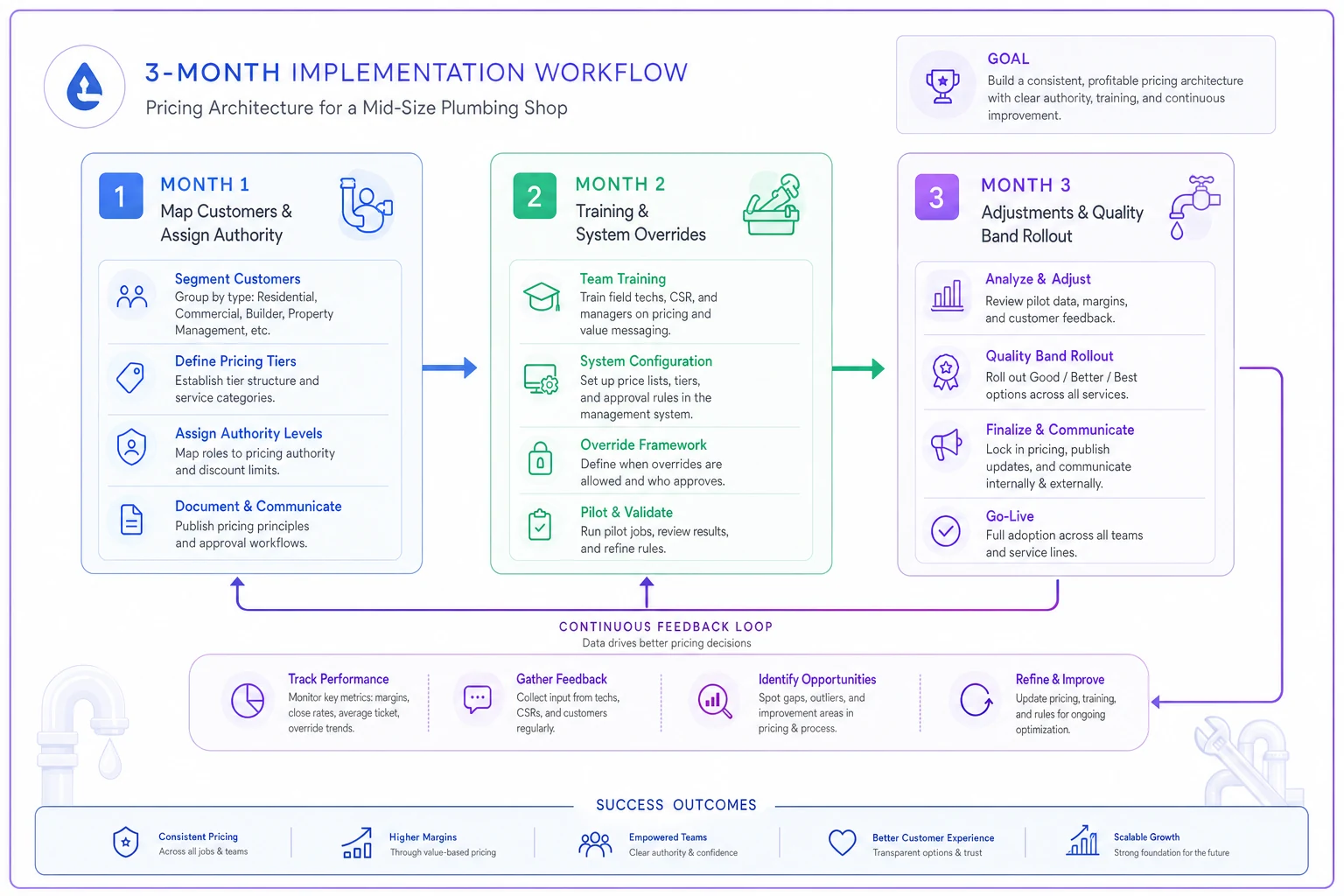
Use this as a one-page reference during the rollout to keep focus on timely deliverables.
Integration with Field Operations
A pricing architecture can't exist in isolation. It needs to integrate with your dispatch system, tie into your job costing, and feed your KPI tracking.
The handoffs matter:
Dispatch → Field: Customer segment, pricing authority, and special flags travel with the work order.
Field → Office: Override requests, dispute flags, and pattern alerts flow back immediately.
Office → Training: Override patterns trigger specific training modules, not generic "pricing reviews."
Training → Authority: Completed training unlocks new pricing powers systematically.
AI-powered operational software makes these connections automatic. When dispatch assigns a job, the system already knows the customer segment, the tech's authority level, and any special pricing rules. The tech sees available options, not the entire price universe.
When patterns emerge—like multiple techs discounting the same service in the same week—the system flags it for review. You're not waiting for month-end reports to spot problems that have been happening for weeks.
The Architecture Maturity Path
Your pricing architecture won't be perfect on day one. It evolves through predictable stages:
Stage 1 — Basic Segmentation: Separate residential from commercial, create basic tech authorities, implement manual escalations.
Stage 2 — Systematic Overrides: Track all overrides, identify patterns, create automatic rules for common situations.
Stage 3 — Integrated Governance: Connect pricing to customer history, implement quality bands, add progression paths for tech authority.
Stage 4 — Predictive Pricing: Use patterns to predict optimal pricing, automatically suggest adjustments, flag risks before they become disputes.
Stage 5 — Full Automation: Routine pricing decisions handled by the system, complex scenarios route automatically, continuous optimization based on outcomes.
Most shops get stuck at Stage 1 and treat everything else as too complex or something to deal with later. But each stage builds on the previous one—you can't jump to predictive pricing without first tracking overrides systematically.
Making It Stick: Change Management for Pricing Architecture
The hardest part about implementing a pricing architecture isn't the framework—it's getting your team to actually use it consistently. Techs who've been quoting their own way for years won't change overnight.
Start with wins, not restrictions.
Show techs how clear authorities protect them from awkward customer situations. No more "I need to call my boss" moments standing in someone's kitchen.
Demonstrate how automatic discounts for maintenance members mean they never accidentally charge a plan member full price and create a mess.
Explain how escalation rules protect their commission—they're not losing sales, they're ensuring the right price for complex situations gets handled correctly.
Frame training triggers as skill development, not punishment. "You've escalated five commercial quotes this month—let's get you certified for commercial pricing so you can handle these yourself."
The architecture should feel like it's making their job easier. When a tech doesn't have to guess whether they can offer a discount, when they know exactly which customers get special treatment, when disputes have clear resolution paths—that's less stress, not more bureaucracy.
Beyond Individual Transactions: Portfolio Pricing Governance
A mature pricing architecture looks beyond individual jobs to portfolio-level patterns. This is where AI-powered operational software earns its keep—spotting trends humans miss across thousands of transactions.
Portfolio patterns worth tracking:
Geographic clusters requesting similar discounts might indicate market pressure or competitor activity in a specific area.
Seasonal override patterns might suggest your book pricing doesn't account for demand fluctuation.
Customer segment migration—transactional customers becoming maintenance members—might justify different acquisition pricing.
Tech-specific patterns might reveal training gaps or exceptional judgment worth rewarding and developing.
Service-specific disputes might indicate your flat-rate pricing structure needs refinement for certain job types.
The architecture should include review triggers for these portfolio patterns. Not daily fire drills, but monthly or quarterly strategic adjustments based on accumulated data.
The Competitive Advantage of Pricing Discipline
Most plumbing shops compete on price or service. With a proper pricing architecture, you compete on consistency and appropriate value delivery. Customers know what to expect. Techs know what they can deliver. The office knows margins are protected.
This discipline becomes a competitive moat. While competitors scramble with ad-hoc pricing decisions and margin erosion from unauthorized discounts, your operation runs more predictably. Same problems, better framework for handling them.
Scaling also gets easier. Adding new techs? They slot into existing authority bands. Adding new services? The governance framework already exists. Expanding geographically? Customer segments and pricing rules travel with you.
Pricing architecture isn't about control—it's about clarity. Clear rules for who can quote what. Clear triggers for when human judgment overrides systematic rules. Clear pathways for developing pricing authority. Clear feedback loops for continuous improvement.
Without this architecture, every pricing decision is an island. With it, every decision connects to a larger operational framework that protects margins, develops your team, and serves customers consistently. The shops that thrive don't necessarily have the best prices or the best techs. They have the best systems for ensuring the right prices get to the right customers through the right techs at the right time. Build the framework, and the pricing decisions handle themselves. Try to handle every pricing decision individually, and you'll always be playing catch-up. Your price book is just data. Your pricing architecture is what turns that data into consistent, profitable operations.
Ready to optimize your plumbing operations?
Join 500+ plumbing businesses using Plummerly to save time, reduce scheduling errors, and improve customer satisfaction.