

Most plumbing owners don't have a hiring problem. They have a system problem that only looks like a hiring problem.
When a tech quits, or you finally land enough work to justify truck number four, the whole operation suddenly gets loud. You post an Indeed listing, you scramble through resumes between service calls, you interview someone in the warehouse at 7pm, and you make an offer because you're desperate and this guy seems fine. Three months later he's cutting corners on installs, the callbacks are piling up, and you're wondering if you hired wrong — or if you just never built anything for him to succeed inside of.
That's the real issue. People fail inside broken systems far more often than they fail on their own. And the people side of a plumbing business is probably the least systematized part of the entire operation, even in shops that have dialed in their pricing, dispatch, and job costing.
This article walks through how to treat recruiting, onboarding, skills verification, coaching, and pay as one connected system — and how that system has to change as you add trucks. If you've already mapped out your maturity roadmap with hiring and tech gates, this is the people-ops layer that sits underneath it.
Why the people side breaks at every growth gate
Your people system doesn't break gradually. It breaks at specific truck counts, and it breaks for predictable reasons.
At 1–2 trucks, you are the system. You hired the tech, you trained him by riding along, you know exactly what he can and can't do, and you pay him what feels fair. There's no documentation because it all lives in your head. This works right up until it doesn't.
At 3–5 trucks, your head stops being big enough. You can't ride along anymore because you're running the business. You've now got techs you didn't personally train, doing work you don't personally see, charging customers prices you set but can't enforce. This is where callbacks quietly climb and you can't figure out why. Usually it's because two of your four techs are doing the job one way and the other two are improvising, and nobody wrote down which way is right.
At 6–10 trucks, the cracks become structural. Now you've got a lead tech or a field supervisor, maybe an office manager handling intake. Pay gets political — somebody finds out the new hire makes almost as much as the guy who's been there three years, and suddenly you've got a morale problem you didn't see coming. Onboarding is inconsistent because whoever happens to be free that week "shows the new guy around." Your best people start leaving because there's no clear path forward, just more of the same work.
What breaks at scale isn't any single thing. It's the gap between what you know in your head and what the business can actually execute without you. A people-ops system is just the work of getting that knowledge out of your head and into something repeatable.
The recruitment funnel: stop treating hiring as an event
The first mental shift is this: hiring is not something you do when you're short a tech. It's a funnel that runs in the background, even slowly, year-round.
Stop missing service calls and double bookings.
Plummerly helps you schedule, assign, and manage every plumbing job efficiently.
- Centralized job scheduling
- Technician dispatch & tracking
- Customer notifications
No credit card required
Shops that only recruit when desperate always overpay and under-screen. You hire the person who's available, not the person who's good, because you can't afford to wait. The shops that grow cleanly keep a lightweight funnel alive so that when they need someone, they're choosing from a short list instead of starting from zero.
-
Always-on intake. A simple application link on your site and job posts that stay up even when you're not actively hiring. You're collecting names for later.
-
Phone screen (15 minutes). One person, one script. You're checking for license status, reliability signals, and whether they can actually describe a job they ran start to finish. Most candidates fall out here, and that's the point.
-
Working interview or ride-along. This is the single most predictive step and most shops skip it. Watching someone diagnose a real problem for half a day tells you more than any interview. Pay them for it.
-
Reference and background check. Not a formality. Call the last employer and ask one question: "Would you hire him again?" The pause before the answer tells you everything.
-
Offer with a clear scorecard attached. More on scorecards below.
Worth noting: the shops with the lowest turnover usually have the slowest hiring process, not the fastest. They let the funnel do the filtering instead of hoping an interview gut-check will catch problems.
Hiring scorecards
A scorecard is a one-page document that defines what "good" looks like before you meet anyone. Without it, every interview turns into vibes — you hire people you like and are surprised when likability doesn't translate to competent installs.
A workable technician scorecard rates candidates on a simple scale across things like:
-
Diagnostic reasoning (can they explain why, not just what)
-
Code and safety knowledge
-
Customer communication (do they talk to homeowners like humans)
-
Reliability history (job tenure, gaps, no-call patterns)
-
Upsell instinct without being a shark
-
Teachability (this one matters more than existing skill at the junior level)
Score each candidate independently if more than one person interviews. When two people score the same candidate wildly differently, that disagreement is useful signal — talk it out before you decide.
The plumbing technician onboarding checklist
This is where most of the money leaks out, and it's the part owners most underestimate. A sloppy first two weeks costs you for years because bad habits set in early and get expensive to unlearn.
A real plumbing technician onboarding checklist has to cover administrative setup, technical standards, and cultural expectations — not just "here's your truck, go." Here's a version small shops can actually use:
Before day one
-
[ ] Offer letter signed, pay band and review cadence documented
-
[ ] Truck assigned, keys, fuel card, inventory count completed and photographed
-
[ ] Software logins created (dispatch, invoicing, time capture)
-
[ ] Uniforms, PPE, and tool list confirmed
Days 1–3
-
[ ] Review company pricing structure and how to present it (not negotiate it)
-
[ ] Walk through the standard diagnostic and documentation workflow
-
[ ] Photo and evidence standards for every job
-
[ ] Shadow a senior tech on at least 3 complete jobs
-
[ ] Review safety protocols and incident escalation
Week 1
-
[ ] First supervised solo jobs (senior tech reviews work after)
-
[ ] Truck inventory and restocking process
-
[ ] How to handle a job that goes sideways (when to call, when to escalate)
-
[ ] Customer interaction standards — arrival, explanation, sign-off
Weeks 2–4
-
[ ] Independent jobs with same-day work review
-
[ ] First callback review if any occur (coaching, not punishment)
-
[ ] Confirm he can run a job end to end without prompting
The insight most owners miss: onboarding isn't about information transfer, it's about standard-setting. The new tech is watching to see what you actually tolerate. If his first week includes a sloppy install that nobody corrects, you've just taught him your real standard — and it's lower than the one in your head.
30/60/90 templates: making expectations measurable
A checklist gets someone productive. A 30/60/90 plan tells them — and you — whether they're actually becoming the tech you need.
The problem with "how's the new guy doing?" is that it's unanswerable without a target. Everyone has a vague sense, nobody has a number, and by the time it's obvious he isn't working out, you've sunk three months into him.
Here's a practical framework:
| Milestone | What "on track" looks like | Red flag |
|---|---|---|
| 30 days | Running simple jobs solo, following documentation standards, callback rate near shop average | Still needs hand-holding on basic diagnostics; cutting documentation corners |
| 60 days | Handling moderate-complexity jobs, average ticket within range of peers, clean callback record | Avg ticket far below peers; customer complaints; inconsistent photos |
| 90 days | Fully independent, contributing to revenue at target, requires normal supervision only | Can't work unsupervised; recurring quality issues; morale friction |
The 90-day mark should be a real decision point, not a rubber stamp. If someone isn't tracking by day 90, the kind thing — for them and for you — is to be honest about it rather than drag it out for another six months.
The skills verification matrix
Once you have more than two or three techs, "I think he can handle that" stops being good enough for dispatch decisions. You need to actually know who can do what, documented somewhere your dispatcher can see.
A skills verification matrix is a grid: techs down the side, skills across the top, with each cell marked as not trained / trained / verified / can teach. Skills might include water heater installs, repipe work, sewer camera and locating, drain cleaning, gas line work, backflow, commercial vs residential, and so on.
This does two things at once. It makes dispatch smarter — you stop sending your newest guy to the job that needs your most experienced one. And it makes your pay bands defensible, because now compensation maps to verified capability instead of tenure or who negotiated hardest.
The mistake shops make here is marking someone "verified" because they did the job once and it didn't blow up. Verification should mean consistently good, confirmed by someone checking the work — not "survived it once."
Coaching cadence: the part everyone skips
Most plumbing shops coach reactively. A tech only hears from the owner when something goes wrong. Which means feedback is always negative, always late, and always feels like getting chewed out. That's how you lose good people.
A coaching cadence is just scheduled, predictable one-on-one time that isn't tied to a problem. Even 20 minutes every two weeks changes the whole dynamic. You review their numbers together — average ticket, callback rate, jobs completed, customer feedback — and you talk about what's working before you talk about what isn't.
Keep each coaching session to a consistent, short agenda — numbers, wins, and one development item.
The shops that do this well tie coaching directly to the KPIs they already track. If you've built out your technician-level metrics and dashboards, the coaching conversation almost writes itself — you're looking at the same numbers together, and the tech can see exactly where he stands instead of guessing what the boss thinks.
A workable cadence by size:
-
1–3 trucks Owner does biweekly check-ins directly
-
4–6 trucks Lead tech or field supervisor handles weekly field reviews, owner does monthly
-
7–10 trucks Supervisor owns the cadence, owner reviews the roll-up and handles pay conversations
When coaching is only about catching mistakes, techs hide mistakes. When it's regular and forward-looking, they bring problems to you early, when they're still cheap to fix.
Compensation bands tied to measured KPIs
This is where it all connects — and where most owners get nervous, because pay has been handled informally forever and formalizing it feels risky.
The hidden cost of informal pay is enormous. When compensation is a one-off negotiation each time, you end up with a pay structure that makes no sense: the guy who complained loudest earns more than the quieter tech who's twice as good. Eventually everyone finds out, and the resentment poisons the whole crew.
Pay bands fix this by defining ranges for each level — apprentice, technician, senior technician, lead — and tying movement within and between bands to the skills matrix and measured performance. Someone moves up when they verify new skills and hit KPI targets consistently, not when they threaten to quit.
| Level | Base range | Movement driver |
|---|---|---|
| Apprentice | Entry | Completing onboarding, basic skill verification |
| Technician | Mid | Independent on standard jobs, KPIs at shop average |
| Senior Tech | Upper-mid | Verified on complex work, strong ticket + low callbacks |
| Lead / Field Supervisor | Top | Mentoring others, consistent top-tier numbers |
Pay-band governance just means having rules for how and when pay changes — tied to review cycles, documented reasons, consistent across people. It takes the emotion and favoritism out, which is exactly what you want once you're past a few employees.
When this makes sense — and when it doesn't
This system makes sense when you're at or approaching 3–4 trucks, when you've had turnover that confused you, or when you're starting to feel like you can't see what your techs are actually doing.
This is overkill when you're a one-truck owner-operator or a two-person shop where you ride along daily. Don't build governance for a team that fits in one truck cab. A simple onboarding checklist and a fair pay conversation is enough at that stage.
Who should NOT rush into formal pay bands: shops in financial stress. If your margins are thin and inconsistent, lock those down first — a comp structure built on shaky numbers just formalizes a problem.
A real scenario
A residential plumbing shop running four trucks kept losing techs around the one-year mark. They'd hire, train informally, the tech would get decent, and then leave for a competitor — usually over money and feeling like there was nowhere to go.
The owner wasn't tracking much at the per-tech level. When he finally started, the picture was ugly: callback rates ranged from under 5% for his best tech to nearly 18% for one he'd been carrying without realizing it. Pay had no logic to it — that same 18% guy was earning more than one of his cleanest techs because he'd negotiated harder at hire.
They built the basics: an onboarding checklist, a skills matrix, biweekly coaching tied to each tech's numbers, and three pay bands with clear movement rules. Nothing fancy. Most of it lived in spreadsheets and their field software at first.
Over the following two quarters, callbacks across the team tightened into a 6–8% range, and the shop went from losing a tech or two a year to keeping everyone through the period. The owner's own comment was that the biggest change wasn't the numbers — it was that he finally knew, on any given morning, exactly who could handle what and who needed attention. The scramble was gone.
Making the system actually run without you
The reason these pieces fail isn't that owners don't understand them. It's that keeping scorecards, matrices, 30/60/90 tracking, coaching notes, and pay-band records updated by hand is a part-time job nobody has time for — so it slides, and within a few months you're back to running people on gut feel.
This is where keeping the people system inside the same platform you use for dispatch, job costing, and KPIs actually matters. When a tech's callback rate, average ticket, and job history already live in your operational software, coaching conversations and pay-band decisions pull from real numbers instead of guesses. AI-assisted operational tools can flag when a tech drifts off their ramp targets, surface who's due for a review, or track which skills are verified — so the system maintains itself in the background instead of depending on you remembering to update a spreadsheet.
Below is a workflow diagram showing how hiring, onboarding, skills, dispatch, coaching, pay, and retention connect in a repeatable system.
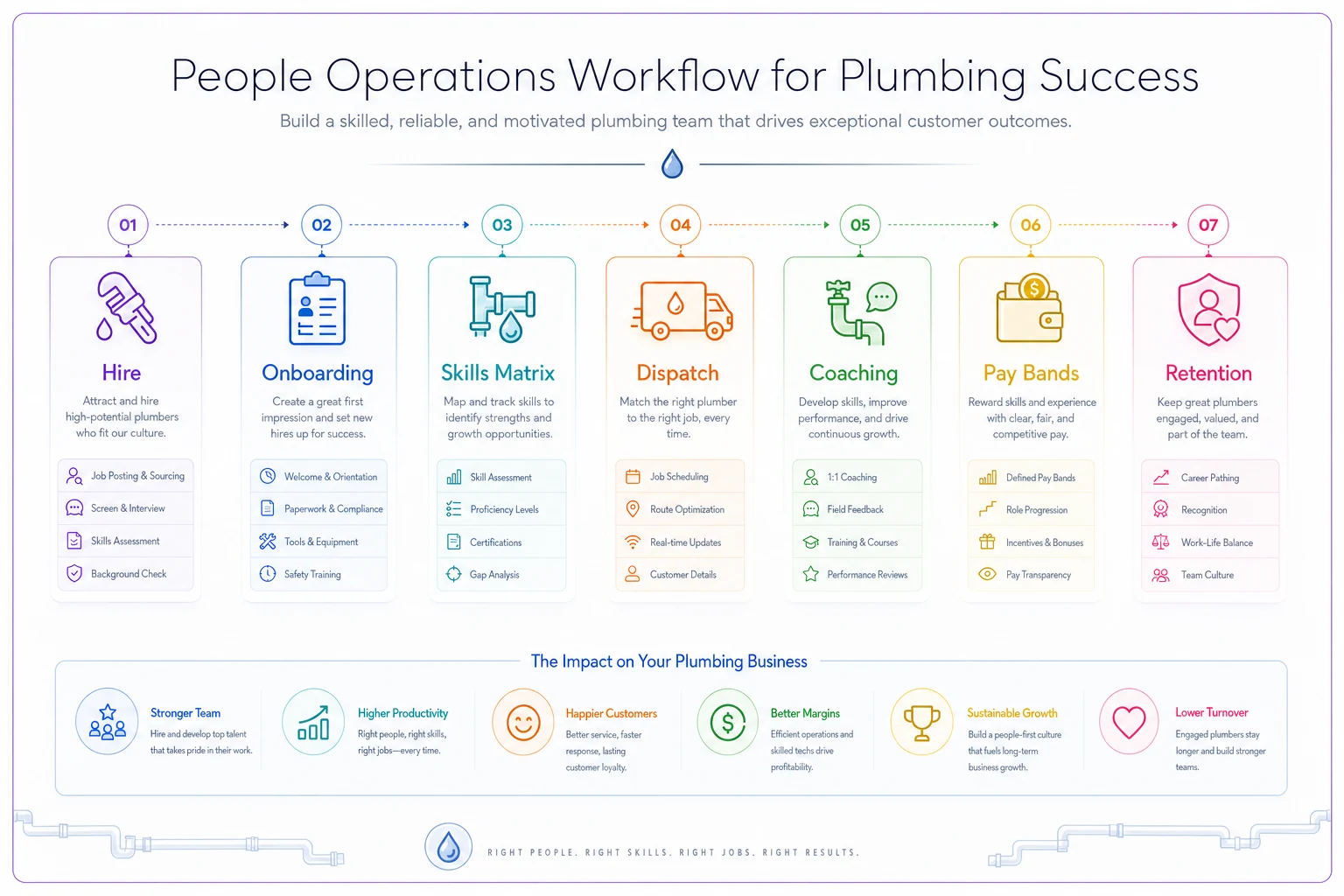
The point isn't the software, though. It's that people-ops only works when it's connected to the rest of the business. Hiring feeds onboarding, onboarding feeds the skills matrix, the matrix feeds dispatch and pay, performance feeds coaching, and coaching feeds retention. Pull any one piece out and the others get wobbly.
Most plumbing owners build the technical side of their business long before they build the people side, and then wonder why growth feels so fragile past a few trucks. Get this layer right — even imperfectly — and the next truck stops feeling like a gamble and starts feeling like a plan.
Ready to optimize your plumbing operations?
Join 500+ plumbing businesses using Plummerly to save time, reduce scheduling errors, and improve customer satisfaction.