

Most plumbing owners think about compliance the way they think about backflow testing—something you do when someone forces you to. Then a technician cuts into a wall with active mold, or a helper twists an ankle on a jobsite, or an inspector asks for two years of pressure-test records you never kept, and suddenly compliance stops being paperwork and starts being the thing standing between you and a lawsuit, a shut-down permit, or a denied insurance claim.
The frustrating part is that the businesses that get burned rarely had bad intentions. They had gaps. A checklist that lived in one senior tech's head. An incident that got reported over text and never made it into a file. Training that happened once during onboarding and never again. None of that shows up as a problem until the exact moment it becomes an expensive one.
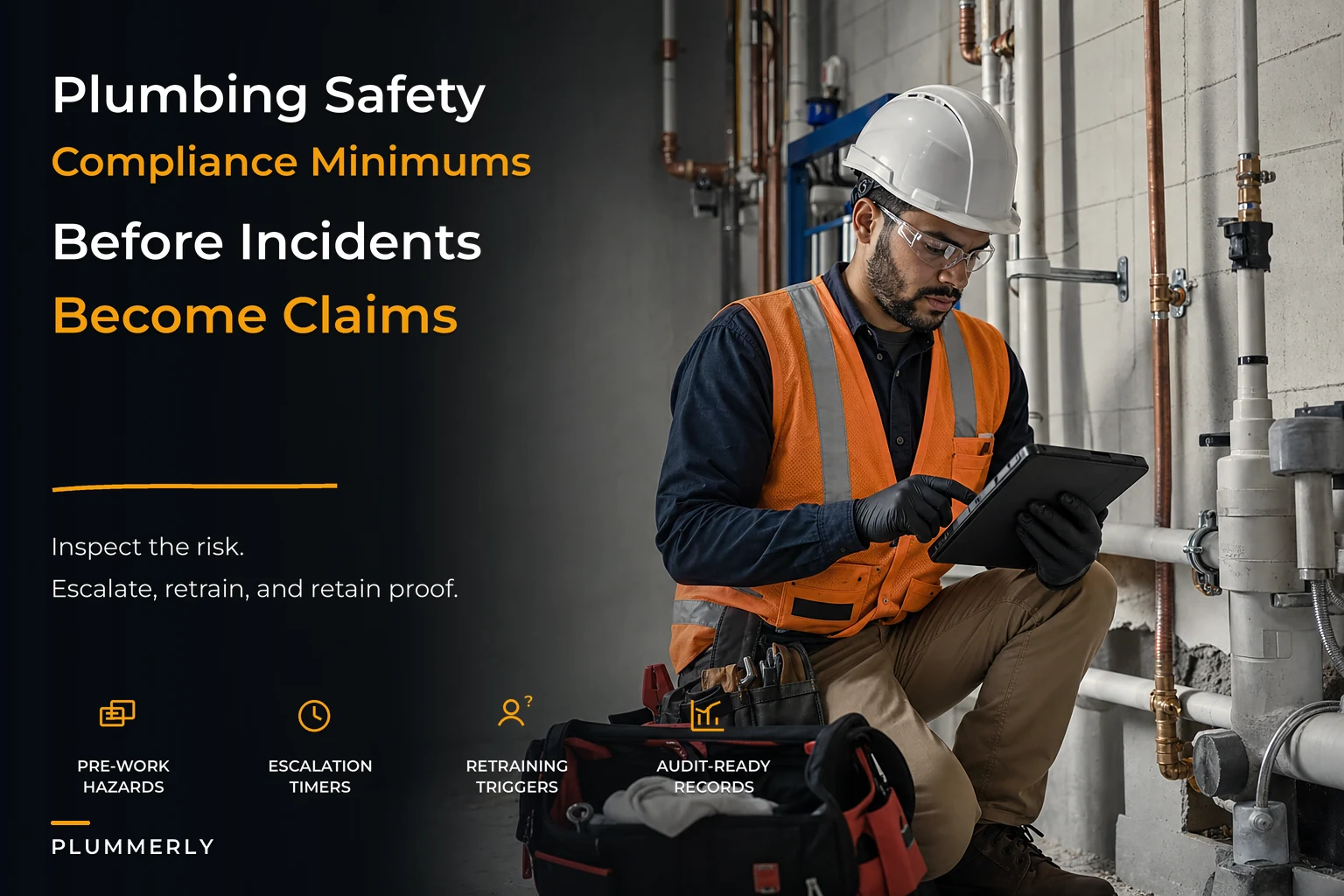
This is a systems piece, not a list of safety tips. The goal is to show how inspection checklists, incident escalation, training triggers, and record retention actually connect—and where those connections break as you add trucks, hire greener techs, and take on more complex work. If you run a 1–10 truck shop, this is the compliance floor you want under you before you scale, not after.
Why compliance breaks even when everyone means well
Compliance in plumbing isn't one thing. It's four separate systems that most shops treat as unrelated:
-
Inspection and pre-work verification (is the site and the job safe/legal before we start?)
-
Incident handling and escalation (what happens when something goes wrong?)
-
Training and requalification (do the people doing the work still know how to do it safely and to code?)
-
Record retention (can we prove any of the above later?)
The reason these break isn't ignorance. It's that each one has a different owner, a different trigger, and a different timeline—and small shops usually have no mechanism to keep them synced.
Think about how it actually plays out. Inspections happen at the job. Incidents happen unpredictably. Training happens on some fuzzy annual-ish schedule. Records are supposed to happen constantly but usually happen never. In a two-truck operation, the owner holds all four in his head and it more or less works because he's on most jobs. The moment you hit four or five trucks and you're no longer physically present, the mental model stops working and nobody notices until an inspector, an insurer, or an injury exposes it.
What tends to happen across small trades operations is that the failure almost always shows up at the seams—the handoffs between these four systems. The inspection caught the problem but nobody escalated it. The incident got escalated but never triggered retraining. The retraining happened but there's no record it did. Each system half-worked. The connective tissue is what was missing.
Inspection checklists: the difference between "we looked" and "we can prove we looked"
Every plumber inspects before they cut. The problem is that "inspection" as most shops practice it is a mental scan, not a documented step. A good tech notices the gas line, checks for asbestos-era materials in an old build, confirms the shutoff works, tests for pressure before opening a system. A great tech does all that and leaves a record that it happened.
Stop missing service calls and double bookings.
Plummerly helps you schedule, assign, and manage every plumbing job efficiently.
- Centralized job scheduling
- Technician dispatch & tracking
- Customer notifications
No credit card required
The distinction matters enormously when something goes sideways. If a customer claims you flooded their basement, "my guy always checks the shutoff" is worthless. A timestamped checklist entry with a photo is a defense.
-
Water/gas shutoff located and tested before any work begins
-
Material hazards in older properties (lead solder joints, galvanized corrosion, potential asbestos wrap on old lines)
-
Pressure test / leak-down results captured before and after on any pressurized system
-
Backflow and cross-connection verification where applicable
-
Confined space / ventilation check for crawlspaces, pits, and water heater closets
-
Permit status confirmed for anything that requires one (and a flag if the customer is pushing you to skip it)
-
Code applicability for the specific work—venting distances, trap arm lengths, TPR valve discharge routing, whatever the job demands
The mistake owners make here is building a checklist that's too long to actually complete. A 40-item form gets skipped. A tight 8–10 item form that a tech can knock out in under two minutes gets used. Completion beats comprehensiveness every time. A checklist nobody fills out is worse than no checklist, because it creates a paper trail that proves you had a standard and ignored it.
Incident escalation: the gap between "something happened" and "the right people knew in time"
Here's the pattern that quietly wrecks small shops: an incident occurs, the tech handles it in the field, tells the owner casually that evening, and it never becomes a documented, escalated event. Ninety percent of the time that's fine. The tenth time, it's the water heater that a tech red-tagged verbally but nobody put in writing, and three weeks later there's a CO scare.
Escalation only works when it's tiered and automatic, not left to individual judgment in the moment. A tech who just watched a pipe fail is not in the right headspace to decide whether something needs to go up the chain.
| Tier | Trigger examples | Who gets notified | Timeline |
|---|---|---|---|
| Tier 1 – Log only | Minor property scuff, small tool damage, near-miss with no injury | Field lead, logged same day | End of day |
| Tier 2 – Notify + document | Water damage to customer property, gas smell resolved on site, minor first-aid injury | Owner/ops manager + written report | Within 2 hours |
| Tier 3 – Immediate escalation | Any injury needing more than first aid, active gas leak, CO exposure, code violation you were asked to bury, property damage over a set dollar threshold | Owner immediately, insurer/legal as needed | Immediately, work stops |
The number that matters most here isn't in the table—it's the dollar and severity thresholds you set for Tier 3. A shop that says "call me for anything over roughly $2,500 in damage or any injury beyond a Band-Aid" removes the judgment call from a stressed technician. Ambiguity is what kills escalation. If a tech has to decide whether something is serious enough to call you, he'll usually decide it isn't.
This ties directly into how you handle urgent inbound work, too. The same discipline you'd use for emergency call triage and response tiers applies to internal incidents—clear tiers, clear scripts, no guessing. If you've already built triage logic for customer emergencies, you've done most of the thinking needed for internal incident tiers.
Training triggers: the requalification most shops skip entirely
Onboarding training is universal. Ongoing training tied to actual events is rare. That's the gap that bites you.
Training shouldn't run on a pure calendar. Calendar-only training ("annual safety refresher") is theater—everyone sits through it, nobody's sharper afterward. The training that actually reduces incidents is triggered by real signals:
-
Incident-triggered
any Tier 2 or Tier 3 event should automatically flag a retraining review for the involved tech and, if it's a pattern, the whole crew
-
Code-change-triggered
local code adoption cycles (many jurisdictions update on a multi-year cadence) should trigger a targeted refresh on what actually changed, not a generic review
-
New-work-type-triggered
first time a tech takes on medical gas, commercial backflow, or anything outside their usual residential scope
-
Requalification-triggered
certifications with expiration dates—backflow assembly tester certs, med-gas certs—need a tracked renewal window, not a scramble when a job requires proof
Shops that tie training to incidents see the same type of incident stop recurring. Shops that only do annual training see the same incidents cycle back every year with different names attached. The trigger is what closes the loop.
The failure point at scale is tracking. With two techs you know everyone's cert status. With eight, you've got a spreadsheet nobody updates, and you find out a cert lapsed when a commercial GC asks for current documentation and you can't produce it.
Record retention: the system that only matters when it's too late to build
Retention is the least glamorous of the four and the one that most often determines whether the other three actually protected you. An inspection you didn't record didn't happen, legally speaking. An escalation with no written trail is a "he said / she said." Training you can't prove is training that didn't count when an insurer reviews your claim.
| Record type | Suggested minimum retention | Why |
|---|---|---|
| Injury / incident reports | 5+ years | Injury claims and workers' comp disputes have long tails |
| Inspection & pressure-test records | Life of the installed system where feasible; 3–7 yrs minimum | Defends warranty and liability claims |
| Permit & code-compliance docs | Permanent for major installs | Comes up on resale, disputes, and future work |
| Training & certification records | Duration of employment + several years after | Proves competency at time of work |
| Backflow test reports | Per local requirement (often submitted to water authority) | Regulatory, not optional |
The mistake here is storing everything in fragmented, unsearchable places—photos on one tech's phone, reports in an email thread, certs in a filing cabinet, permits in a truck glovebox. When you need records, you need them fast and complete. Scattered records are functionally the same as no records.
How these four systems connect (and where the seams tear)
Here's the workflow when it works end to end:
Quick visual of the job-level flow.
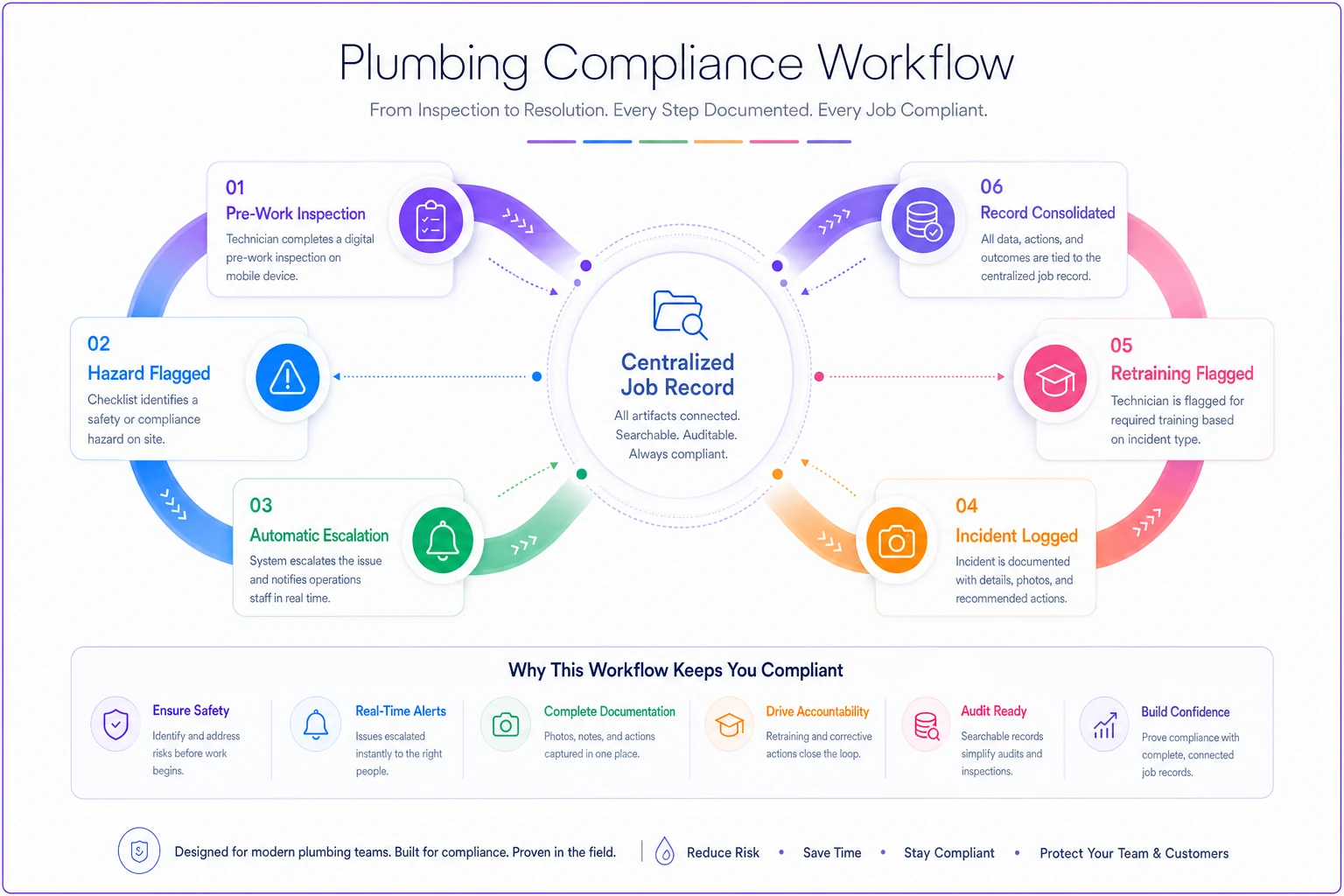
-
The inspection happens but isn't documented, so the flag never fires.
-
The flag fires but the tech decides it's "not a big deal" and skips escalation because the threshold was fuzzy.
-
Escalation happens over text and never becomes a formal report.
-
The report exists but never triggers any training review, so the same thing happens on the next old-house job.
-
Nothing is retained centrally, so six months later when it matters, you can reconstruct maybe half of it.
Each tear is small. Together they mean that when you actually need your compliance system—during a claim, an OSHA visit, a lawsuit, an inspection audit—it isn't there.
A minimum-viable compliance system you can actually run
You don't need an enterprise EHS platform to run a 6-truck plumbing shop safely. You need the four systems wired together with the least friction possible. Here's the build order:
-
Write the inspection checklist first. Keep it under 10 items. Make it mandatory before a job can be marked started. Include photo capture on any flagged hazard.
-
Define your escalation tiers with hard thresholds. Dollar amounts and injury severity, in writing. Remove judgment from the field.
-
Set your training triggers. At minimum
incident-triggered review, cert-expiration tracking, and new-work-type sign-off.
-
Pick one retention home. Everything—checklists, incident reports, training records, certs, permits—lives in one searchable place tied to jobs and technicians.
-
Test the seams, not the pieces. Run a fake incident. Does the checklist flag route to escalation? Does escalation generate a report? Does the report trigger a training flag? Can you pull all of it in under five minutes?
Keep the inspection checklist under 10 items so it's actually used.
That last step is the one everyone skips and the one that actually reveals whether you have a system or four disconnected habits.
Most modern field-service platforms can carry a lot of this if you configure them intentionally—mandatory checklists gating job status, photo capture with metadata, digital forms that route to the office, and a central record store tied to each job. The value isn't the software being clever; it's that it removes the human-memory dependency that breaks every manual compliance system as it scales. When a checklist has to be completed before a job moves forward, completion stops depending on whether a tech remembers to care that morning. If you're formalizing this alongside your other operating procedures, it fits naturally into a broader operations playbook with copyable SOPs rather than living as a separate binder nobody opens.
A real scenario: the four-truck shop and the denied claim
A residential-and-light-commercial plumbing shop running four trucks took a water heater replacement in an older home. The tech did solid work. Two weeks later the customer reported water damage and filed a claim, alleging the tech had ignored a pre-existing shutoff problem.
What the shop had: a good tech's word, a paid invoice, and nothing else. No documented pre-work inspection. No before-photos of the shutoff. No note about the condition of the existing setup. The insurer had nothing to work with, the claim dragged, and the shop ate somewhere in the $6k–$8k range between the settlement contribution and the time spent fighting it. Not catastrophic—but entirely avoidable.
After that, the owner built the checklist-to-record chain described above. Mandatory pre-work inspection with shutoff verification and photos, gating job start. Six months later, a nearly identical dispute came in on a different job. This time the tech's checklist showed the shutoff tested fine before work began, with a timestamped photo. The claim was closed against the customer in about a week.
Same type of dispute, completely different outcome—and the only variable that changed was whether the documentation existed. The owner's own take afterward was blunt: the second job wasn't done any better than the first. It was just provable.
When this level of rigor makes sense—and when it's overkill
When it makes sense: The moment you're no longer physically on most jobs. That's usually around the 3–5 truck mark. The compliance system replaces the oversight your own presence used to provide. It also makes sense earlier if you do any commercial, medical-gas, or backflow work where documentation is contractually or legally required regardless of your size.
When it's overkill: A true owner-operator on every single job doesn't need a formal escalation tier structure—he is the escalation path. Building heavy process here too early can slow a one-truck operation without reducing real risk. The right move for a solo operator is to keep the records discipline (photos, pressure tests, permits) and skip the internal-notification machinery until there's someone to notify.
Who should not half-build this: Don't create checklists and forms you won't enforce. A partial compliance system is genuinely worse than an honest lack of one, because it manufactures evidence that you had a standard and didn't follow it. If you're not going to gate job status on checklist completion, don't pretend the checklist is a control. Either commit to the seams working or keep it simple and honest.
Closing thought
Safety compliance in plumbing isn't a document you produce once and file away. It's four moving systems—inspection, escalation, training, and retention—that either talk to each other or fail quietly in the gaps between them. Small shops get away with disconnected habits right up until the moment they don't, and that moment is always more expensive than the system would have been.
Build the checklist tight, make the escalation thresholds hard numbers, trigger training off real events instead of the calendar, and keep every record in one place you can search under pressure. Then test the seams. The shops that survive their first serious incident, claim, or audit aren't the ones that were luckier—they're the ones who could prove what they did.
Ready to optimize your plumbing operations?
Join 500+ plumbing businesses using Plummerly to save time, reduce scheduling errors, and improve customer satisfaction.