

Most plumbing shops don't actually have a quality assurance system. They have a founder or a lead tech who spot-checks a few jobs when something feels off, maybe reviews a bad Google rating after the fact, and calls it QA. That works at two trucks. It falls apart somewhere between truck four and truck seven, usually without anyone noticing until callbacks start eating margin and the office is getting blindsided by angry customers.
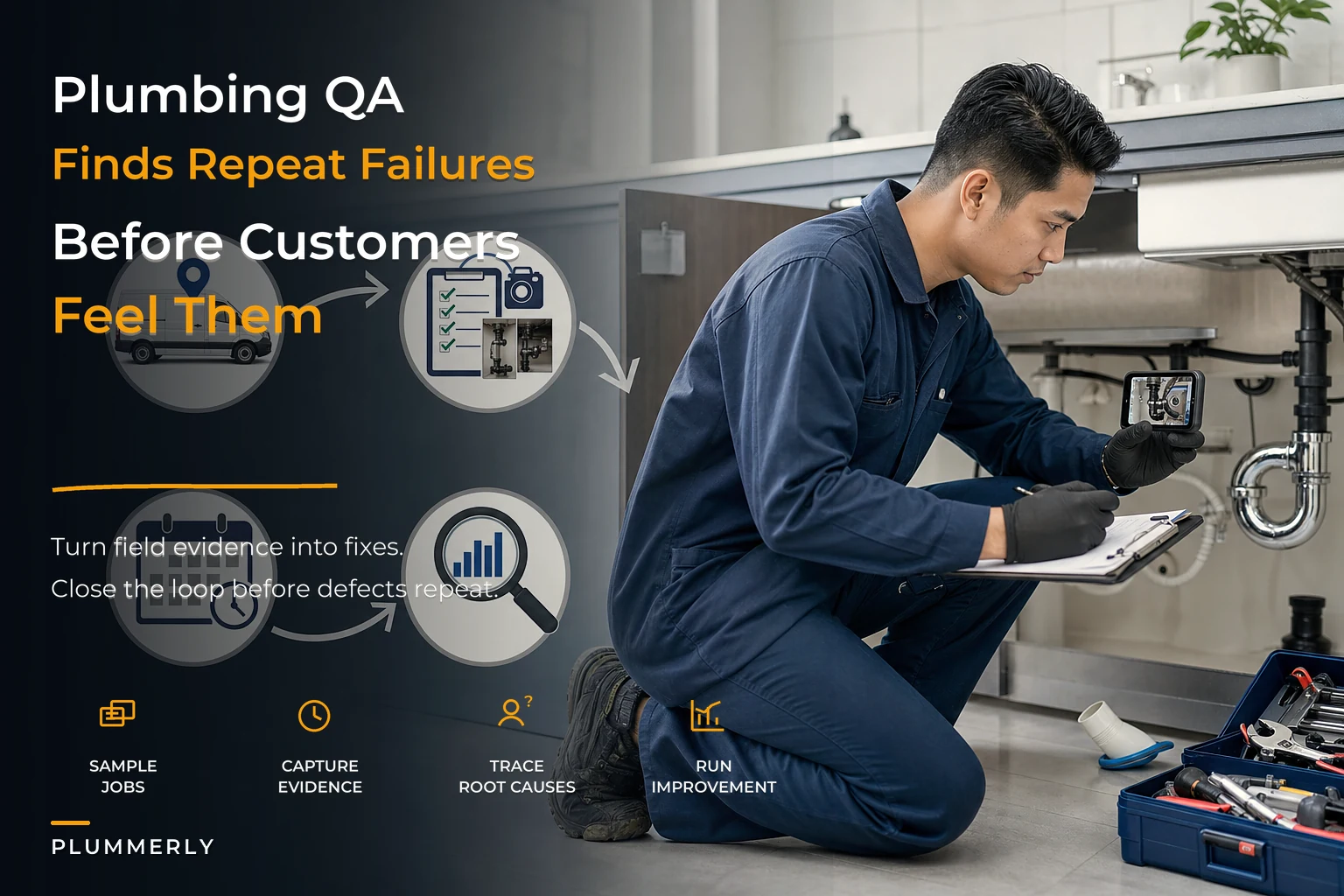
The gap isn't that owners don't care about quality. It's that quality is being measured as a feeling instead of a loop. A real plumbing field service quality assurance program closes the loop: you sample jobs on purpose, you capture evidence consistently, you trace failures back to a cause, and you fix that cause in short, scheduled cycles — then re-sample to confirm the fix actually worked. Everything connects. Pull one piece out and the whole thing leaks.
This is the system view. Not "10 tips to improve quality," but how the pieces fit together, where they break as you grow, and what a functioning loop actually looks like in a real shop.
Why spot-checking quietly fails as you add trucks
Spot-checks work early because the owner is the system. They were on the truck last year. They know what a clean shut-off valve swap looks like, they recognize their techs' handwriting on invoices, and they can tell from the photos when someone rushed through a job.
That knowledge doesn't scale — and more importantly, it doesn't transfer. When you add techs faster than you add oversight, a few predictable things happen:
-
Quality standards drift per tech. Each person has their own idea of "good enough," and nobody ever wrote the real standard down.
-
Problems get discovered by customers instead of by you. The feedback loop runs through your reviews and your refunds — the most expensive place possible to learn you had a problem.
-
Nobody can tell whether a callback was a parts issue, a diagnostic miss, a workmanship problem, or a communication failure. It all just lands in a bucket called "that job went bad."
The pattern worth naming: shops don't lose quality all at once, they lose the ability to see quality. The actual work might only be a little worse, but your visibility drops to near zero, so you're flying blind while your reputation slowly erodes. By the time it shows up in your Google rating, the damage is already three months old.
A closed-loop QA program is really a visibility system first and a correction system second.
The four parts of the loop (and how they connect)
A working QA loop has four moving parts. The mistake most shops make is building one or two of them and wondering why nothing improves.
Stop missing service calls and double bookings.
Plummerly helps you schedule, assign, and manage every plumbing job efficiently.
- Centralized job scheduling
- Technician dispatch & tracking
- Customer notifications
No credit card required
-
Sampling — deciding which jobs to review and how many, on purpose.
-
Audit + evidence capture — reviewing those jobs against a fixed standard, using consistent evidence.
-
Root-cause workflow — turning a failed audit into a diagnosed cause, not just a complaint.
-
Improvement sprints — fixing causes in short cycles and re-measuring.
The connection between them is the whole point. Sampling without audits is just paperwork. Audits without root-cause work generate a list of bad jobs and hurt feelings. Root-cause without sprints produces a binder full of good intentions. Sprints without sampling means you never actually know if your fix worked.
Here's how each one runs in practice.
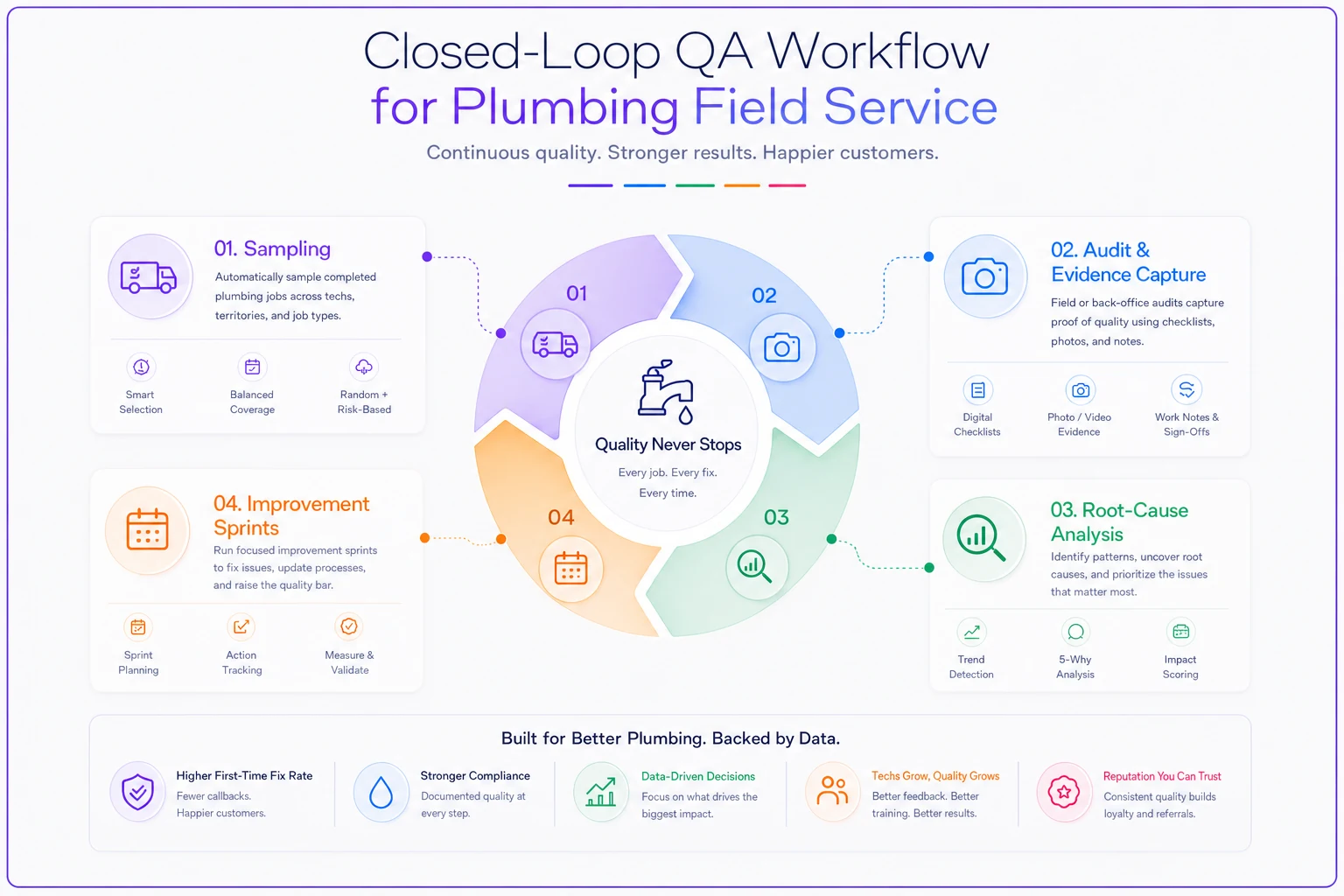
A simple diagram like this makes it easier to explain the loop to techs and office staff.
Part 1: Sampling plans — stop auditing "whatever's suspicious"
If you only audit jobs that already look like problems, your data is garbage. You'll confirm what you already suspected and miss everything that's quietly wrong. Good sampling is partly random, partly targeted.
A practical sampling mix for a small fleet:
| Sample type | What it covers | Suggested rate |
|---|---|---|
| Random baseline | Any completed job, chosen blind | 5–10% of all jobs |
| High-risk job types | Repipes, water heater installs, sewer work, anything over a dollar threshold | 20–30% of those jobs |
| New or probationary techs | First 60–90 days of any new hire | 50%+ until they stabilize |
| Callback-triggered | Any job that generated a return visit | 100% |
| Complaint-triggered | Any job with a customer complaint or refund | 100% |
The random baseline is the part everyone skips, and it's the most valuable. It's the only sample that tells you the true state of your operation — not just the state of your worst jobs. A shop that audits only complaints will swear its quality is fine right up until complaints spike, because they were never looking at normal jobs where the drift was building.
Use a software randomizer rather than a person to select baseline samples to remove human bias.
One practical note: keep the random sample genuinely random. If your office manager is picking jobs, they'll unconsciously avoid the techs who argue about feedback. Let a randomizer or your software pick. Take the human bias out of it.
Part 2: Audits and evidence — the standard has to exist before the audit does
You can't audit against a standard that lives in someone's head. The audit template is where you force that standard to become real and written.
A plumbing QA audit isn't one giant checklist — it's a few short ones tied to job type. A water heater install audit checks different things than a drain clearing audit. But every template should score across the same four dimensions so you can compare across job types later:
-
Workmanship — was the physical work done to code and to your standard? (fittings, supports, sealing, cleanup)
-
Diagnostics — was the actual problem correctly identified, or did the tech fix a symptom?
-
Documentation — are the photos, notes, and sign-offs complete and usable?
-
Customer experience — pricing explained up front, expectations set, site left clean?
Here's a sample workmanship section for a water heater install audit:
-
[ ] Correct unit and capacity vs. the quote
-
[ ] T&P discharge piped to code
-
[ ] Shutoff and expansion tank present and installed correctly
-
[ ] Proper venting / clearances
-
[ ] No visible leaks after 15-minute pressure hold
-
[ ] Old unit removed, area cleaned
-
[ ] Before/after photos from required angles
-
[ ] Customer walkthrough completed and signed
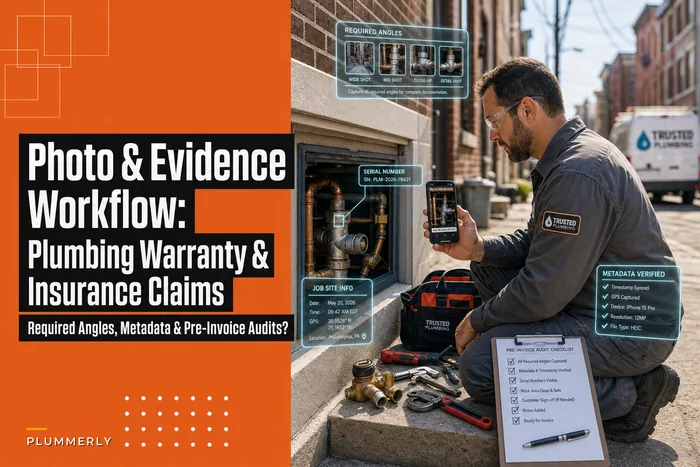
The documentation dimension is where most shops lose the plot, and it's the easiest to fix. If evidence capture is inconsistent, your audits are guesswork — you're grading a job you can't actually see. This is why your QA program and your field evidence process have to be built together. The required angles, metadata, and pre-invoice checks laid out in the photo and evidence workflow for warranty and insurance claims do double duty here: the same photos that protect you on a claim are exactly what your auditor needs to score workmanship without being on site.
Same goes for anything safety-related. A QA audit that ignores safety is incomplete, and the inspection and record-retention minimums in the safety and compliance guide should be baked into your audit template as pass/fail items, not soft suggestions.
Where AI quietly helps the audit load
The honest problem with auditing: it's time-consuming, and the person doing it is usually your most expensive person. At 10% sampling across a few hundred jobs a month, that's real hours.
This is one place where AI-assisted operational software earns its keep without any hype. A platform that already holds your job photos, notes, and invoices can do a tedious first pass — flagging jobs missing required photos, catching invoices where the parts don't match the job type, surfacing jobs with unusually short on-site times for the work billed. It doesn't judge the plumbing. It hands your auditor a pre-sorted pile so they spend time on the jobs that actually need human judgment, instead of opening 40 job files to find the 6 worth reviewing. The goal isn't to remove the human from QA — it's to stop wasting the human on sorting.
Part 3: Root-cause workflow — a failed audit is a question, not a verdict
This is where most QA attempts turn toxic and die. An audit fails, someone blames a tech, the tech gets defensive, and within a month the whole program is seen as a punishment tool. Techs start gaming it or hiding problems. You've made quality worse by measuring it badly.
The fix is to separate the finding from the cause. When an audit fails, the question isn't "who screwed up" — it's "what in the system let this happen." A simple structure:
-
What failed? The specific audit item (e.g., missing T&P discharge photo, or a diagnostic that treated a symptom).
-
Why? First pass at a cause — rushed, unclear standard, missing parts on truck, no training on this unit type, scheduling pressure.
-
Is this a one-off or a pattern? One miss is a coaching note. The same miss across three techs is a process failure.
-
Category. Tag the root cause
Training, Process, Parts/Inventory, Scheduling/Time pressure, Tooling, or Communication.
That categorization step is what turns QA from anecdotes into direction. When you tag causes consistently over a couple months, patterns surface that no single audit would reveal. A typical example: a shop keeps failing water heater installs on the expansion tank item. Looks like a workmanship problem per job. Tagged and aggregated, it turns out the trucks weren't stocking the right expansion tanks consistently, so techs were skipping or improvising. That's not a tech problem — it's a par-level problem wearing a workmanship costume.
You only find that if you're categorizing causes instead of assigning blame.
Part 4: Improvement sprints — fix causes in cycles, not whenever you get around to it
The missing ingredient in almost every shop's quality effort is a rhythm. Problems get noticed, maybe discussed in a meeting, and then everyone goes back to firefighting. Nothing changes because nothing was scheduled to change.
Sprints fix this. Run a short cycle — two to four weeks works for most small fleets — where you take your top one or two root-cause categories and actually attack them. Not ten things. One or two. The constraint is the feature.
-
Pick the target. Pull the most common or most expensive root-cause category from the last period's audits.
-
Set a measurable goal. "Cut expansion tank failures on water heater installs from most jobs to near zero." Tie it to the specific audit item.
-
Make the change. Update the par-level, add a one-page standard, run a 20-minute training — whatever the cause actually demands.
-
Re-sample during and after. Re-audit the same job type at a higher rate to confirm the fix held.
-
Lock it in or iterate. If it worked, bake the change into your SOP so it doesn't regress. If it didn't, you misdiagnosed the cause — go back to step one.
Step 4 is the whole reason this is called a closed loop. Most shops "fix" things and never verify. Re-sampling is cheap insurance against fixing the wrong thing. And when a fix sticks, drop that job type's audit rate back to baseline and move attention to the next category. Your QA effort naturally flows to wherever the current weakness actually is.
A real scenario: four-truck residential shop
A residential plumbing shop running four trucks, doing roughly 300–340 jobs a month, had a callback rate hovering around 11–12% — high enough that it was eating a day or two of productive time every week on return visits that generated no revenue. The owner was spot-checking jobs when something felt off and had no real picture of which job types were actually driving the problem.
They built a basic loop: 8% random sampling plus 100% on callbacks, a short audit template per job type, and root-cause tagging. The first month of data was the eye-opener. The callbacks weren't spread evenly — a big chunk clustered around drain and sewer work, and nearly all of those tagged back to two causes: incomplete diagnostics (clearing a clog without checking for the underlying cause) and thin documentation that left the office unable to set proper customer expectations.
Two sprints. First one tightened the diagnostic step on drain jobs with a required check and a photo. Second one fixed the documentation gap so the office could actually tell customers what to expect. Over the next couple months the callback rate settled into the 6–7% range. Nothing dramatic happened in a single week — it was the loop grinding down one cause at a time. The owner put it plainly: for the first time, quality stopped being a vibe and became a number they could actually move.
Worth noting what did the work. Not harder-working techs. A loop that pointed attention at the actual causes instead of at random suspicious jobs.
When a full closed-loop QA program makes sense — and when it doesn't
This isn't a universal prescription. Running a formal loop has overhead, and at the wrong scale that overhead is pure drag.
It makes sense when:
-
You're past three trucks and the owner can't personally see most jobs anymore.
-
Callbacks, refunds, or review damage are showing up in your numbers.
-
You're hiring and can't tell if new techs are hitting standard.
-
You're trying to build something sellable or franchisable, where consistency is the asset.
It's probably overkill when:
-
You're an owner-operator or two trucks and you personally touch most jobs. Build the habits and written standards now, but you don't need formal sampling plans yet.
-
You don't have written standards at all. Don't build an audit program on top of nothing — write the standard first, then audit against it. Auditing against a standard that doesn't exist just generates arguments.
Who should not do this: any shop that intends to use audit scores as a disciplinary weapon. If QA is punishment, techs will hide problems, and hidden problems are far more expensive than visible ones. The loop only works in a shop where a failed audit means "the system needs a fix," not "you're in trouble." If you can't commit to that culture, fix the culture first.
Why the pieces have to connect
The reason this is a system and not a checklist is that each part protects the others from the ways they naturally fail. Sampling keeps audits honest. Audits give root-cause work real data. Root-cause tagging aims the sprints at the right targets. Sprints and re-sampling confirm the fixes actually held. Pull out root-cause and your sprints chase symptoms. Pull out re-sampling and you never learn. Pull out random sampling and you only ever see your worst jobs.
The shops that get quality right aren't the ones with the strictest standards or the best techs. They're the ones who turned quality into a loop that runs on a schedule, points at real causes, and verifies its own work. Everything else — the templates, the KPIs, the software that lightens the audit load — is just infrastructure for that loop. Build the loop first, and the rest has somewhere to drain to.
The shops that get quality right aren't the ones with the strictest standards or the best techs. They're the ones who turned quality into a loop that runs on a schedule, points at real causes, and verifies its own work. Everything else — the templates, the KPIs, the software that lightens the audit load — is just infrastructure for that loop. Build the loop first, and the rest has somewhere to drain to.
Ready to optimize your plumbing operations?
Join 500+ plumbing businesses using Plummerly to save time, reduce scheduling errors, and improve customer satisfaction.