


A denied warranty claim rarely comes down to the work. It comes down to what you can prove. When a manufacturer's rep asks for the serial plate photo on a failed water heater and your tech only shot the leak, that's a $900 warranty part you're now eating. When an insurance adjuster wants "cause of loss" evidence on a slab leak repair and all you have is a hero shot of the finished copper, you've handed them a reason to lowball.
Most plumbing shops don't have a photo problem. They have a specificity problem. Techs are snapping pictures — sometimes 15 or 20 a job — but the wrong ones, at the wrong angles, with no timestamp discipline and no way to tie them back to the exact invoice line they support. This is a field documentation SOP for plumbing photo documentation insurance claims that fixes that, angle by angle, rule by rule.
Why "we took photos" isn't the same as "we documented the job"
The pattern that keeps showing up in shops that get claims kicked back: the photos exist, but nobody shot them for the audience who eventually reviews them.
A warranty department and an insurance adjuster want completely different things. The warranty rep wants to confirm the part failed on its own — not abused, not misinstalled, not out of its warranty window. The adjuster wants to isolate cause. Was this sudden and accidental (usually covered) or gradual seepage and wear (usually not)? Your tech, standing in a flooded crawlspace at 7pm, is thinking about neither. He's thinking about getting the water off and getting home.
So he shoots what's obvious: the puddle, the finished repair, maybe a wide shot of the room. None of those three answer the questions that decide the money.
This usually happens when photo capture is treated as a personal habit instead of a defined step in the job. Each tech has his own style. One shoots close-ups only. One shoots everything but forgets serial plates. One takes great photos and dumps them to his personal camera roll where they die. No standard, no defensible record.
The required angles, mapped to what each one actually proves
Forget "take good pictures." Every photo should exist because a specific reviewer needs it. Break the job into four documentation moments and shoot for the question being asked at each.
Stop missing service calls and double bookings.
Plummerly helps you schedule, assign, and manage every plumbing job efficiently.
- Centralized job scheduling
- Technician dispatch & tracking
- Customer notifications
No credit card required
Before touching anything (cause & baseline):
-
Wide establishing shot of the affected area before cleanup — this is your cause-of-loss evidence for insurance
-
The failure point itself (the crack, the burst fitting, the corroded nipple) at close range with something for scale
-
Water line / staining / damage extent — adjusters use this to separate "sudden" from "gradual"
-
Shutoff valve position on arrival (open, closed, seized)
Equipment identity (warranty foundation):
-
Full serial/data plate, in focus, readable — not a blurry angle shot
-
Manufacturer label and model number as a separate frame
-
Install date sticker or permit tag if present
-
Overall unit shot showing it in context
During the repair (workmanship proof):
-
The failed component removed and laid out
-
The replacement part still in packaging or with its own label visible
-
Connections mid-install (this defends you against "improper installation" denials)
-
Any code-relevant detail
expansion tank, drip leg, dielectric unions, proper venting
After (completion & condition):
-
Finished repair, clean, from the same angle as the "during" shot
-
Pressure test or gauge reading if applicable
-
Restored shutoff position
-
Wide shot showing surrounding area undamaged by your work
The angle that gets skipped most? The serial plate in focus. Techs think they got it, the flash washed it out, and nobody notices until the warranty desk asks for it three weeks later and the unit's already hauled to the scrap yard.
Metadata and timestamp rules that survive a dispute
A photo without reliable metadata is a photo an adjuster can question. If your images have no timestamp — or worse, timestamps that don't line up with your dispatch record — you've created doubt where you wanted certainty.
A few non-negotiables:
-
Timestamps must be on and accurate. Phones drift, and screenshot-of-a-screenshot photos strip metadata entirely. Original camera captures only.
-
The photo time must match the job timeline. If your intake says the emergency call came in at 6:40pm and your "before" photo is stamped 2:15pm, you've got a problem you can't explain later.
-
Location data helps more than it hurts on claims work — geotagging confirms the photos came from the loss address, not a similar job across town.
-
Never edit the image. Cropping in a text thread, adding arrows, brightening — all of it can strip or alter metadata. Keep originals untouched; annotate copies.
-
One capture session, one job. Photos from two different addresses in the same folder is how a reviewer starts distrusting all of it.
The quiet failure here is the "I'll text it to the office" workflow. The moment a photo travels through a messaging app, most platforms re-compress the file and drop the metadata. Now your timestamp is gone, and you're relying on the tech's memory of when he took it.
Mobile capture templates: making the right shot the default
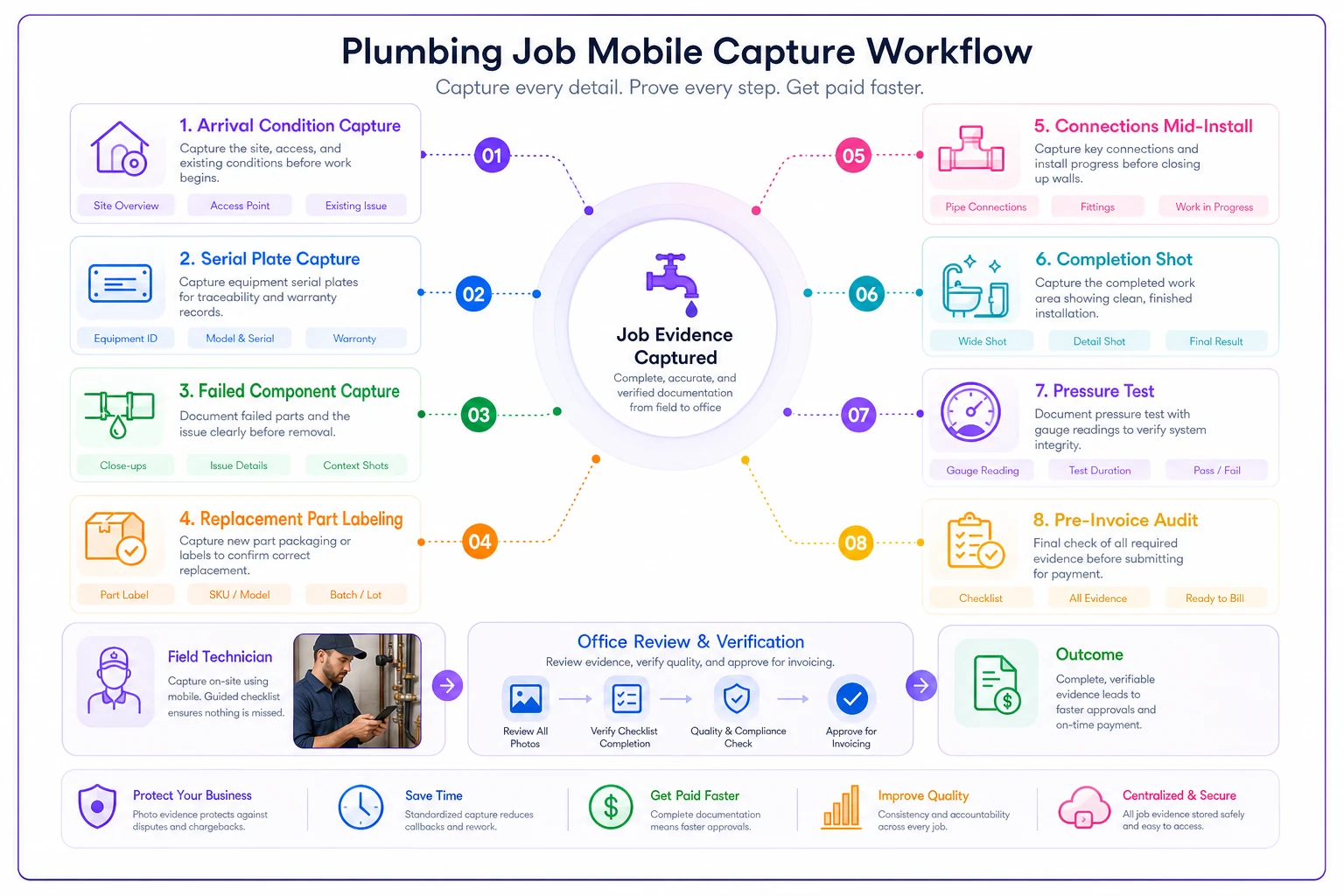
The fix for inconsistent field photos isn't training people to remember 16 angles. Nobody remembers 16 angles at 7pm in a crawlspace. The fix is a capture template tied to the job type, so the checklist appears on the phone and the tech just fills the slots.
A water heater failure template prompts: arrival condition → serial plate → model label → failed component → new unit label → connections → completion → pressure check. A slab leak template prompts different frames. A sewer backup template prompts different frames again.
This is where AI-assisted operational platforms earn their keep. Instead of a generic photo dump, the mobile workflow can require specific frames for that job type before the tech marks the job complete — and flag when a required shot like the serial plate is missing or too blurry to read. Nothing magical about it. It just refuses to let an incomplete evidence set slide through, which is exactly the discipline that breaks down when people are tired and rushing.
The same structured approach applies to a well-built field SOP set. If you haven't standardized your field steps yet, the Plumbing Operations Playbook Template with copyable SOPs for dispatch, quoting, parts and QA is a natural place to bolt documentation requirements onto your existing job stages.
Make the serial plate frame a required capture for water heater templates so a tech can't close the job without it.
A quick schematic of the mobile capture template workflow:
Nothing magical about it. It just refuses to let an incomplete evidence set slide through, which is exactly the discipline that breaks down when people are tired and rushing.
Pre‑invoice audit: catch the gap before you send the bill
The best time to catch missing documentation isn't when the claim gets denied. It's before the invoice goes out — while the truck might still be nearby and the unit hasn't been scrapped.
| Scenario | Must-have photos | Common denial reason | The audit catch |
|---|---|---|---|
| Water heater warranty | Serial plate, model label, failed part, new part label, connections | "No proof of covered part / abuse suspected" | Serial plate missing or unreadable |
| Slab leak (insurance) | Pre-cleanup wide shot, failure point, water extent, cause detail | "Gradual/seepage, not sudden" | No before-cleanup cause evidence |
| Sewer backup claim | Blockage cause, backup extent, cleanout access | "Maintenance issue, not covered event" | No shot isolating cause |
| Frozen/burst pipe | Burst point, ambient/exposure context, damage extent | "Owner negligence / no heat" | No context showing conditions |
| Fixture failure warranty | Data/model info, failed unit, install date if present | "Out of warranty window" | No install date documentation |
The audit itself is fast. Someone — a dispatcher, an office lead, or an automated check inside your workflow platform — confirms the required frames exist and are readable for that job type. If a slab leak invoice shows up with no pre-cleanup wide shot, it gets flagged before billing, not after the adjuster says no.
A tight version of the process:
-
Job is tagged as warranty- or insurance-eligible at dispatch (not after the fact).
-
Tech follows the job-type capture template in the field.
-
On job completion, required frames are verified present and legible.
-
Pre-invoice gate
audit checklist cleared for the specific scenario.
-
Originals stored, unedited, attached to the job record.
-
Invoice releases only after the evidence set passes.
If a slab leak invoice shows up with no pre-cleanup wide shot, it gets flagged before billing, not after the adjuster says no.
A real scenario: the water heater that got denied twice
A three-truck residential shop kept losing tank water heater warranty claims. Not constantly — maybe a handful a quarter — but each denied part plus the labor to swap it again ran them somewhere in the $600–$900 range once you counted the return trip and goodwill discounts to keep the customer happy.
The root cause was almost boring: techs weren't reliably capturing a readable serial plate before hauling the old unit off. By the time the warranty desk asked, the tank was gone. Two claims in one quarter got kicked, and on the second one the manufacturer wouldn't even reconsider.
They added exactly one thing: a water heater capture template with a required, in-focus serial plate frame, plus a pre-invoice check that wouldn't let a warranty-tagged job bill without it. Over the next two quarters, denials on that category basically stopped — one borderline case, approved on resubmission. Roughly $1,500–$2,000 in recovered parts and avoided rework over six months, from a change that added maybe ninety seconds to a job.
The point isn't the exact dollars. The money was leaking through a single missing photo, and no amount of "take good pictures" coaching had fixed it. A structural gate did.
When this level of rigor makes sense (and when it's overkill)
When it's worth it: any shop doing meaningful warranty volume, insurance restoration work, water heater and tankless installs, slab leak repairs, or anything where a manufacturer or adjuster is the one deciding whether you get paid. If more than a few thousand dollars a year flows through claims, the documentation SOP pays for itself quickly.
When it's lighter-touch: a shop doing almost entirely straightforward service calls paid on the spot by the homeowner doesn't need a four-stage evidence protocol on a faucet cartridge swap. Force full documentation there and techs will start ignoring it everywhere, which poisons the discipline for the jobs that actually need it.
Who should NOT bolt this on blindly: shops that haven't defined job types or dispatch tagging yet. If you can't reliably flag a job as warranty- or insurance-eligible up front, the whole thing falls apart — the tech won't know which template to follow. Get the tagging and stage structure sorted first.
Tie the documentation to the numbers so it doesn't quietly die
A documentation SOP that nobody measures becomes optional within a month. Track two simple things: the percentage of eligible jobs that pass the pre-invoice audit on the first try, and your claim denial rate over time. If first-pass audit rates are low, you've got a template or training gap. If denials stay high despite clean audits, your angles are wrong for what reviewers actually want.
These fit naturally alongside the operational metrics you're probably already watching — the same discipline covered in Plumbing KPIs That Drive Decisions across executive, ops and technician levels. And since every recovered warranty part and every avoided rework trip changes the math on a job, it's worth connecting this back to how you cost work in the first place, which the job costing template for single-visit residential plumbing walks through with real calculations.
The takeaway
Warranty and insurance money doesn't get lost on the wrench. It gets lost in the gap between "we did the work" and "we can prove exactly what failed, when, and how." Required angles give reviewers what they actually need. Metadata and timestamp discipline keeps the record credible. Mobile templates make the right shots the default instead of a memory test. And the pre-invoice audit catches the missing frame while you can still do something about it — not three weeks later when the unit's already scrap.
Start with your two or three highest-volume claim scenarios, build the exact capture template for each, and put a gate in front of the invoice. That's the whole system. Everything else is just refining the angles once you see which ones adjusters keep asking for.
Ready to optimize your plumbing operations?
Join 500+ plumbing businesses using Plummerly to save time, reduce scheduling errors, and improve customer satisfaction.