


Most plumbing owners expand the same way they bought their second truck: a referral started coming in from a nearby town, demand looked "pretty good," and someone decided to start running jobs out there. No scoring, no coverage math, no margin floor. Just a gut feeling that there was money sitting 20 minutes north.
Sometimes it works. Usually it quietly bleeds money for eight months before anyone notices the drive time, the missed SLAs, and the tech burnout that came with it.
A real plumbing territory expansion strategy isn't about ambition. It's about building a system that tells you when a market is worth entering, how much capacity you need before you enter it, and when to pull back if the numbers stop working. The goal is to make expansion a decision you can defend with data instead of something you just hope pays off.
This covers the whole system — the mapping logic, the scoring, the coverage rules, the margin thresholds, and the ramp timelines — and how they connect so one piece doesn't quietly break the others.
Why expansion decisions usually go wrong
The failure almost never happens at the "should we grow" stage. It happens because growth gets evaluated as a revenue question when it's actually a capacity-and-coverage question.
Here's the pattern that repeats across small fleets. An owner looks at a new ZIP code and sees demand. What they don't model is that serving that demand pulls trucks away from the core service area, stretches drive times, and forces dispatch to make tradeoffs it was never designed to handle. Revenue goes up. Margin goes down. And because margin erosion shows up slowly, the business keeps chasing the new market long after it stopped being profitable.
A typical example looks like this: a four-truck shop starts taking calls in a town 25 minutes outside its normal zone. Each job out there eats an extra 40–50 minutes of round-trip windshield time. On paper the jobs look fine — a $480 average ticket, decent parts margin. But once you account for the two "lost" jobs per truck per day you didn't run because your techs were driving, the real cost of that expansion is brutal. You didn't add a market. You diluted your existing one.
This is why expansion needs to be tied directly to dispatch and technician capacity rules — not treated as a separate marketing decision. If you want the capacity-and-hiring side of this in more depth, the maturity roadmap for scaling plumbing operations lays out the hiring and tech gates that should sit underneath any territory move.
The mapping layer: define territories before you score them
Before you can score a market, you have to stop thinking in cities and start thinking in serviceable zones. A "city" is a marketing idea. A zone is an operational unit you can actually dispatch against.
Stop missing service calls and double bookings.
Plummerly helps you schedule, assign, and manage every plumbing job efficiently.
- Centralized job scheduling
- Technician dispatch & tracking
- Customer notifications
No credit card required
-
Drive-time rings, not mileage. A zone should be defined by how long it takes a truck to get there in real traffic, not how many miles away it is. 15 miles on a highway and 15 miles through downtown are completely different animals.
-
Core / Edge / Reach tiers. Your core is where you already dominate and routing is dense. The edge is adjacent, partially served. Reach is anything you'd have to deliberately push into.
-
Density over size. A smaller zone with tight job density beats a huge sprawling one every time. Clustering is what makes routing efficient, and tight routing is what protects your margin. This connects directly to zone-based route clustering — if your clustering falls apart in a new zone, your expansion economics fall apart with it.
Use actual routing-based drive-time data rather than guessed distances when drawing drive-time rings.
The mistake here is drawing zones around where you want to grow instead of where your trucks can realistically operate. Map honestly first. Score second.
Market scoring: a template you can actually use
Once zones are defined, every candidate zone gets scored on the same criteria. The point of scoring isn't precision — it's consistency. You want to compare apples to apples so emotion doesn't creep in.
| Factor | Weight | What you're measuring | Score (1–5) |
|---|---|---|---|
| Drive-time from core | 25% | Round-trip time to the zone's center | |
| Demand density | 20% | Call volume / household density for your job types | |
| Competitive saturation | 15% | How many established plumbers already own the zone | |
| Avg ticket potential | 15% | Home age, income band, repair vs. replace mix | |
| Serviceability | 15% | Can you hit your SLA here without adding capacity? | |
| Strategic fit | 10% | Does it connect two existing zones or orphan a truck? |
Multiply each score by its weight, total it, and you get a single number per zone. The pattern worth noticing: zones that score high on demand but low on drive-time and serviceability are exactly the ones that look tempting and lose money. The weighting is designed to punish that combination on purpose.
A practical note on scoring demand: don't use raw population. Use the job types you actually run. A dense zone of 40-year-old homes with original cast iron is a very different opportunity than a new-build subdivision where everything is under warranty.
Coverage SLAs: the constraint that decides everything
Most expansion plans skip this part entirely. A market is only "serviceable" if you can hit your response-time promise there without wrecking it everywhere else.
-
Core zones same-day for standard, under 2 hours for emergencies.
-
Edge zones next-day standard, under 4 hours for emergencies.
-
Reach zones scheduled only, no same-day promise until density justifies it.
The reason this matters: when you quietly extend same-day coverage into a reach zone without the capacity to back it, you don't just fail that customer. You pull a truck out of position and cause a cascade of missed windows back in your core. One over-promise in a new market can degrade reliability across your entire operation.
The rule worth holding to: you don't advertise an SLA in a zone until you can prove you can hit it 90%+ of the time. Below that, you're not expanding — you're generating refunds and bad reviews.
Margin thresholds and objective expansion triggers
This is where the system earns its keep. Instead of "let's try that town," you set numeric triggers that have to be met before — and after — you enter a market.
Entry triggers (must hit before expanding):
-
Market score above your threshold (e.g., 3.6 / 5.0 weighted).
-
Projected zone margin at or above your floor (e.g., 38% gross after loaded labor and drive time).
-
Existing core utilization above 80% — meaning you actually need the capacity, you're not just running from a slow core.
-
A capacity plan in place
either an existing truck with slack or a committed hire.
Exit / pullback triggers (watch after you expand):
-
Zone margin drops below floor for two consecutive months.
-
SLA compliance in the zone falls under 85%.
-
Drive-time ratio (productive hours vs. windshield hours) drops below your core average by more than 15%.
Writing exit triggers down is what separates operators from gamblers. Most owners will happily enter a market. Almost none define, in advance, the number that means "this isn't working, stop feeding it." That number is what keeps a bad expansion from quietly draining a good business for a year.
Ramp timelines tied to capacity
Expansion isn't a flip you switch. It's a ramp, and the ramp has to match your actual dispatch and tech capacity — not your marketing spend.
-
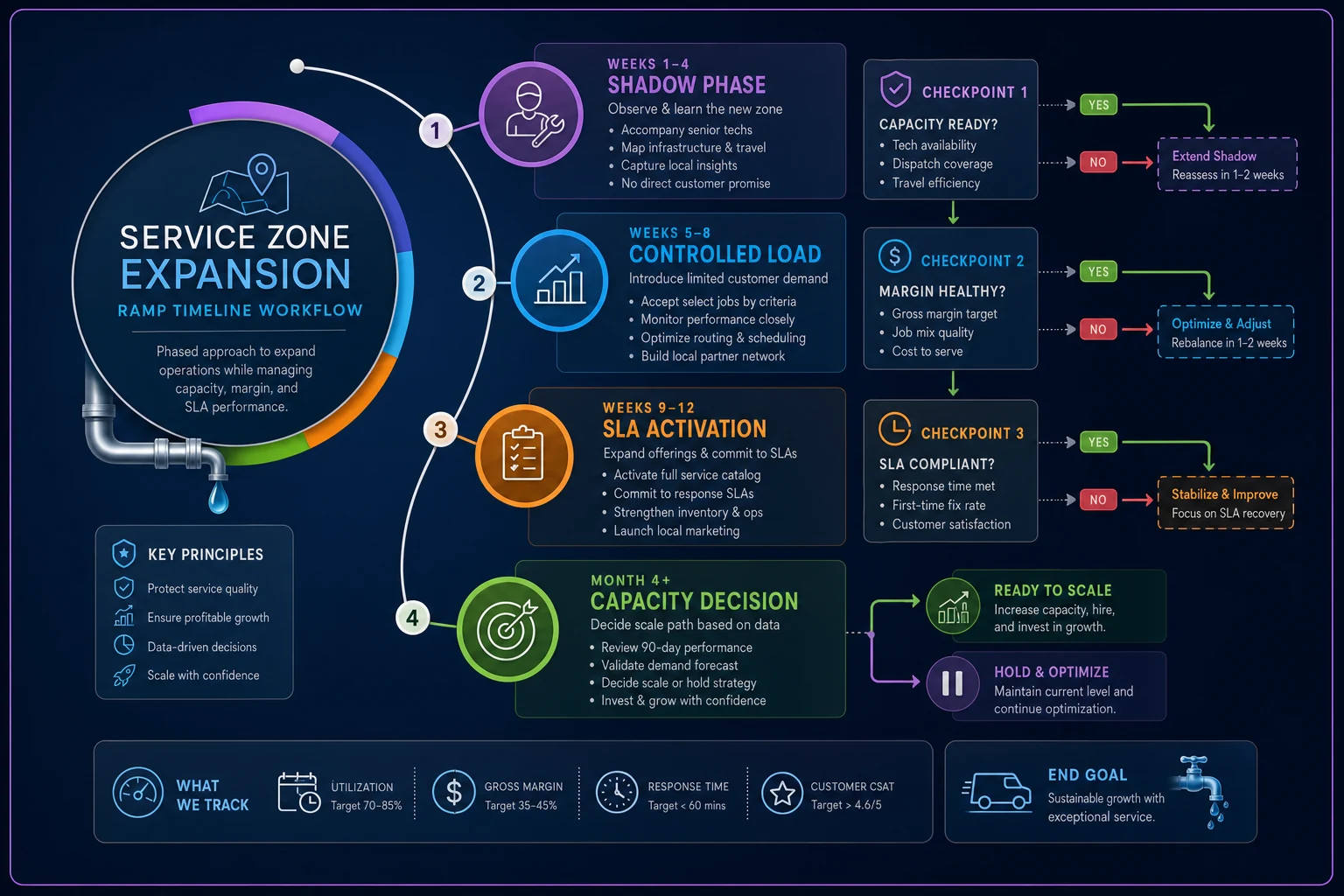
Weeks 1–4 — Shadow phase. Take overflow and scheduled jobs only. No SLA promises. You're collecting real drive-time and ticket data.
-
Weeks 5–8 — Controlled load. Cap the zone at a fixed number of jobs per day that one truck can absorb without breaking core routing.
-
Weeks 9–12 — SLA activation. Once you've proven you can hit response times, publish the edge SLA and start marketing.
-
Month 4+ — Capacity decision. If density and margin hold, this is where a dedicated truck or new hire gets justified by the numbers, not the hope.
A simple visual of the ramp workflow:
The common failure is compressing this. Owners want to go from zero to full marketing in week one, which floods a single truck, destroys SLA, and poisons the market's reputation before it ever had a chance to stabilize. Ramp slowly enough that each phase earns the next.
A real scenario
A six-truck residential shop wanted to expand into a growing suburb about 22 minutes from their core. Historically they'd just "start taking calls" in new areas. This time they scored it first.
The zone scored well on demand and ticket potential — older homes, lots of repipe and water heater work — but poorly on drive-time. Weighted score landed around 3.4, just under their 3.6 threshold.
Instead of walking away, they ran the shadow phase. Over six weeks they tracked roughly 40 jobs out there. Average ticket came in strong, close to $520, but the drive-time ratio was ugly. Techs were spending about 30% more windshield time per job than in core zones. Projected margin landed near 31%, well under their 38% floor.
The decision the old system would've made: keep pushing because revenue looked good. The decision the new system made: don't activate an SLA, keep it scheduled-only overflow, and revisit in two quarters once a nearby zone filled in enough to cluster routes together.
The outcome wasn't dramatic. It was the absence of a disaster. They avoided committing a truck to a zone that would have quietly run 7 points under margin, and they freed that capacity to deepen a core zone where utilization was already high. Six months later, when the adjacent area matured, the two zones clustered cleanly and the expansion finally made sense.
When this system makes sense
You're at 3+ trucks and expansion decisions now affect core reliability.
-
You're at 3+ trucks and expansion decisions now affect core reliability.
-
Your core utilization is consistently high and growth is a real capacity question.
-
You've had at least one expansion that looked good on revenue but hurt margin.
You've had at least one expansion that looked good on revenue but hurt margin.
When it's a bad idea
You're a one or two-truck operation still figuring out your core zone. You don't have a territory problem yet — you have a density problem. Fix routing first.
-
You're a one or two-truck operation still figuring out your core zone. You don't have a territory problem yet — you have a density problem. Fix routing first.
-
Your job costing isn't trustworthy. If you can't calculate true zone margin including loaded labor and drive time, scoring is just dressing up guesses.
Your job costing isn't trustworthy. If you can't calculate true zone margin including loaded labor and drive time, scoring is just dressing up guesses.
Who should NOT do this
Anyone running from a weak core. Expansion is not a fix for a slow market or a pricing problem. If your core zone is underperforming, a new territory just spreads the same weaknesses over more miles. Get the core healthy, then expand from strength.
-
Anyone running from a weak core. Expansion is not a fix for a slow market or a pricing problem. If your core zone is underperforming, a new territory just spreads the same weaknesses over more miles. Get the core healthy, then expand from strength.
Get the core healthy, then expand from strength.
Where the system usually breaks
A few bottlenecks show up again and again once a shop starts expanding methodically:
-
Dispatch can't enforce zone rules. If your dispatcher can override SLA tiers under pressure, your coverage discipline collapses the first busy Monday.
-
Margin data lags. By the time you feel a zone underperforming, you're two months deep. Zone-level margin needs to be visible monthly, not buried in a year-end review.
-
No single source of truth for territory rules. When zone definitions, SLAs, and triggers live in someone's head, they don't survive a hire, a sick day, or a surge.
This is where keeping territory rules, zone margins, and capacity data in one operational system — rather than scattered across a whiteboard, a spreadsheet, and a dispatcher's memory — stops being a convenience and starts being what holds the whole model together. The scoring and triggers only work if someone can actually see the numbers when the decision has to be made.
A territory growth system isn't about growing faster. It's about growing in a way that doesn't quietly damage what's already working. Map honestly, score consistently, protect your SLA, set a margin floor you won't break, and ramp at the speed your capacity can actually support.
Most expansion failures aren't bad markets — they're good markets entered badly. The owners who win over the long run aren't the ones who move first. They're the ones who can look at a zone, run the numbers, and say not yet without flinching. That restraint, backed by a repeatable system, is the real plumbing territory expansion strategy worth building.
Ready to optimize your plumbing operations?
Join 500+ plumbing businesses using Plummerly to save time, reduce scheduling errors, and improve customer satisfaction.