


Your plumbing business runs on handoffs. A lead comes in through marketing, dispatch converts it to a booking, your tech completes the job, then someone needs to follow up for reviews, maintenance plans, or repeat work. Each of those transitions either strengthens the customer relationship or creates a gap where revenue quietly disappears.
Most plumbing operations treat these handoffs casually. Marketing throws leads over the wall to dispatch. Dispatch schedules without considering tech capacity. Techs complete jobs without capturing upsell opportunities. Finance processes invoices weeks after service. The whole customer lifecycle becomes a series of disconnected events rather than a coordinated flow.
The difference between $800k and $1.4 million in annual revenue often comes down to how tightly you manage these transitions — not the quality of your plumbing work. That's table stakes. The real separator is whether customers move smoothly through your pipeline or leak out at predictable failure points.
Why Traditional Customer Management Breaks in Plumbing Operations
Plumbing businesses face lifecycle challenges that generic CRM systems just aren't built for. Your customer journey includes emergency calls at 2am, multi-visit repairs, warranty claims, seasonal maintenance, and property management relationships. Each pathway requires different handoffs, different metrics, and different ownership.
The typical breakdown starts around 15-20 jobs per week. Below that volume, one person can mentally track everything. The owner knows Mrs. Johnson needs her water heater checked. They remember to follow up on the commercial repipe quote. But once you cross into 25+ weekly jobs across multiple techs, that mental tracking system collapses.
What replaces it usually makes things worse. Someone builds a spreadsheet. Marketing uses one system for leads. Dispatch tracks jobs on a whiteboard. Techs write notes on paper invoices. Finance enters everything into QuickBooks weeks later. Each department optimizes their own piece without thinking about the downstream impact.
Marketing celebrates booking rates while dispatch drowns in calls they can't fulfill. Dispatch prides themselves on same-day scheduling while techs burn out from impossible routes. Techs focus on fix rates while missing opportunities to educate customers about preventive maintenance. Finance maintains perfect books while customers wait 30 days for invoices.
The Four-Phase Lifecycle Map
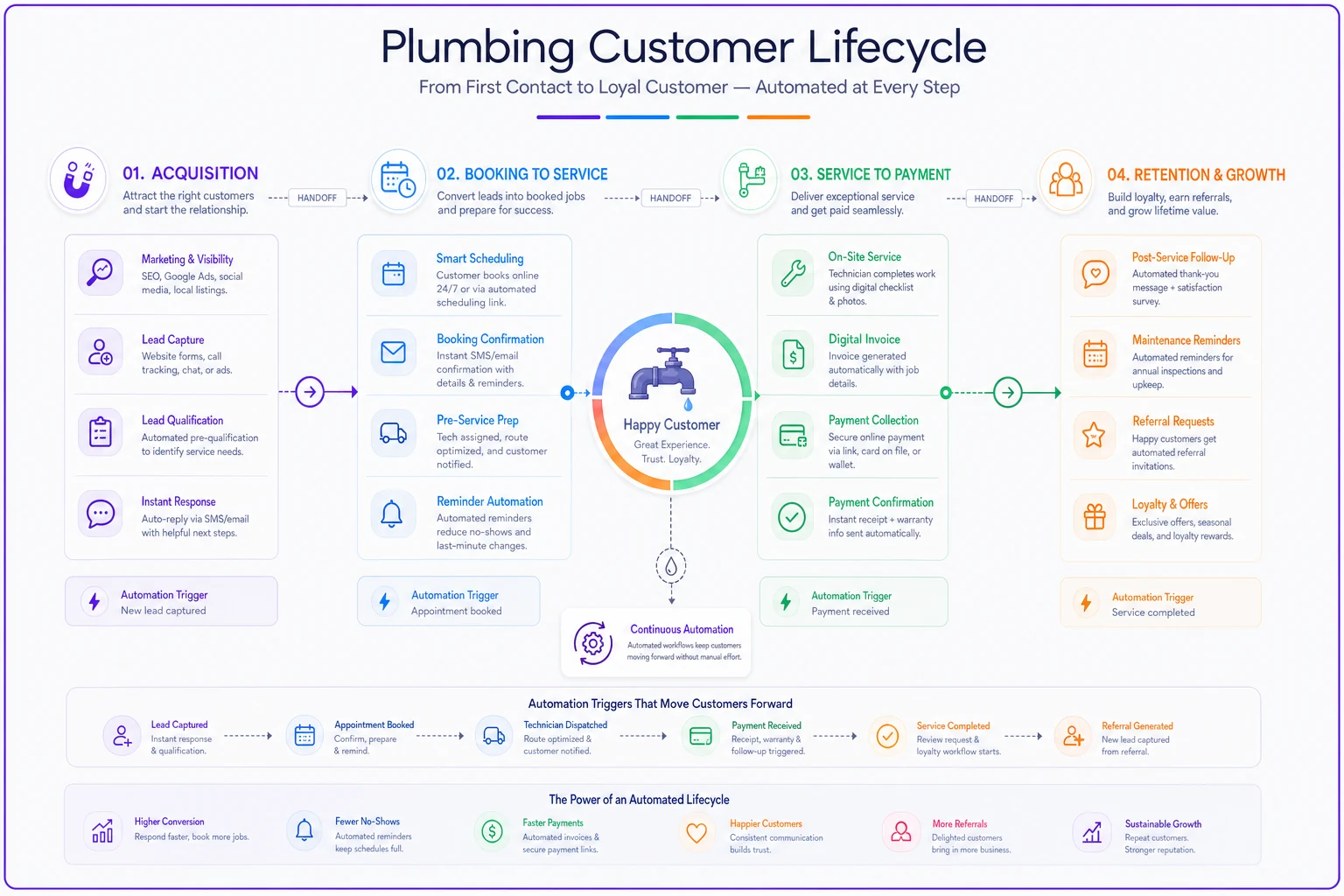
A properly designed customer lifecycle system breaks into four distinct phases, each with clear ownership, metrics, and automation triggers. The magic isn't in having perfect processes — it's in defining exactly where responsibility shifts and what information must transfer at each handoff.
Stop missing service calls and double bookings.
Plummerly helps you schedule, assign, and manage every plumbing job efficiently.
- Centralized job scheduling
- Technician dispatch & tracking
- Customer notifications
No credit card required
> Lifecycle Flow Overview
> [GRAPH: Four-phase customer lifecycle workflow — Acquisition → Booking to Service → Service to Payment → Retention & Growth, showing handoff steps between each phase and where automation triggers fire to move customers forward without manual intervention]
Phase 1: Acquisition (Marketing → Operations)
Primary Owner: Marketing Support Role: Dispatch Handoff Point: Qualified lead ready for scheduling
The acquisition phase runs from first contact through booking confirmation. Marketing owns lead generation, initial response, and qualification. But the handoff to operations happens earlier than most shops realize — the moment a lead expresses readiness to schedule.
Critical Automation Checkpoints:
-
Lead capture form submission triggers immediate text confirmation
-
No response in 5 minutes triggers backup notification to dispatch
-
Quote request triggers automated pricing guide email
-
Missed call triggers callback queue addition
KPIs That Matter:
-
Response time under 5 minutes (target
85%)
-
Lead to booking conversion (target
35-45% for standard repair, 60-70% for emergency)
-
Cost per booked job — not just cost per lead
-
Channel-specific conversion rates
Information Required at Handoff:
| Field | Detail |
|---|---|
| Contact details | Name, phone, preferred contact method |
| Service type | Urgency level and job category |
| Property notes | Type, access requirements |
| Budget signals | Financing interest or known constraints |
| Service history | Prior visits or open warranties |
Marketing often measures vanity metrics like total leads while operations struggles with unqualified volume. The real measurement should be "bookable leads delivered" — prospects who actually match your service capacity and geographic coverage.
Phase 2: Booking to Service (Operations → Field)
Primary Owner: Dispatch/Operations Manager Support Role: Lead Technician Handoff Point: Tech receives their route assignment
This phase covers everything from scheduling confirmation through job completion. Operations owns capacity management, route optimization, and job preparation. The handoff to field happens when the tech receives their route — not when they show up on site.
Critical Automation Checkpoints:
-
Booking triggers automated appointment confirmation
-
24 hours before triggers reminder text with tech name
-
Morning of service triggers "on the way" notification
-
Job completion triggers photo upload requirement
-
Parts used triggers inventory adjustment
KPIs That Matter:
-
Schedule efficiency (target
75-80% productive hours)
-
First-call completion rate (target
70% for standard repairs)
-
Average ticket value tracked by service type
-
Parts availability on truck (target
85% for common repairs)
Operations teams typically optimize for maximum daily jobs while field teams need quality setup time. The sweet spot is usually around 5-6 solid jobs per tech rather than 8-10 rushed calls that generate callbacks. That balance matters more than most dispatch managers want to admit.
Phase 3: Service to Payment (Field → Finance)
Primary Owner: Lead Technician/Service Manager Support Role: Billing/AR Team Handoff Point: Job completion with payment or approved invoice
The service phase includes diagnosis, repair, customer education, and payment collection. Field teams own the customer experience, upsell opportunities, and capturing payment. The handoff to finance should include either payment in hand or a clearly documented approval for invoicing.
Critical Automation Checkpoints:
-
Job completion triggers invoice generation
-
Warranty work triggers automatic documentation
-
Maintenance plan sale triggers enrollment workflow
-
No payment triggers credit card on file charge attempt
-
Large invoice triggers approval workflow
KPIs That Matter:
-
Payment collected at service (target
80% for residential)
-
Maintenance plan attachment rate (target
20-30%)
-
Invoice accuracy (target
98%)
-
Days sales outstanding (target
under 15 for residential)
Techs often skip documentation to squeeze in more calls. But incomplete handoffs to finance create roughly three times the downstream work. A two-minute documentation habit saves hours of payment chasing.
Phase 4: Retention & Growth (Operations → Marketing)
Primary Owner: Operations Manager Support Role: Marketing Handoff Point: 7 days post-service
The retention phase starts immediately after service and doesn't really have an end date. Operations owns the immediate follow-up, review requests, and maintenance scheduling. Marketing owns long-term nurture, win-back campaigns, and referral programs.
Critical Automation Checkpoints:
-
24 hours post-service triggers satisfaction survey
-
Positive survey triggers review request sequence
-
Maintenance plan triggers quarterly check-in
-
11 months triggers annual service reminder
-
18 months inactive triggers win-back campaign
KPIs That Matter:
-
Review generation rate (target
25% of happy customers)
-
Maintenance plan renewal rate (target
70%)
-
Customer lifetime value tracked by acquisition source
-
Referral generation rate (target
roughly 1 per 10 customers)
Most shops abandon customers after payment clears. The real profit sits in year two and beyond — when acquisition cost is zero and trust is already established.
Role Clarity Across the Lifecycle
The biggest source of plumbing lifecycle failures is unclear ownership at transition points. Marketing thinks dispatch owns lead follow-up. Dispatch thinks techs own upselling. Techs think the office handles maintenance reminders. Customers fall through those assumption gaps constantly.
Marketing Owns:
-
Lead generation and initial response
-
Brand messaging and reputation management
-
Long-term nurture campaigns
-
Referral program management
-
Win-back campaigns after 12+ months inactive
Operations Owns:
-
Lead qualification and scheduling
-
Capacity and route management
-
Job preparation and dispatch
-
Quality control and warranties
-
Maintenance plan administration
Finance Owns:
-
Invoice generation and accuracy
-
Payment processing and collections
-
Financial reporting and job costing
-
Credit decisions and terms
-
Commission calculations
Field Owns:
-
Customer education and service delivery
-
Upsell identification and execution
-
Payment collection at service
-
Documentation and photo capture
-
Immediate follow-up needs
The clearest shops document these boundaries in their SOPs and operational playbooks. They don't assume everyone knows where their responsibility ends.
Scale-Based Breakpoints
Your customer lifecycle system needs different infrastructure at different revenue levels. What works at $500k breaks at $1.2M. What works at $1.2M breaks at $2.5M.
Under $750k Annual Revenue (1-2 trucks)
At this scale, the owner touches everything. You need basic handoff protocols but can rely on direct communication. The focus should be on consistent lead follow-up and payment collection.
Minimum Viable System:
-
Shared calendar for scheduling
-
Basic CRM or spreadsheet for customer history
-
Text message templates for confirmations
-
Simple invoice system with payment links
-
Manual review requests after good jobs
Around 20-25 jobs per week, the owner can't personally manage every handoff. Leads start getting missed. Follow-ups get forgotten. Customer history lives inside someone's head instead of somewhere the whole team can access.
$750k - $1.5M Annual Revenue (2-4 trucks)
This range demands real structure. You've added staff who don't have the full picture. Communication gaps open up between office and field. Customer expectations are rising but your systems haven't caught up.
Essential Infrastructure:
-
Proper dispatch software with mobile access
-
Automated appointment reminders
-
Digital payment processing in the field
-
Basic performance tracking across KPIs
-
Systematic review generation process
Multiple people doing the same tasks different ways is where this range falls apart. Marketing books jobs dispatch can't fulfill. Techs make promises operations can't keep. Finance chases payments that should've been collected at service.
$1.5M - $3M Annual Revenue (4-8 trucks)
At this scale, department silos become genuinely dangerous. Marketing operates independently from operations. Dispatch schedules without thinking about profitability. You need forced integration points and shared metrics.
Advanced Requirements:
-
Integrated platform connecting all departments
-
Automated workflow triggers between teams
-
Real-time capacity visibility for booking
-
Dynamic routing optimization
-
Proactive maintenance plan management
Departmental metrics start conflicting with company goals at this level. Marketing drives volume that crushes operations. Dispatch optimizes routes that destroy tech morale. Finance implements policies that frustrate customers. It's a pattern that repeats across shops in this range.
Above $3M Annual Revenue (8+ trucks)
Larger operations need sophisticated handoff automation. Manual coordination becomes unmanageable when you're juggling multiple crews, territories, and service lines simultaneously.
Enterprise Elements:
-
AI-powered dispatch optimization
-
Predictive maintenance scheduling
-
Multi-channel customer communication
-
Advanced analytics across the lifecycle
-
Automated escalation workflows
Without proper automation at this scale, you end up hiring coordinators to manage handoffs between departments. That administrative bloat kills margins that should actually improve with scale. It's one of the more frustrating growth traps in this industry.
Common Failure Points and Fixes
Every plumbing operation hits predictable lifecycle failures. The question isn't whether you'll encounter them — it's whether you'll recognize them fast enough to do something about it.
Acquisition → Booking Failures
The Problem: Marketing generates leads but booking rates stay low. You're paying for traffic that never converts to revenue.
Why It Happens: Marketing measures lead volume while operations needs qualified, bookable leads. The handoff happens without proper qualification, flooding dispatch with tire-kickers.
The Fix: Build a lead scoring process that marketing completes before handoff. Include budget qualifiers, service area confirmation, and urgency. Only count "marketing qualified leads" toward their targets — not raw volume.
Booking → Service Failures
The Problem: Scheduled jobs have high cancellation rates, or techs arrive completely unprepared for the actual work.
Why It Happens: Dispatch schedules based on availability rather than job requirements. Critical information from the booking call never makes it to the field tech.
The Fix: Build a job setup checklist that must be completed before dispatch. Customer photos, equipment model numbers, specific symptoms. Don't let techs start their route without reviewing job details.
Service → Payment Failures
The Problem: Completed work sits in limbo for weeks before invoicing. Collections drag out for months.
Why It Happens: Techs focus on service delivery and skip payment collection. They hand off incomplete paperwork that finance can't process efficiently.
The Fix: Make payment collection part of job completion. Techs shouldn't be able to close tickets without entering a payment method or getting signed approval for NET terms. Digital forms that require those fields help enforce this without needing a manager to chase it down.
Payment → Retention Failures
The Problem: Happy customers never come back. You're constantly hunting new business instead of nurturing existing relationships.
Why It Happens: Once payment clears, customers disappear from your radar entirely. No one owns the relationship after the immediate service need is resolved.
The Fix: Build a systematic post-service workflow. Seven days after service, trigger a satisfaction check. For positive responses, automatically request reviews and present maintenance plan options. For equipment over 8 years old, schedule a proactive replacement consultation before something breaks.
Building Your Automation Stack
The right automation eliminates handoff friction without removing human judgment. The goal isn't to replace your team — it's to eliminate the repetitive coordination tasks that grind everyone down.
Start with the highest-volume, lowest-complexity handoffs. Appointment reminders. Review requests. Basic follow-ups. These don't require any human creativity but eat up enormous time when done manually across dozens of jobs per week.
Phase 1 Automation Priorities:
-
Lead response and confirmation
-
Appointment scheduling and reminders
-
Basic invoice generation
-
Review request sequences
-
Simple post-service follow-up triggers
Once those run smoothly, layer in more sophisticated automation. Dynamic routing based on tech skills and location. Maintenance reminders tied to equipment age. Escalation workflows for overdue payments.
Phase 2 Automation Additions:
-
Lead scoring and routing
-
Capacity-based booking rules
-
Smart dispatch optimization
-
Maintenance plan management
-
Performance alert triggers
Some decisions still require human experience — handling an upset customer, diagnosing a complex problem. But routine handoffs between acquisition, booking, service, and retention should flow without constant manual intervention.
Modern operational platforms can connect these pieces while keeping department autonomy intact. Marketing can see which campaigns drive profitable jobs without accessing financial details. Dispatch can review tech performance without micromanaging field decisions. Finance can track collection metrics without interfering with operations day-to-day. It's not magic, it's just better coordination infrastructure.
Implementation Sequence That Actually Works
Don't try to fix your entire lifecycle system at once. That path leads to paralysis and half-finished projects that make things worse before they get better. Identify your single biggest leak and plug it first.
-
Month 1 — Document Current State Map your existing lifecycle, broken as it might be. Identify every handoff point. Note who currently owns each phase. List the information that should transfer but doesn't.
-
Month 2 — Fix the Biggest Leak Pick your worst handoff — usually wherever customers complain most or where your team argues about responsibility. Build a simple protocol with clear ownership and basic automation.
-
Month 3 — Measure and Adjust Track performance at your improved handoff. Are jobs flowing smoother? Fewer customers falling through? Adjust the process based on actual results, not assumptions about what should work.
-
Month 4-6 — Expand Systematically Apply the same approach to your next worst handoff. Use what you learned from the first fix. Build momentum with each improvement rather than trying to overhaul everything simultaneously.
The shops that win don't have perfect systems. They have clear handoffs, defined ownership, and basic automation that prevents customers from disappearing between departments. They treat the customer lifecycle as one connected system rather than a collection of isolated department functions.
The Compound Effect of Lifecycle Excellence
Small improvements at each handoff add up faster than most owners expect. A 10% improvement in lead-to-booking conversion might add $8k in monthly revenue. A 15% increase in payment collected at service could free up $50k in working capital. A 20% boost in maintenance plan attachment might add $100k in recurring revenue annually.
The real win is the compounding. Better handoffs reduce staff stress, which improves customer service, which generates more referrals, which lowers acquisition costs, which improves margins, which supports better wages, which attracts better people, which improves operations further. It reinforces itself over time in ways that are hard to see until you're already on the other side of it.
Most plumbing businesses leak revenue at predictable handoff points and blame market conditions or staff quality when the real problem is structural. Your customer lifecycle either creates friction or removes it. There's no neutral option.
The shops pulling ahead aren't necessarily better plumbers. They've built operational systems that move customers smoothly from stranger to advocate, with defined ownership at each phase and automation handling the routine handoffs while human judgment is reserved for the things that actually require it. Start with one broken handoff. Fix it properly. Then move to the next. Within six months, you'll be running a fundamentally different operation.
Ready to optimize your plumbing operations?
Join 500+ plumbing businesses using Plummerly to save time, reduce scheduling errors, and improve customer satisfaction.