

Your tech drives 22 minutes, diagnoses a failing water heater, writes up a quote, and leaves. Two days later the homeowner calls a competitor who happened to have the part on the truck and closed it in one trip. You paid for the drive time, the diagnostic labor, and the trust-building—and someone else got the repair check.
That gap between finding the problem and fixing it on the spot is where most plumbing shops quietly bleed margin. The diagnostic-to-repair conversion problem isn't really a sales problem. It's an operational sequencing problem. The tech doesn't have the words, the numbers, or the parts lined up to close in the moment, so the job goes cold.
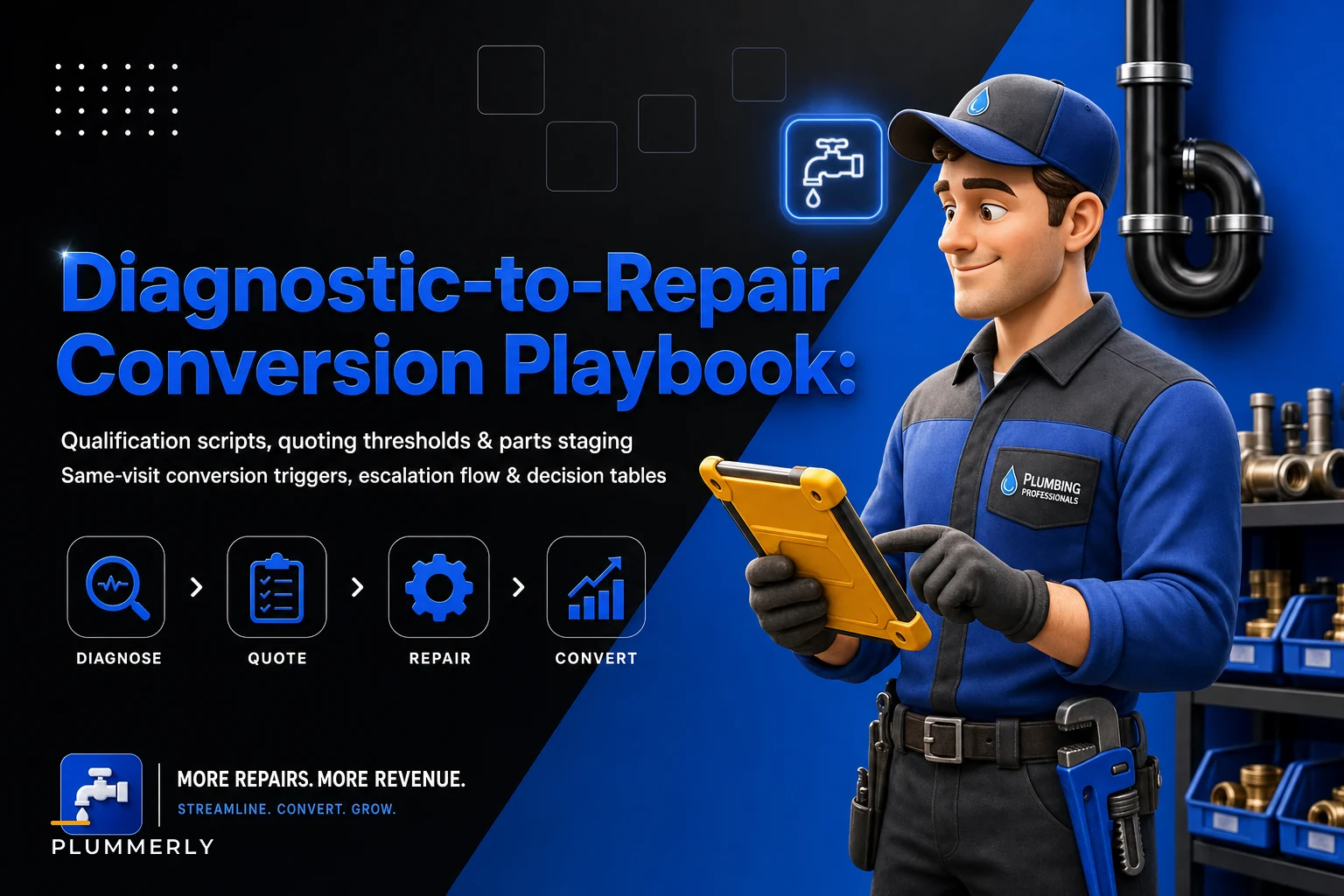
This is a playbook for closing that gap. Not "sell harder"—a repeatable system of qualification scripts, quoting thresholds, staging rules, and a clean escalation path when the quote genuinely can't close on-site.
Why Same-Visit Conversion Falls Apart
The mechanics of a lost conversion are almost always the same, and they rarely have anything to do with the customer being difficult.
-
No authority to quote past a certain dollar amount, so they say "the office will call you with a price." That delay kills momentum.
-
The part isn't on the truck, so even a yes turns into a return trip that gets rescheduled, then forgotten.
-
No script for framing the repair, so the tech mumbles a number, the homeowner says "let me think about it," and there's no structured follow-up.
Same-visit closes tend to land in the 60–75% range when the tech is properly equipped. Follow-up quotes—the ones that leave without a decision—often close at 20–30%, and that's being generous. Every job you push to follow-up, you're roughly cutting your odds in half.
The entire game is: make the on-site close possible more often, and when it genuinely can't happen, run a follow-up process that doesn't leak.
The Qualification Script: Two Minutes Before You Quote
Most techs quote too early. They spot the problem, get excited to solve it, and throw out a number before they understand what the homeowner actually wants or can decide on. A short qualification script fixes this—not to manipulate anyone, but to make sure the quote you present matches the decision the customer is ready to make.
Stop missing service calls and double bookings.
Plummerly helps you schedule, assign, and manage every plumbing job efficiently.
- Centralized job scheduling
- Technician dispatch & tracking
- Customer notifications
No credit card required
The script has three jobs: confirm the decision-maker, understand the timeline, and surface the "good/better/best" appetite before you name a price.
-
"Before I write anything up—are you the one who'll make the call on this, or is there someone else who should be part of it?" (Decision-maker check. If the answer is "my husband gets home at 6," you've just learned your close won't happen at 2pm and you plan accordingly.)
-
"Is this something you want handled today while I'm here, or are you thinking about it down the road?" (Timeline. A "today" answer means you go straight to staging the repair. A "down the road" answer means you shift into quoting-for-later mode.)
-
"Some folks want the fastest fix, some want the longest-lasting option even if it costs more—where's your head at?" (This tells you which tier to lead with. Leading with the wrong tier is the single most common reason a quote gets a flinch.)
The pattern matters: qualify before you quote, not after. A tech who quotes and then discovers the homeowner can't decide without a spouse has wasted the pitch and boxed themselves in.
Quoting Thresholds: Who Can Approve What, and When
This is where a lot of shops accidentally sabotage their own techs. If every repair over $400 requires a call back to the office, and the office is slammed on a Tuesday, your tech is standing in someone's kitchen for fifteen minutes waiting for a callback while the homeowner's enthusiasm cools.
| Repair Total | Approval Path | Discount Authority | Turnaround Expectation |
|---|---|---|---|
| Under $600 | Tech quotes and closes solo | Up to 5% at tech discretion | Immediate |
| $600–$1,500 | Tech quotes solo, flags large jobs to dispatch | Up to 10% with reason logged | Immediate |
| $1,500–$4,000 | Tech quotes, quick dispatch confirmation on pricing | Up to 10%, manager sign-off above | Under 10 min |
| Over $4,000 | Manager review before final number | Case-by-case | Same day, may schedule |
The point isn't the exact numbers—your margins and market set those. The point is that 90%+ of your everyday repairs should be closeable by the tech without a phone call. If your thresholds are so tight that techs constantly need permission, you've built a system that structurally favors follow-up quotes, which means you've built a system that loses jobs.
Shops that raise their solo-approval threshold usually see same-visit conversion jump before they change anything else. The tech was never the bottleneck. The approval loop was.
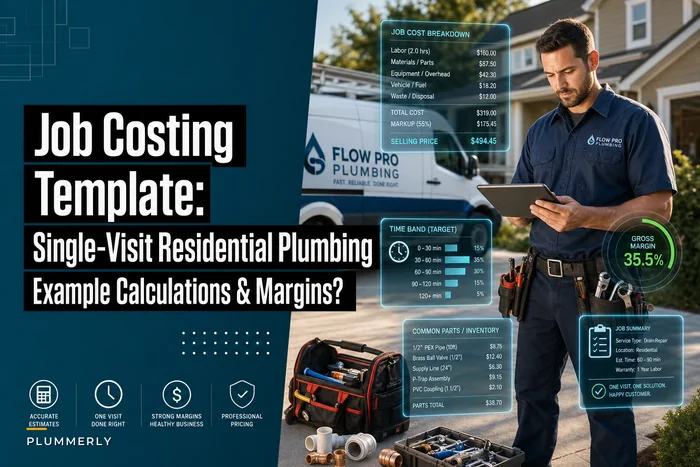
For the pricing logic underneath these thresholds, it helps to have your job costing worked out in advance so the tech isn't guessing at margin. If you haven't built that foundation yet, the job costing template for single-visit residential plumbing walks through the margin math that should sit behind every number on this table.
Parts Staging: The Real Reason Return Trips Happen
You can have the best script and the smartest thresholds and still lose the job because the part is 30 minutes away at the supply house. Staging is the unglamorous half of conversion that most people skip over.
The insight most owners miss: staging isn't just about what's on the truck—it's about what's on the truck relative to what the tech is likely to diagnose that day. A truck loaded for water heater season during a slab-leak week is a truck full of dead weight.
-
Tier 1 — Always stocked the parts tied to your top 10 most common repairs. These should never trigger a return trip. If a Tier 1 repair can't close because of parts, that's an inventory failure, not a customer objection.
-
Tier 2 — Route-loaded parts matched to the day's booked call types. If dispatch sees three water heaters on the schedule, the anode rods, T&P valves, and connectors get pulled that morning.
-
Tier 3 — Supply-house dependent genuinely uncommon parts where a return trip is acceptable and expected. The key is that these stay rare, and the customer is told upfront.
Treat Tier 1 discipline like a KPI—if techs are consistently running for the same parts, the par levels need adjustment rather than coaching.
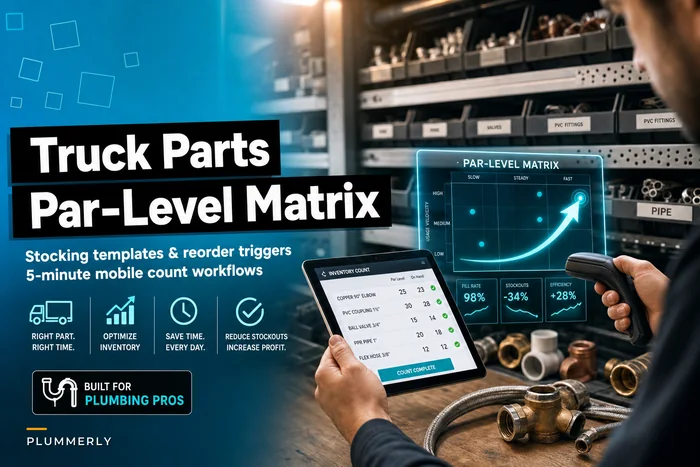
The difference between a shop that converts and one that doesn't often comes down to Tier 1 discipline. If your techs are running to the supply house for common repairs, you're converting on delay, and delay loses. Dialing in par levels is its own discipline—the truck parts par-level matrix covers how to set and count those stocking levels without turning it into a daily chore.
A quick way to see the cost: say a shop runs around 300 diagnostic-heavy calls a month. If 15% of those bounce to a return trip purely on parts availability, that's roughly 45 jobs a month where you've paid twice for drive time and cut your close odds. Fix Tier 1 staging and you're not adding revenue out of thin air—you're stopping the leak.
Same-Visit Conversion Triggers
Trigger 1 — The diagnostic itself is a demonstration. When the tech physically shows the failed part, the corroded fitting, the pressure reading—the homeowner is looking at proof, not a sales pitch. This is the highest-conversion window in the entire visit. Quote here, while the evidence is in hand, not after you've packed up.
Trigger 2 — The "while I'm already here" bundle. If a tech is replacing a fill valve and notices the shutoff is seized, that's the moment to mention it. The marginal cost of adding a related repair to an existing visit is huge in the customer's favor, and most people say yes when they understand they're saving an entire second trip charge.
Trigger 3 — The urgency reveal. Some repairs are genuinely "fix now or risk worse." A tech who can clearly explain what happens if this waits—without fearmongering—converts far more of those situations. The homeowner isn't buying a repair, they're avoiding a flood.
One thing to be careful about: manufacturing urgency where there isn't any. It works once and destroys trust permanently. In plumbing, your reputation is most of your lead flow, and techs who lean on fake urgency get short-term closes and long-term damage.
When to Push Same-Visit vs. When to Let It Breathe
Not every job should be closed on the spot, and pretending otherwise makes your best techs feel like used-car salesmen.
-
It's a Tier 1 or Tier 2 parts situation (you can actually do the work now)
-
The decision-maker is present
-
The repair is straightforward and the risk of waiting is real
"Let it breathe" doesn't mean 'abandon the follow-up'—it means match the decision pressure to the situation.
-
The job is large enough that a homeowner should think it over ($4k+ repipes, for instance)
-
A spouse or co-owner genuinely needs to weigh in
-
The customer is visibly overwhelmed—pushing here backfires
Match the pressure to the size and urgency of the decision. A $250 disposal swap and a $6,000 sewer line are not the same conversation, and treating them the same is how you either lose small jobs to hesitation or bulldoze big ones into buyer's remorse.
The Escalation Flow for Follow-Up Quoting
When a quote genuinely can't close on-site, the game shifts. Now you're fighting that 20–30% follow-up close rate, and the enemy is time. Every hour that passes, the quote goes colder.
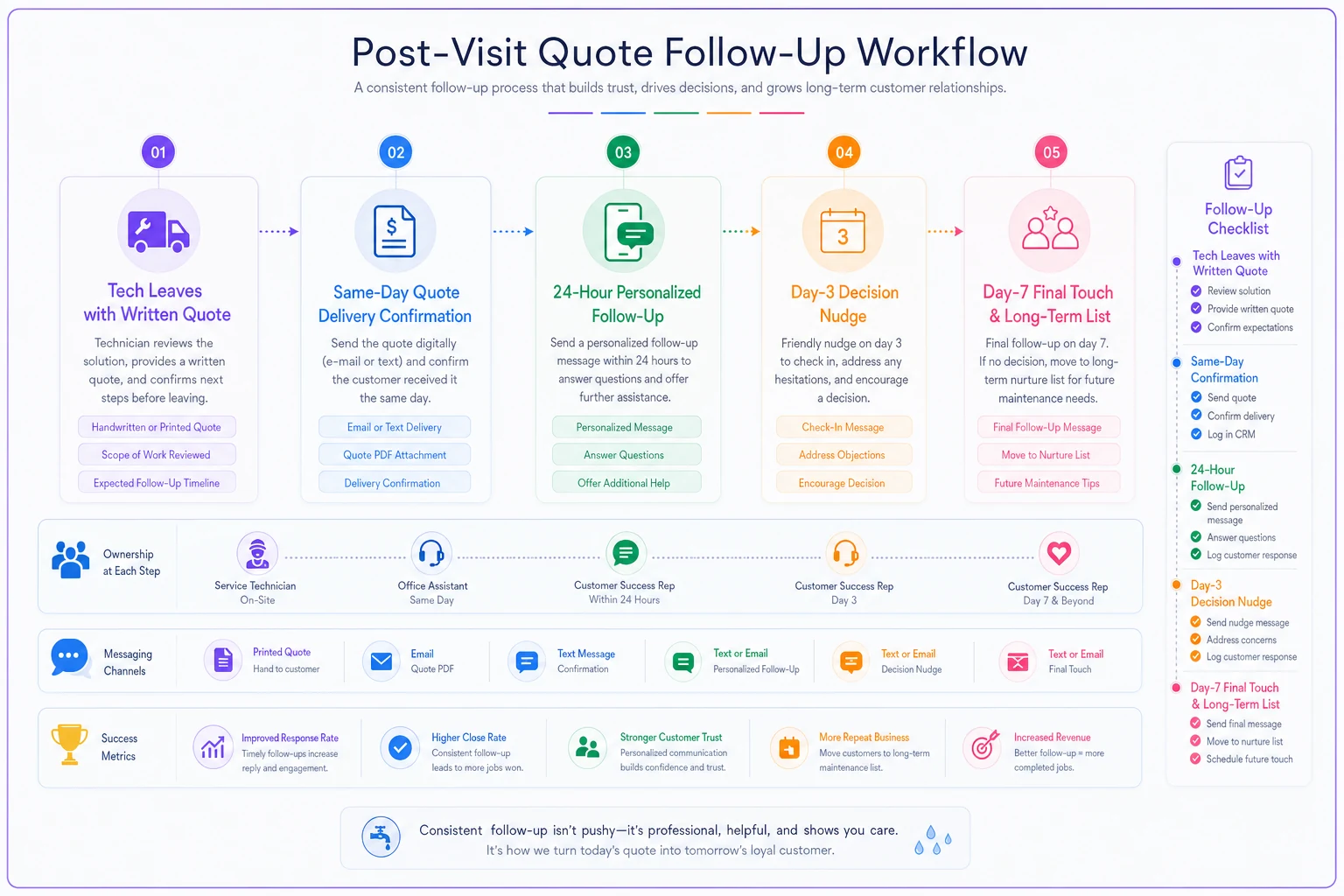
Here's a simple workflow for follow-up touches that keeps quotes warm.
-
Same day — leave a written quote in hand. The tech never leaves without a physical or texted copy. A verbal number is forgotten by dinner.
-
Within 24 hours — a real follow-up touch. Not a mass "just checking in" text. A specific message referencing their problem: "Wanted to make sure you got the quote for the water heater—happy to answer anything before you decide."
-
Day 3 — the decision nudge. If there's a price that expires or a scheduling window filling up, mention it honestly. If there isn't, a simple "we can still get you on the schedule this week" works.
-
Day 7 — final touch, then move to long-term. After a week with no response, one last message, then the quote moves into a longer-cycle follow-up list rather than active pursuit.
The single biggest failure here is that most shops do step 1 and nothing else. The tech leaves a quote, and the whole system just hopes. Follow-up quotes don't close because nobody owns them after the truck pulls away.
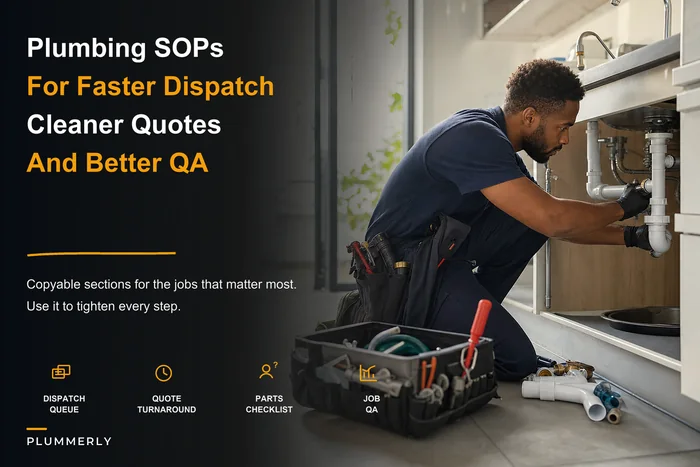
This is where having a real system beats relying on memory. A shop tracking open quotes—who's holding them, how old they are, what the next touch is—recovers jobs that a paper-and-hope process forgets entirely. Whether that lives in a spreadsheet or in operational software you already use for dispatch and quoting, the point is that someone or something is watching every open quote. The plumbing operations playbook with copyable SOPs lays out how quoting and follow-up fit into the rest of your dispatch and QA workflow so these steps don't live in one tech's head.
A Real Scenario
A three-truck residential shop was running roughly 280–300 diagnostic-heavy calls a month with a same-visit close rate hovering around 45%. Techs were quoting, then leaving, then hoping. Follow-up recovery was somewhere around 25%.
They changed three things: raised the solo-approval threshold from $400 to $600, pulled their top-10 repair parts into a strict "always stocked" Tier 1 list, and assigned one person to own the 24-hour and day-3 follow-up touches on every open quote.
Within a couple months, same-visit closes moved into the high 50s to low 60s. The bigger surprise was follow-up recovery climbing toward 35%—simply because someone was actually working the list. No new marketing, no new trucks. They were just converting more of the visits they already paid for.
Where This Actually Lands
The diagnostic-to-repair conversion problem in plumbing gets treated like a training issue—"our techs need to sell better." Usually it isn't. It's thresholds set too tight, trucks stocked wrong for the day's work, and follow-up quotes that nobody owns after the visit ends.
Fix the sequencing—qualify before you quote, give techs the authority and the parts to close in the moment, and build a follow-up flow that actually runs—and the conversion rate takes care of itself. You're not squeezing customers harder. You're just stopping the jobs you already earned from walking out the door.
Start with your thresholds and your Tier 1 parts list. Those two changes cost nothing and tend to move the number fastest. The follow-up flow is where you recover the jobs you can't close today—and those add up faster than most owners expect.
Ready to optimize your plumbing operations?
Join 500+ plumbing businesses using Plummerly to save time, reduce scheduling errors, and improve customer satisfaction.